Geb Myth Meaning & Symbolism
The myth of Geb, the earth god, tells of the primal separation from his sister-wife Nut, the sky, creating the world and a sacred, enduring tension.
The Tale of Geb
In the time before time, in the warm, silent dark of the Nun, a great stillness held sway. But within that stillness, a potential stirred. From the limitless waters, the first thought of a god arose—Atum. And from him, the first divine breath was born: Shu, the dry wind. And with him came his twin, his other half, Tefnut, the moist breath. Together, air and moisture danced in the void, and from their union, two more were brought forth.
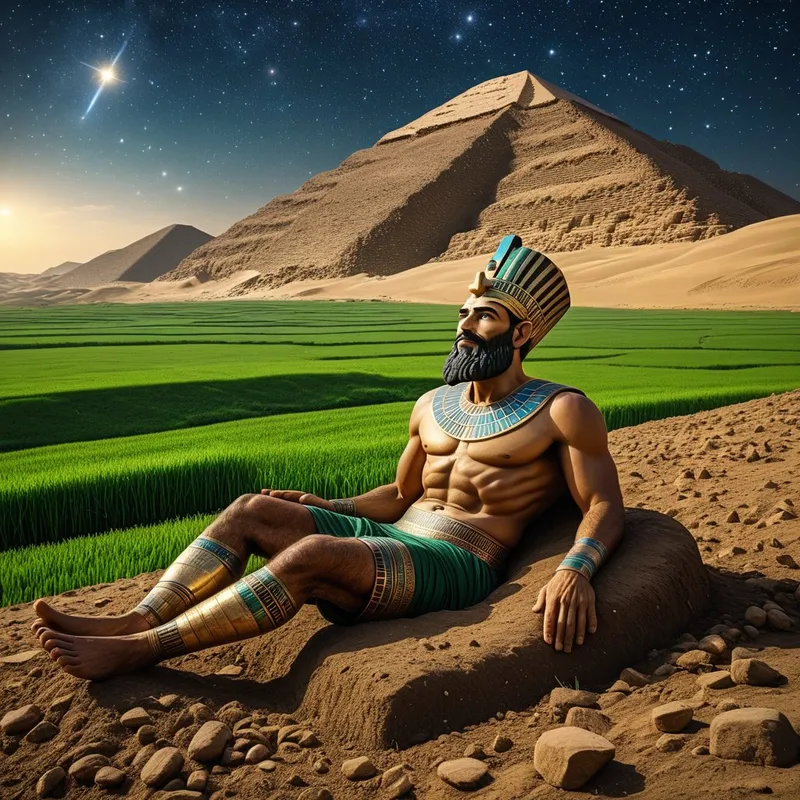
First came Geb. He did not stand, but lay, vast and dreaming. His body was not flesh and bone, but the rich, dark soil itself, teeming with the promise of seed and root. His skin was fields of barley, his bones the ridges of mountains yet to be. Upon his brow often rested the white goose, whose honking cry was said to have shattered the primeval silence. Then came his sister, his counterpart, his heart’s desire: Nut. She was the vault of night, her skin the deep blue of twilight, her body adorned with the glittering, unformed sparks of a thousand stars. She was the expanse, the heavens, the limitless potential above.
From the moment of their birth, Geb and Nut were entwined. He, the solid, receptive earth, reached up. She, the boundless, embracing sky, curved down. They lay together in a perfect, unbroken union, a single divine entity of earth-and-sky. In their embrace, no space existed for life, for breath, for dawn or dusk. The world was complete, but it was static, a divine egg waiting to be cracked.
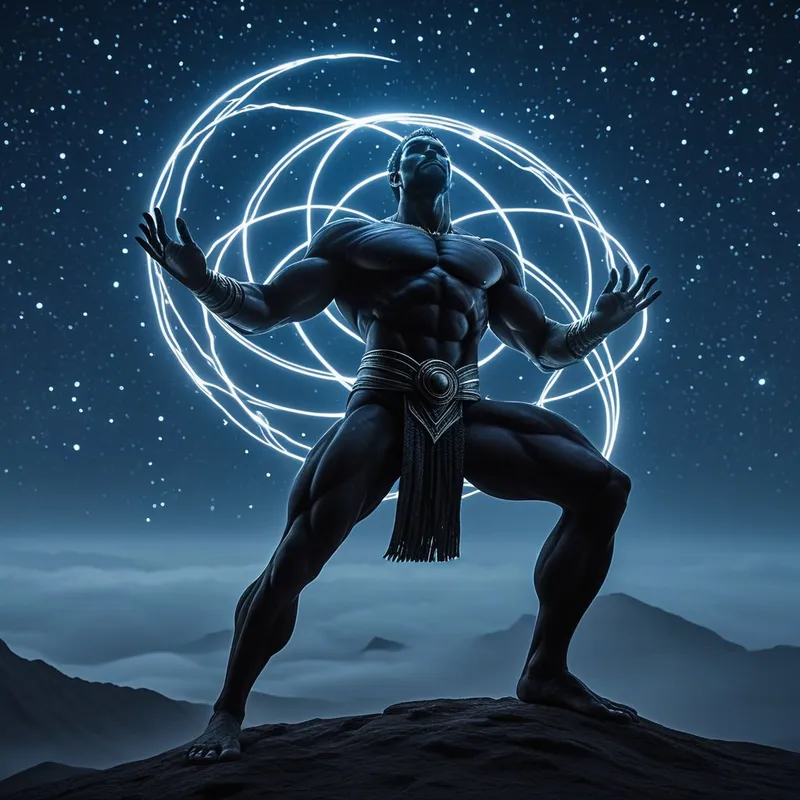
This eternal embrace could not last. The order of the cosmos demanded distinction. The command came, perhaps from Atum, perhaps from the very law of Maat itself. The task fell to their father, Shu. With a mighty, agonizing heave, the god of air inserted himself between his children. You could hear the groan of the firmament, the sigh of the soil parting from the stars. Shu pushed upwards, his arms trembling with the strain of cosmic creation. Nut was lifted, arched high, her body now the celestial dome. Geb was pressed down, anchored, his body becoming the foundation of all that is.
They were separated, forever. Yet, in their separation, the world was made. The space Shu created—the air, the light—became the realm of life. Geb’s body now held rivers and nurtured trees. Nut’s body gave the sun a path to travel and a place for the stars to dwell. Each evening, Nut swallows the sun, and each morning, she gives birth to it anew over the body of her beloved Geb. Their love persists, not in union, but in a perpetual, fruitful tension—the very rhythm of the world.
Cultural Origins & Context
The myth of Geb is not a single, codified story from a sacred text, but a foundational narrative woven into the very fabric of ancient Egyptian cosmology. It was articulated in funerary texts like the Book of the Dead and the earlier Coffin Texts, where the geography of the afterlife mirrored the cosmic landscape of Geb and Nut. Priests and temple scribes were its custodians, but its truth was felt by every farmer whose plough turned Geb’s soil under Nut’s sky.
Its societal function was profound and dual. First, it was an etiological myth, explaining the origin of the physical world: why the earth is below and the sky above, why there is air to breathe. Second, and more importantly, it established a sacred model for kingship. The Pharaoh was the “Heir of Geb,” the living embodiment of the stable, fertile, and sovereign earth. His duty was to maintain the separation—to uphold Maat against the chaos of Nun, just as Shu held Nut aloft. The myth legitimized the political and natural order as a divine, necessary structure.
Symbolic Architecture
Geb represents the archetype of the foundational principle. He is not the dynamic hero, but the essential ground of being. His symbolism is rich and multifaceted:
- The Embodied World: Geb is literalization—the divine made substance. He symbolizes the physical plane in all its fertility and solidity, the principle of manifestation itself.
- Receptivity and Nurturing: As the earth, he receives the seed, the water, the dead, and from him springs all life. He is the ultimate caregiver, providing unconditionally.
- Stability vs. Limitation: His separation from Nut creates the stable platform for existence, but it also represents a necessary loss of primal unity. He is the foundation, but also the definition that creates boundary and, potentially, isolation.
The myth of Geb teaches that creation is born not from union, but from a sacred, agonizing separation. The ground of our being is established through a loss of cosmic intimacy.
Psychologically, Geb symbolizes the ego’s necessary grounding in reality. He is the development of a stable sense of self, separate from the unconscious, boundless “sky” of potential (Nut). This separation is painful—a loss of oceanic oneness—but it is the prerequisite for conscious life and individual identity.
The Dreamer's Resonance
When the pattern of Geb emerges in modern dreams, it speaks to processes of grounding, foundation, and the ache of separation. One might dream of lying on warm, comforting soil that feels like home, or conversely, of being trapped under immense, crushing rock. One might dream of a vast, beautiful ceiling or sky that is receding, leaving one feeling abandoned on an empty plain.
These dreams point to a somatic and psychological negotiation with the “earth principle.” Are you feeling ungrounded, chaotic, without foundation? The psyche may invoke Geb as a call to connect with the body, with nature, with practical reality. Are you feeling trapped, overburdened, or defined solely by material concerns? The dream may reflect the shadow side of Geb—the isolation and heaviness that comes when connection to the aspirational “sky” (spirit, creativity, relationship) is lost. The dream often carries the somatic residue of that primal separation—a deep, wordless longing for a wholeness that now exists only as a memory in the bones.

Alchemical Translation
The alchemical process modeled here is not one of fiery transformation, but of patient crystallization and grounding—the coagula stage following the solve. The psychic transmutation is the movement from fluid, unconscious entanglement to solid, conscious foundation.
For the modern individual, the “struggle” is to perform Shu’s role within one’s own psyche. We must find the strength to separate conflicting inner forces—perhaps the boundless anxiety or fantasy (Nut) from the depressive inertia or over-identification with the physical (Geb). We must create inner “air,” the space for reflection and consciousness, between them.
Individuation requires us to become the Shu of our own souls, courageously creating the life-giving space where earth and sky within us can exist in sacred tension, not chaotic fusion.
The triumph is not reunion, but the establishment of a sustainable inner cosmology. To integrate the myth of Geb is to accept the foundational loneliness of being a separate, embodied self, while recognizing that this very separation allows for a relationship with the transcendent. We learn to be the steady earth that supports our own life, while gazing with love and longing at the starry sky of our own unfulfilled potential, understanding that the rhythm between them—the daily death and rebirth—is the pulse of a soul fully engaged in the world.
Associated Symbols
Explore related symbols from the CaleaDream lexicon: