Gayomart the First Mortal Myth Meaning & Symbolism
The luminous first man, Gayomart, is slain by the primordial darkness, his body seeding the world and humanity from a union of spirit and matter.
The Tale of Gayomart the First Mortal
In the beginning, when time was not yet a river but a still, boundless ocean, there was only Light. From the essence of boundless, uncreated Light, Ahura Mazda brought forth the perfect, immaculate creation. The sky was a crystal dome, the earth a flat, untroubled disk, and the waters lay calm in their deep basins. But this world was static, a jewel awaiting its setting. It needed a king, a consciousness to behold it.
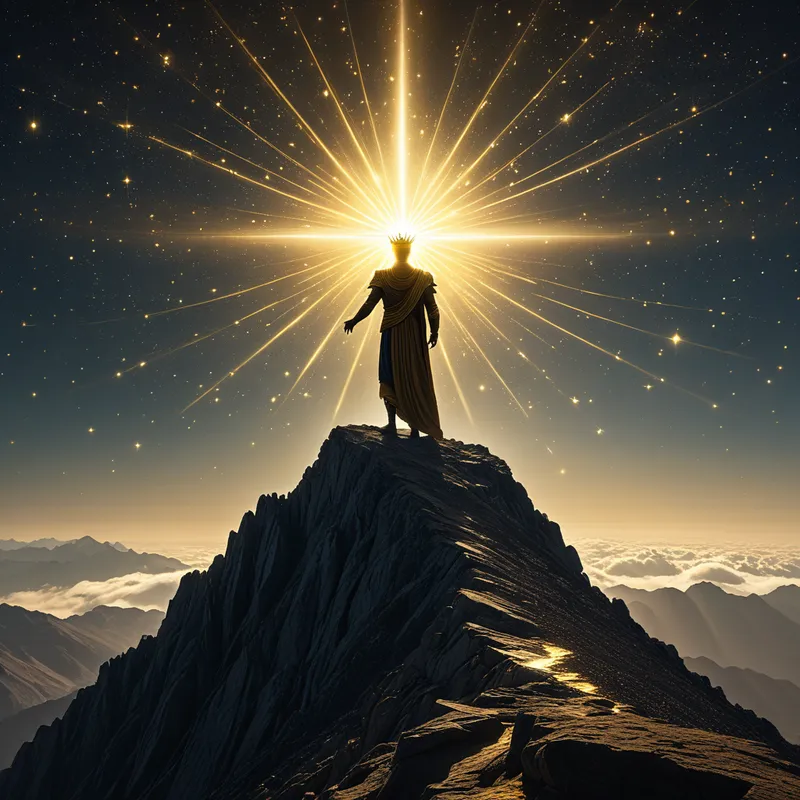
And so, from the heart of the celestial fire, Ahura Mazda fashioned Gayomart. He was not born; he was shone forth. For thirty years he grew, a giant of radiant light, his body like polished silver and gold, his substance the very essence of spirit given form. He stood upon the world, a luminous pillar connecting the high heavens to the steadfast earth. He was the First Thinking Being, the seed of all humanity, dwelling in a state of perfect, solitary harmony within the Bundahishn.
Yet, where there is a summit, a shadow is cast. From the void of non-being, the Angra Mainyu beheld this perfection and was pierced by a hatred as cold and absolute as Gayomart’s light was warm and whole. This was the great conflict written into the fabric of existence: the uncreated Light against the uncreated Lie. The Angra Mainyu invaded the pristine world, bringing with it the poison of decay, the heat of lust, the chill of death, and the scream of chaos.
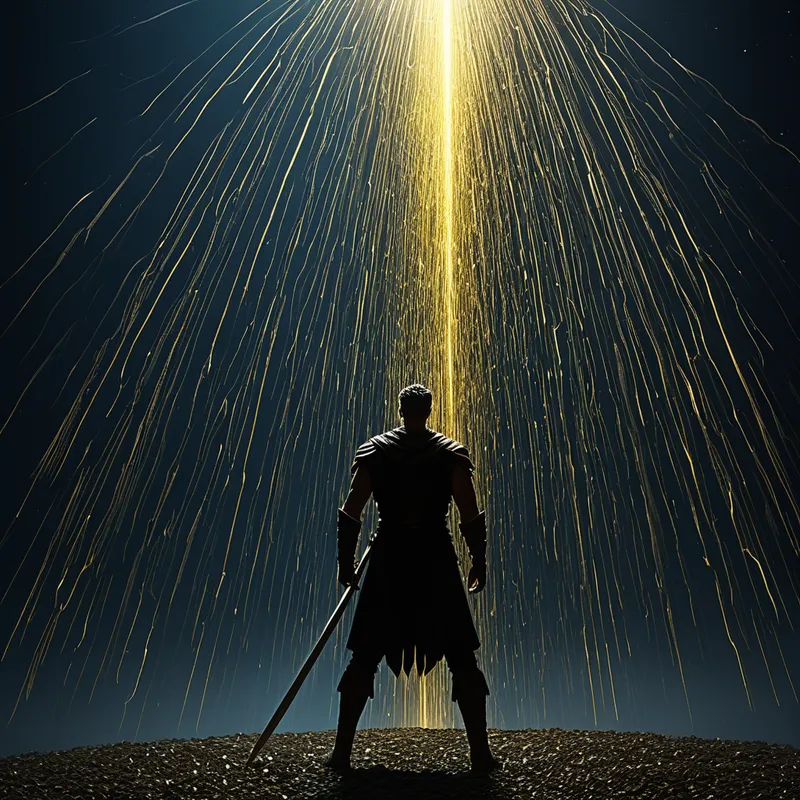
For thirty years, Gayomart withstood the assault, a bastion of light in the newly swirling gloom. But the Angra Mainyu is cunning. It fashioned not a weapon of force, but a weapon of essence—a dart of absolute corruption, a manifestation of mortality itself. This dart, this negation of eternal light, found its mark. It struck the radiant giant, and the first cry of pain echoed through creation. Gayomart did not fall in battle; he was infected. The luminous silver of his skin tarnished, the golden light of his being dimmed. He fell to the earth, his light guttering like a dying star.
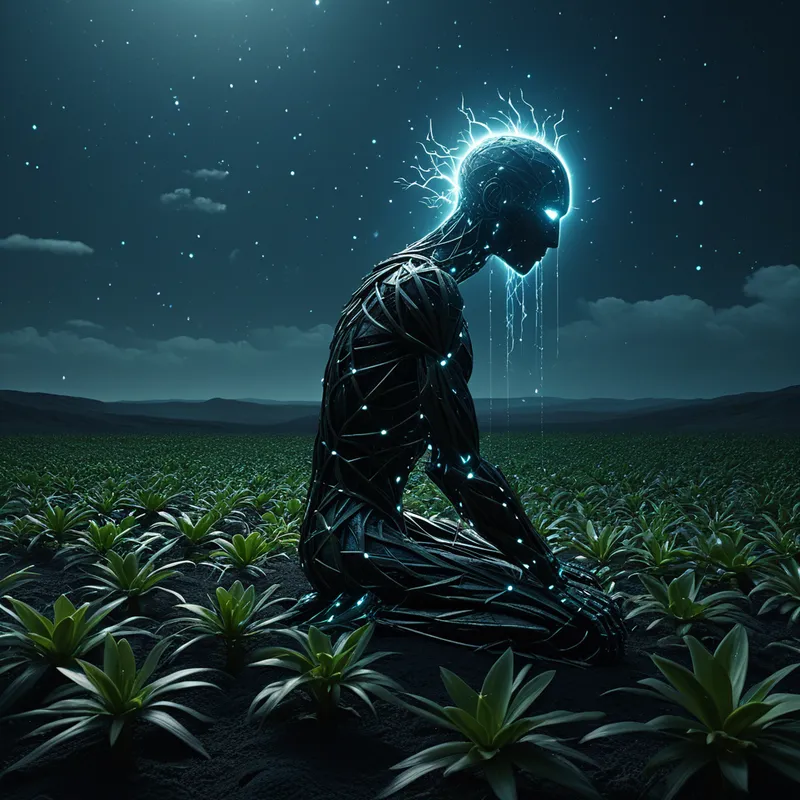
But in the moment of his fall, as his spirit prepared to depart, a miracle of transmutation began. His seed, the essence of his luminous life, spilled upon the earth. For forty years it lay mingled with the soil, purified by the light of the sun and the elements. From this sacred union of fallen spirit and receptive matter, a plant grew—a rhubarb plant of astonishing form. And from this plant, through the divine design of Ahura Mazda, emerged the first human couple: Mashya and Mashyana. They were not giants of light, but beings of flesh and breath, born from both the radiant sacrifice and the dark, fertile earth. The First Mortal had died, so that mortality could begin.
Cultural Origins & Context
The myth of Gayomart is a cornerstone of Zoroastrian cosmology, preserved primarily in the Bundahishn. This text, while compiled in the post-Sassanian era, contains layers of ancient Indo-Iranian belief, reworked through the dualistic lens of Zoroaster’s revelation. The story was not mere entertainment; it was sacred history, recited by priests (Mobeds) and taught as the foundational narrative of human origin and purpose.
Its societal function was profound. It established a theodicy—an explanation for the presence of evil and death in a world created by a benevolent god. Death was not a natural part of Ahura Mazda’s original plan but an invasive poison from the adversary. More importantly, it framed human existence as a direct, physical continuation of the primordial hero. Every human being carries within them the fragmented light of Gayomart and the substance of the earth, making them soldiers in the cosmic war against darkness. The myth provided a template for resilience, sacrifice, and the ultimate hope of Frashokereti, when the world would be restored to its perfect state.
Symbolic Architecture
Gayomart represents the original, integrated Self—a state of psychic wholeness where spirit and awareness exist in uncontaminated purity. He is the archetypal Anthropos, the cosmic human who is the blueprint for the material world and the human soul.
His fall is not a failure, but the necessary fragmentation that precedes a more complex wholeness. The perfect, static light must shatter to enter the realm of time, choice, and growth.
The Angra Mainyu here symbolizes not just external evil, but the inevitable incursion of "the other," of limitation, and of consciousness itself. To become conscious is to know separation, and with separation comes the potential for conflict, decay, and death—the shadow side of individuation. Gayomart’s death is the birth of the human condition: we are the children of that luminous seed and the dark earth that received it. Our duality—capable of great spirit and mired in mortal matter—is our inheritance.
The forty-year gestation of his seed is a profound symbol of alchemical incubation. The pure spirit must be buried, must undergo a period of dissolution and purification within the "earth" of the unconscious, before it can give birth to a new, viable form of life.
The Dreamer's Resonance
When this myth stirs in the modern psyche, it often manifests in dreams of profound, foundational change or violation. One might dream of a radiant, central pillar of the self being attacked or collapsing, of a luminous body becoming tarnished or ill, or of a precious essence being spilled or lost into the ground.
These are not nightmares of mere anxiety, but somatic narratives of a necessary "first death." The dreamer is likely undergoing a process where an old, perhaps idealized, sense of self—a perfect, static identity (the "I am as I have always been")—is being confronted by a disruptive, shadowy force from within (a new truth, a trauma, a calling, a limitation). The fall of Gayomart mirrors the painful but crucial disintegration of a persona or a life-structure that can no longer contain the complexity of the growing psyche. The dream signals the end of an innocent, unified state and the terrifying, fertile beginning of a more human, more conflicted, and ultimately more creative phase of existence.
Alchemical Translation
The alchemical journey modeled by Gayomart is the Opus Magnum itself: solve et coagula (dissolve and coagulate). The initial state is the prima materia of pure, undifferentiated spirit (Gayomart alive). The confrontation with the Angra Mainyu is the nigredo—the blackening, the putrefaction, the encounter with the shadow that leads to the "death" of the old form.
The seed in the earth is the stage of mortificatio and solutio—the death of the previous form and its dissolution into the unconscious, where it is stripped of its old attributes.
The forty-year period is the silent, hidden work of albedo (whitening), where the corruptions are purified by the "sun and moon"—the balancing of conscious and unconscious forces. The growth of the rhubarb plant represents the citrinitas (yellowing), the emergence of a new, living principle from the decay. Finally, the birth of Mashya and Mashyana signifies the rubedo (reddening)—the creation of the philosophical hermaphrodite, the coniunctio oppositorum. This is the new, conscious individual born from the marriage of the redeemed spirit (Gayomart's seed) and acknowledged matter (the earth), no longer a static giant of light, but a dynamic, generative, and mortal being capable of continuing the work of creation.
For the modern individual, this myth instructs that our deepest wounds, our encounters with mortality and limitation (our personal Angra Mainyu), are not merely destructive. They are the necessary agents that shatter our innocent wholeness so that our essential spark can be buried, incubated, and reborn in a more resilient, earthly, and human form. Our task is to tend the garden where that seed has fallen.
Associated Symbols
Explore related symbols from the CaleaDream lexicon:
- Light — The primordial substance of Gayomart and Ahura Mazda's creation, representing pure consciousness, spirit, and the original, uncontaminated Self before the encounter with limitation.
- Shadow — Manifested by the Angra Mainyu, it represents the invasive force of otherness, decay, and the unconscious contents that must be confronted for growth to occur.
- Seed — The immortal essence of Gayomart, containing the potential for all humanity; it symbolizes the core of the Self that survives psychic death and must be buried in the unconscious to germinate anew.
- Earth — The receptive, material principle that receives the spiritual seed; it represents the body, the unconscious, and the necessary grounding of spirit into tangible, mortal existence.
- Death — The first death of Gayomart, which is not an end but a transformative event, a sacred sacrifice that breaches the barrier between the eternal and the temporal, making creation dynamic.
- Sacrifice — Gayomart's fall is the ultimate archetypal sacrifice, a voluntary surrender of a perfect state so that a more complex, manifold existence can come into being.
- Mortality — The gift and curse born from Gayomart's death; it defines the human condition as beings of limited time, making choice, love, and courage meaningful.
- Rebirth — The process embodied by the seed's gestation and the emergence of Mashya and Mashyana; it signifies the psyche's capacity to generate new life forms from the fragments of shattered wholeness.
- Hero — Gayomart as the primordial hero whose struggle and fall establishes the pattern for human existence, facing the ultimate adversary not to win a battle, but to initiate a species.
- Spirit — The essential, luminous nature of Gayomart, representing the divine component within humanity that yearns for the original light while being tasked to work within the material world.