Gates of Ivory and Horn Myth Meaning & Symbolism
A myth of two gates in the House of Sleep, through which true and false dreams pass, revealing the soul's struggle to discern reality from deception.
The Tale of the Gates of Ivory and Horn
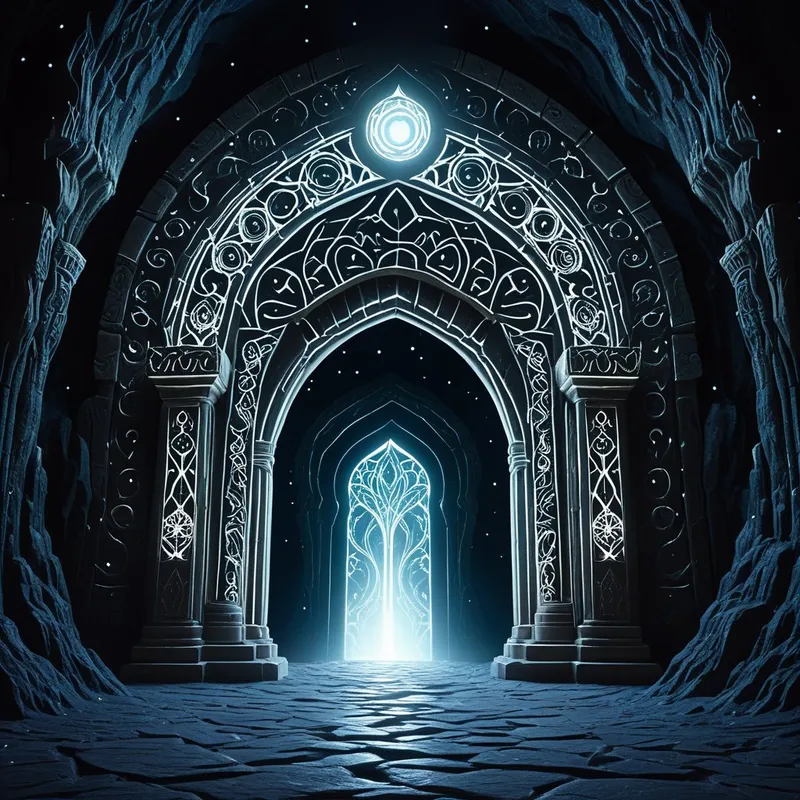
Listen, and let your mind travel to the shadowed borders of the world, where the sun’s chariot is but a memory and the only light is the cold gleam of stars on still water. Here, at the edge of Lethe, where murmurs of the dead are softer than rustling leaves, lies a cavern. This is no ordinary hollow in the earth. It is the House of Hypnos.
Within its deep, silent heart, where poppies bloom without sun and a stillness thicker than stone hangs in the air, the god of Sleep rests. But he is not idle. From the void of his realm, dreams are born. They coalesce from the mist of memory and desire, taking on a thousand shapes—some as comforting as a mother’s voice, others as terrifying as a falling sky.
And before these fledgling dreams can fly to the world of the living, they must pass a final, fateful threshold. For the House of Sleep has two gates. They stand side by side, eternal sentinels in the gloom.
One is wrought of the finest, most flawless ivory, so pale it seems to hold its own moonlight. Its surface is smooth, inviting, carved with scenes of glorious triumph and sweet reunion. The other is formed of horn, dark as old blood and polished by eons, solid and unyielding. Its texture is rough, honest, the substance of a living creature hardened by time.
The shimmering host of dreams approaches this divine fork in the road. Most, in their multitudes, are drawn as by a magnet to the ivory gate. They pass through its luminous arch and emerge into the waking world as visitors to kings and commoners alike. But these dreams, for all their beauty and terror, are eidola—empty images. They are the lies woven by hope or fear, the fantasies that flatter and deceive, the anxieties that distort. They are the dreams that slip through the fingers of memory upon waking, leaving only a vague unease or a bittersweet longing.
But a select few dreams—heavy with meaning, dense with truth—are shepherded by a silent, unseen law toward the gate of horn. These are the dreams that do not flutter, but move with purpose. They pass through the dark, solid arch and travel straight to the soul of the dreamer. These are the dreams that speak in the language of oracles, that show things as they are or as they will be. They are the unvarnished messages from the depths, the ones that startle the sleeper awake with a gasp of recognition, whose truth echoes for days in the marrow of the bones.
And so, through the ivory pass the false, and through the horn pass the true. This is the ancient, unchangeable decree in the silent house at the world’s end.
Cultural Origins & Context
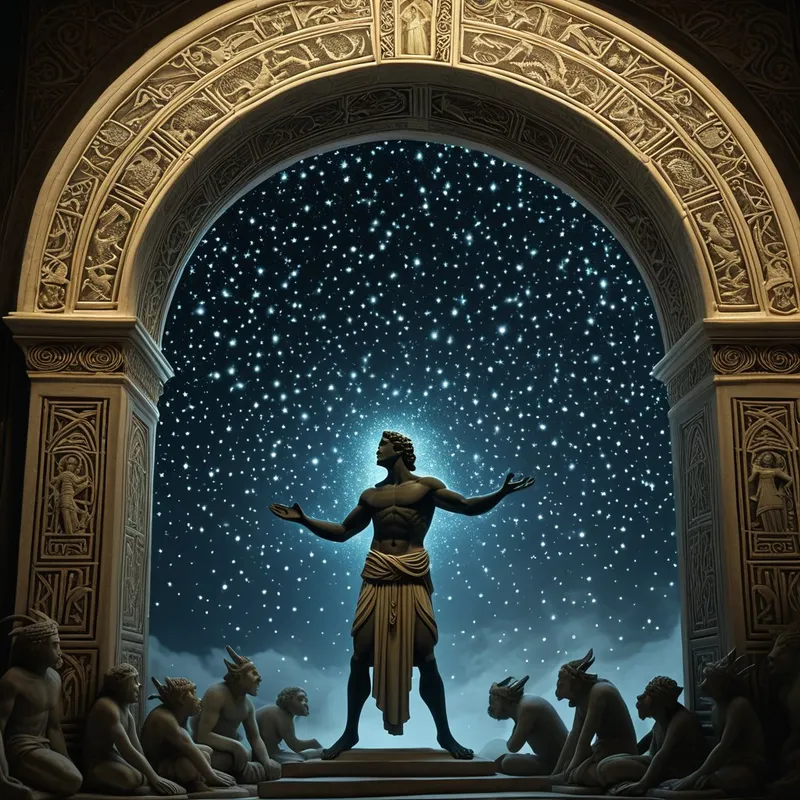
This poignant and philosophically charged myth is not the centerpiece of a grand epic, but a refined detail embedded within one. It appears in the Odyssey, specifically in Book XIX. As the long-suffering Penelope speaks of her confusion between false hopes and true premonitions, she recounts this doctrine of the two gates. The poet does not elaborate; it is presented as established, esoteric knowledge.
This tells us much. The myth functioned as a cultural framework for understanding the profound yet baffling experience of dreaming. In a world where dreams were considered messages from the divine or the dead, a system for classifying their reliability was essential. The gates provided that taxonomy. They offered an explanation for why most dreams are nonsensical or misleading, while a rare few carry the weight of prophecy or profound psychological insight. It was a myth that managed uncertainty, giving a structure to the chaos of the night. Passed down by bards and later explored by philosophers, it moved from folk belief into the realm of metaphysical speculation about the nature of reality and illusion.
Symbolic Architecture
The myth’s power lies in its stark, binary symbolism, a map of the psyche’s own frontiers.
Ivory (elephas): This is the substance of artifice. Ivory must be carved, sculpted, and polished. It represents the crafted image, the pleasing surface, the beautiful lie. It is the ego’s domain—the persona we present, the stories we tell ourselves to make life palatable. Dreams from the ivory gate are the psyche’s fiction, narratives spun from unmet desires and unprocessed fears.
Horn (keras): This is the substance of nature. Horn grows from a living being; it is dense, fibrous, and true to its origin. It cannot be easily shaped into something it is not. It represents the unvarnished core, the raw truth, the authentic self beneath the persona. Dreams from the horn gate are communications from the Self, messages from the deep, instinctual layers of the psyche that have not been edited by consciousness.
The journey of the soul is the slow migration of trust from the luminous gate of Ivory to the somber gate of Horn.
The two gates, therefore, are not just about dreams. They are archetypal portals representing two fundamental modes of perceiving reality: through the lens of illusion (ivory) and through the lens of truth (horn). The myth suggests that truth is often less glamorous, more solid, and harder to look at than the comforting fictions we prefer.
The Dreamer's Resonance
When this myth stirs in a modern dreamer, it signals a critical moment of discernment in the unconscious. You are not dreaming of literal gates, but of their psychological equivalents.
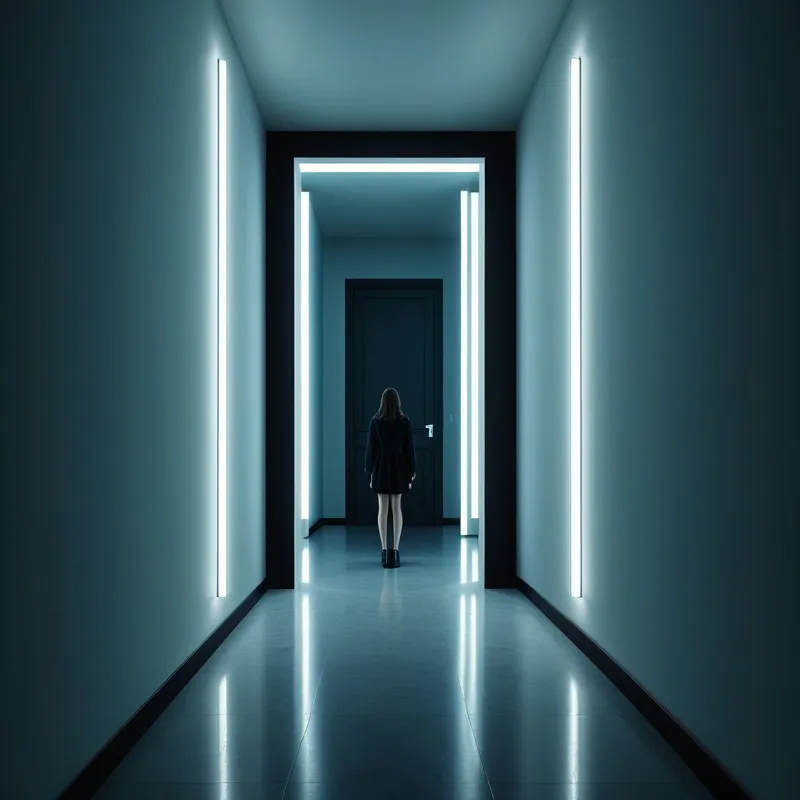
Perhaps you dream of being presented with two choices: one glittering and easy, the other difficult and obscure. You may dream of two doors, two paths, two voices. The somatic feeling is key. The "ivory" choice often brings a feeling of seductive relief that later sours into anxiety or emptiness. The "horn" choice initially brings dread, resistance, or a heavy sense of responsibility, but upon choosing it, a profound, solid calm may follow, even amidst pain.
This dream pattern manifests when the psyche is trying to differentiate between a compulsive fantasy (a wishful solution, a denial of a hard truth) and the path of genuine growth, which requires acknowledging a difficult reality. It is the soul’s own council, urging the dreamer to cultivate the wisdom to tell the difference between a symptom and a solution, between an escape and an arrival.
Alchemical Translation
In the alchemy of individuation—the process of becoming whole—this myth models the essential operation of discernio, or discrimination. The modern individual is constantly bombarded by internal and external images: social media personas, marketing fantasies, personal narratives of victimhood or grandiosity. These are the "ivory dreams" of our culture.
The alchemical work is to build a temenos, a sacred inner space akin to the House of Sleep, where these images can be received and sorted. One must learn to let the beautiful, flattering, and fearful fantasies pass through and out of awareness, acknowledging them but not mistaking them for substance.
The goal is not to destroy the Gate of Ivory, but to no longer mistake its exit for the entrance to the soul.
The true work, the opus, is to turn toward the Gate of Horn. This means having the courage to attend to what is solid, real, and often painful: the authentic feeling, the neglected duty, the shadow aspect of oneself, the unadorned truth of a situation. It is the process of valuing the fibrous, growing truth of one’s own nature over the polished, static ideal. To integrate the contents of the horn gate is to incorporate reality into the self, leading to a consciousness that is grounded, resilient, and whole. The myth, therefore, is an ancient guide for the most modern of tasks: finding truth in an age of illusion, beginning within the cavern of one’s own being.
Associated Symbols
Explore related symbols from the CaleaDream lexicon: