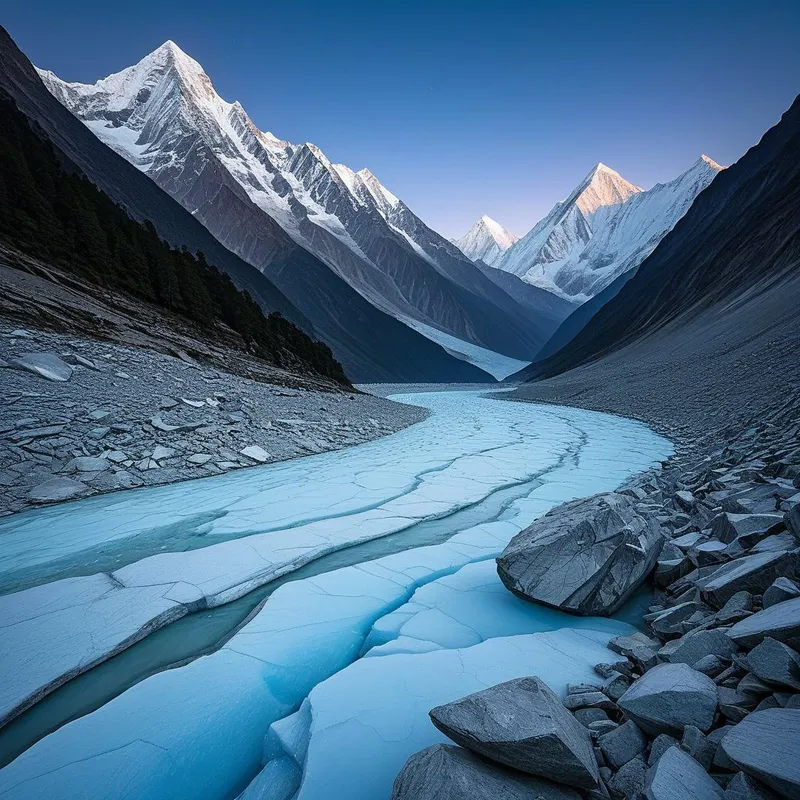
Gangotri Glacier Myth Meaning & Symbolism
The celestial river Ganga, brought to earth by Shiva's matted locks, purifies the ashes of ancestors and nourishes the world from her glacial source.
The Tale of Gangotri Glacier
Listen. Before there was a river, there was a cry. A cry that echoed from the underworld to the highest heavens, a cry of souls trapped in the liminal ash, unable to cross over. They were the sixty thousand sons of Sagara, reduced to smoldering dust by the wrath of a sage. Only the waters of heaven could wash them clean, could grant them passage.
But the waters of heaven are not for mortal earth. They are a torrent of pure consciousness, a liquid lightning that would shatter the bones of the world. The plea reached the throne of Vishnu, who promised a solution, but one of impossible delicacy. The river would descend. But who could bear the impact?
The answer lay in the silent, snow-clad peaks where a god sat in perfect meditation. Shiva, the great yogi, whose matted hair held the power of the cosmos. To him went the king Bhagiratha, whose very name would become synonymous with relentless penance. For centuries, Bhagiratha stood on one foot, on one toe, burning away his own self in the fire of tapas. His will became a single-pointed arrow aimed at the heart of divine compassion.
Shiva opened his eyes. He saw the austerity, heard the ancient cry within the king’s silence, and nodded.
Then came the deluge. From the foot of Kamadhenu in the celestial realms, Ganga surged forth, arrogant in her divine power, convinced she would flood the earth and wash Shiva himself away into the netherworld. She plunged toward the mountain with the fury of a falling galaxy.
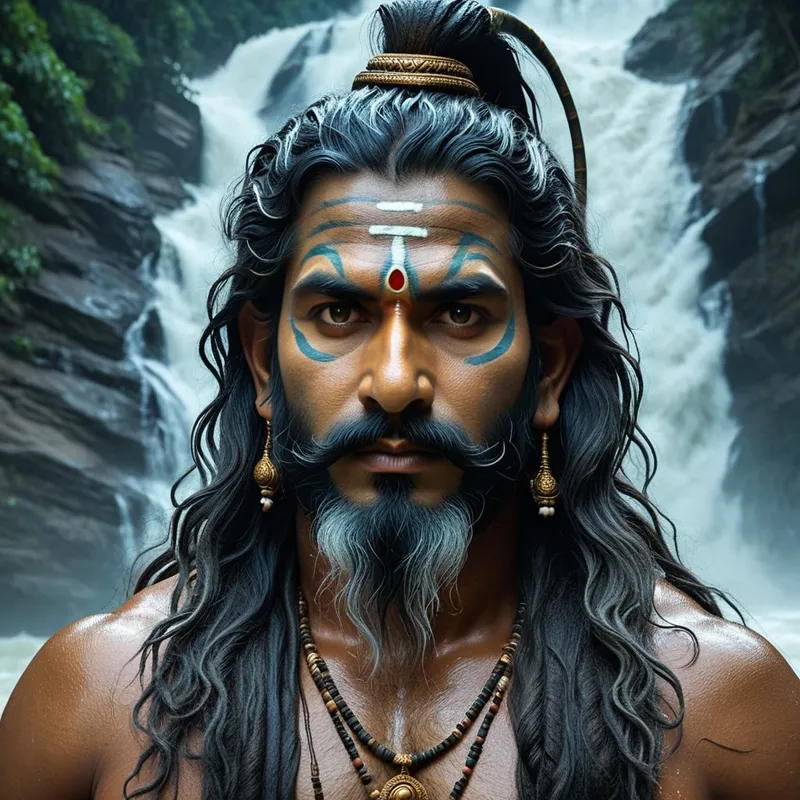
And Shiva smiled. He raised his head, and his jata, a labyrinth of ascetic power, caught her. The mighty river, who sought to shatter the world, became lost in an infinite maze. She twisted, turned, searched for an exit, her roar dampened to a murmur in the tangled forest of his hair. For years, she wandered there, humbled, her force broken into a thousand tiny streams.
Then, with infinite gentleness, Shiva released a single, tamed stream from the side of his head. A silvery ribbon of grace, now fit for the earth. It followed the chariot of the steadfast Bhagiratha, down from the high Himalayas, to the place where the ashes lay. The waters touched the gray dust, and a sound like a sigh of a million souls filled the air. They were clean. They were free.
And where that single stream first touched the mortal rock, born from the glacier of Shiva’s compassion, a place was marked for all time: Gaumukh, the Cow’s Mouth, in the womb of the Gangotri Glacier. From there, the Ganga began her long, singing journey across the plains, a mother now, not a weapon, carrying within her current the memory of both the fall and the catch.
Cultural Origins & Context
This is not merely a story of a river’s birth. It is the foundational Puranic myth that sacralizes the entire geography of India. Primarily found in the Vishnu Purana, Bhagavata Purana, and the epic Ramayana, the tale was preserved and transmitted by kathakars and pilgrims. Its societal function is multifaceted. It explains the supreme sanctity of the Ganga, justifying the countless rituals of purification, shraddha, and immersion performed at her banks. It establishes the Himalayan glaciers, specifically Gangotri, as a tirtha—a crossing point between heaven and earth.
The myth also serves a crucial dharmic purpose: it models the proper relationship between human endeavor and divine grace. Bhagiratha’s extreme penance is the human effort (purushartha), but success is impossible without Shiva’s intervening compassion. It teaches that even the most righteous goal requires a vessel strong enough to contain its transformative power. The story is ritually re-enacted every time a pilgrim journeys to the source, walking the difficult path to Gaumukh, mirroring Bhagiratha’s own determined quest.
Symbolic Architecture
At its core, this is a myth of mediated descent. The raw, undifferentiated power of spirit (Ganga) cannot directly incarnate into matter (Earth) without causing catastrophic inflation or destruction.
The psyche, in its raw, divine potential, is a force of chaos. It must be broken, humbled, and channeled through a structure of conscious suffering to become a nourishing stream of life.
Shiva’s matted hair is the ultimate symbol of this structure. It represents the tangled, complex, and often chaotic realm of the conscious mind and the embodied psyche—the accumulated samskaras and experiences. It is not a neat, ordered system, but a wild, organic network capable of containing infinity. The glacier, then, becomes the frozen potential, the stored, concentrated consciousness at the crown of the world (the head), which must melt and flow downward to animate the lower realms of being.
Bhagiratha represents the disciplined ego, the part of the psyche that undertakes the arduous, single-minded task of integration (individuation). His penance is the focused attention required to petition the deeper Self (Shiva) for help in integrating a powerful, unconscious content.
The Dreamer's Resonance
When this myth pattern stirs in the modern dreamer, it often manifests around themes of overwhelming emotion or a nascent spiritual impulse that feels too powerful to integrate. One might dream of a terrifying flood, a burst pipe in the house, or a tsunami wave. Conversely, one might dream of a profound, numinous light or energy that feels electrifying but dangerous.
The somatic experience is key: a feeling of pressure in the head, a sense of being "flooded" by feeling or inspiration, or a paradoxical combination of intense creative energy with utter creative blockage. The psyche is announcing the arrival of a powerful content from the "heavens" of the unconscious. The conflict is between the desire for this new life (to purify the "ashes" of old, dead patterns) and the terror of its unmediated force. The dreamer is in the moment between Ganga’s arrogant descent and Shiva’s compassionate catch.
Alchemical Translation
The alchemical process modeled here is solve et coagula—dissolve and coagulate—but with a critical intermediate stage: containment. The psychic transmutation involves three distinct phases.
First, the Petition (Bhagiratha's Tapas): This is the conscious recognition of a deep, ancestral need—the "ashes" of our psychological inheritance that keep us stuck. It requires a disciplined, often painful, focusing of will toward the Self, a willingness to stand in the fire of one's own longing until an answer is forced.
Second, the Containment (Shiva's Jata): This is the most crucial and least understood phase. When the transformative energy descends, the ego’s job is not to direct it, but to provide a complex, resilient container—the "matted hair" of our lived experience, our psychological history, our body. The raw archetypal energy must be broken apart, slowed down, and humbled within the labyrinth of our own being. This phase feels like confusion, delay, and a loss of the original "grand" vision.
Individuation is not about catching lightning in a bottle. It is about becoming the labyrinth that teaches the lightning to flow.
Finally, the Release (The Stream from Gaumukh): From the side of the head—the point of balance—a new, sustainable energy emerges. It is no longer a destructive flood but a nourishing river. The integrated power now flows into the world, capable of performing its destined work: cleansing the past, animating the present, and making life fertile. The glacier of potential has melted into the stream of actualization, and the caregiver archetype is born—not as a weak nurturer, but as a mighty, compassionate force that has mastered its own power through surrender to a greater structure. The journey to Gangotri is, therefore, the journey to the source of one's own contained and liberated power.
Associated Symbols
Explore related symbols from the CaleaDream lexicon: