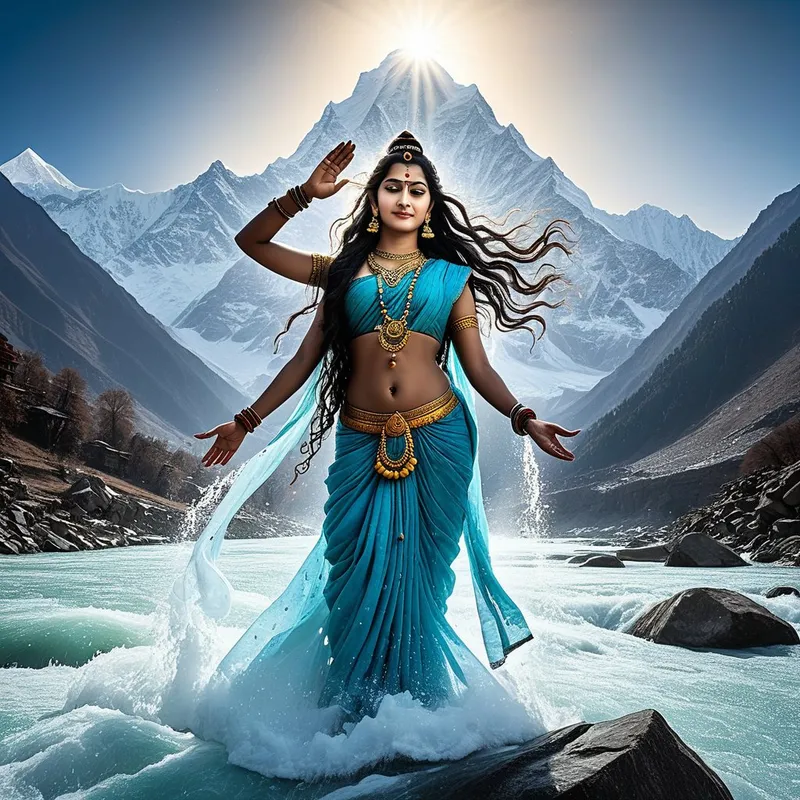
Ganges River Myth Meaning & Symbolism
A celestial river descends from heaven to earth, carrying the power to purify souls, born from divine negotiation, penance, and the god Shiva's compassionate restraint.
The Tale of Ganges River
Hear now the tale of the river that flows from the foot of Vishnu to the ashes of the dead, a story not of a place, but of a promise, a plea, and a power almost too great to bear.
In the beginning, there was only the celestial stream, Ganga, dancing across the vault of heaven. Her waters were the stuff of stars, too pure, too potent for the mortal realm. Her current could shatter mountains and wash away the very foundations of the earth. She flowed for the pleasure of the gods, a liquid jewel in the crown of creation.
But on the parched plains of Bhuloka, a king wept. He was Bhagiratha, and his sorrow was an ocean. Sixty thousand of his ancestors, the sons of King Sagara, lay as piles of ash, their souls cursed to wander, unquiet and unpurified, for they had been incinerated by the wrath of a sage. Only the touch of Ganga’s sacred waters could grant them release, could carry their essence to the peace of the afterlife. But how to bring a river of heaven down to earth?
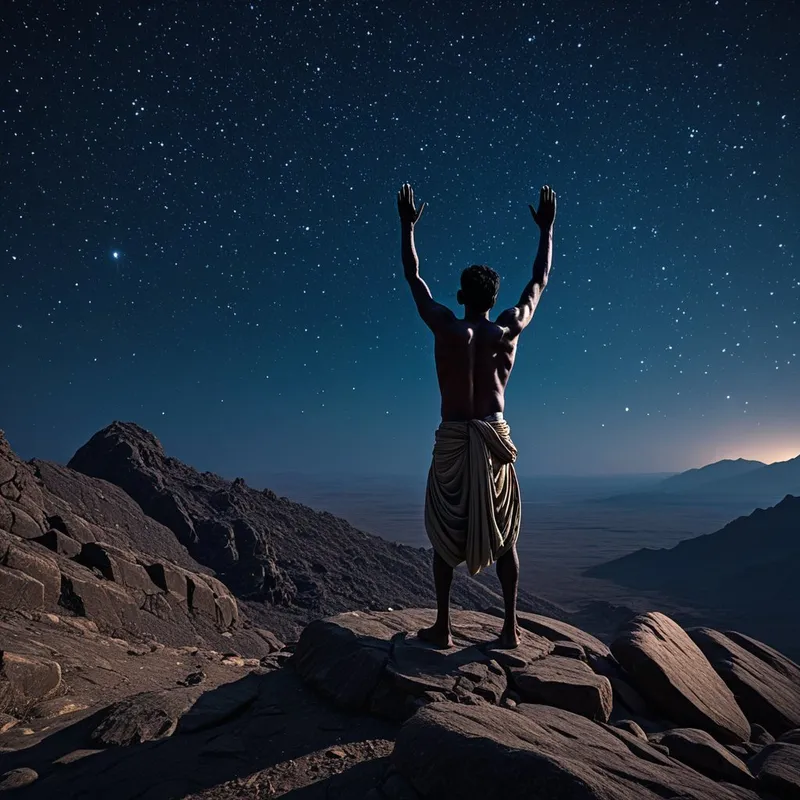
Bhagiratha renounced his throne. For a thousand years, he stood on one foot, arms raised, his will a single-pointed arrow aimed at the heart of the divine. He endured sun, storm, and starvation, his penance carving a channel of pure intent through the cosmos. The gods, moved by his unbearable devotion, finally relented. Brahma appeared in a burst of lotus-born light. “The river may descend,” he declared, his voice like distant thunder. “But her fall will crack the world. The earth cannot bear her weight. Only one can break her descent. You must propitiate Shiva.”
And so Bhagiratha began another penance, longer and more severe, directed at the aloof ascetic god who dwelled on Mount Kailash. Shiva, the great Nataraja, who wears a crescent moon and the river Ganga in his hair, finally acknowledged the king’s tapas. A faint, compassionate smile touched his lips. “Let her come,” he said.
The moment arrived. With a roar that silenced the winds, Ganga, arrogant in her celestial might, plunged from the sky. She intended to sweep away this upstart god who dared to stand in her path, to wash Shiva himself into the netherworld. She became a torrent of liquid diamond, a waterfall of galaxies, a force of utter annihilation.
Shiva did not move. As the cataclysmic deluge struck, he simply raised his matted, tangled locks. His hair, the Jata, was not mere hair; it was the infinite, labyrinthine fabric of space-time itself. The mighty Ganga crashed into that cosmic net. She raged and swirled, seeking an outlet, but the labyrinth had no end. For years, she flowed in furious circles, trapped, her pride humbled, her destructive force dissipated into a trillion tiny streams. Tamed, she became a gentle trickle, emerging from Shiva’s hair as a benevolent, life-giving stream.
Only then did Bhagiratha lead her, step by step, across the bones of the land, to the ashes of his ancestors. As her waters touched the grey mounds, a sigh of profound relief echoed through the realms. Sixty thousand luminous forms arose, purified, their faces turned toward liberation. The river continued her journey, carving the plains of Bharat, becoming the mother of all rivers, the Ganga Ma. She had descended, not as destruction, but as grace.
Cultural Origins & Context
The myth of Ganga’s descent, or Gangavatarana, is a cornerstone of Hindu sacred geography and cosmology. Its most famous literary telling is found in the Ramayana and is elaborated in the Mahabharata and the Puranas, particularly the Vishnu Purana and Shiva Purana. It was not merely a story for entertainment but a foundational narrative performed by bards and priests, explaining the origin of India’s most sacred physical landmark.
The myth served multiple societal functions. It established the theological supremacy of Shiva as the supreme ascetic capable of containing the universe’s raw power. It validated the practice of tapas (austerity) as a means to move heaven and earth. Most importantly, it provided the mythological charter for the ritual of depositing ashes in the Ganges. By linking the river’s origin to the liberation of Bhagiratha’s ancestors, it cemented the belief that her waters possess the unique power to purify karma and grant moksha. The story transformed a geographical river into a theological necessity, a living goddess whose banks became the center of civilization, pilgrimage, and empire for millennia.
Symbolic Architecture
At its core, the myth is a profound allegory for the transformation of raw, undifferentiated cosmic energy into structured, life-sustaining grace. Ganga represents pure, potent consciousness or spiritual power—divine in origin but destructive in its unmediated form. Her descent is the movement of spirit into matter, of the infinite seeking expression in the finite.
The uncontained divine is a cataclysm; the mediated divine is creation.
Bhagiratha symbolizes the human ego or conscious will, driven by a profound duty (to ancestors, to unresolved karma) and an unwavering aspiration. His penance is the focused discipline required to attract higher realities. Shiva is the transcendent Self, the archetypal container. His matted hair (Jata) is the symbolic equivalent of the human psyche’s complex structure—the unconscious, the neural networks, the very fabric of our being that must receive and temper overwhelming experiences, insights, or emotions.
The entire narrative models the necessary process for integrating a spiritual “download” or a psychological breakthrough. The power (Ganga) must be acknowledged, petitioned for (through tapas), but it cannot be received directly by the fragile ego (the Earth). It must first be mediated through the larger, containing structure of the Self (Shiva), which breaks its monolithic force into digestible, life-nourishing streams.

The Dreamer's Resonance
When this myth stirs in the modern unconscious, it often manifests in dreams of overwhelming floods, powerful downward currents, or being caught in a labyrinthine system that transforms chaos. To dream of a mighty, terrifying river from the sky is to confront a surge from the personal or collective unconscious—a raw emotion (like grief or rage), a creative impulse, or a spiritual calling that feels too powerful to integrate. The dream ego may feel like Bhagiratha: desperate, tasked with an impossible duty, watching a force approach that threatens to obliterate everything.
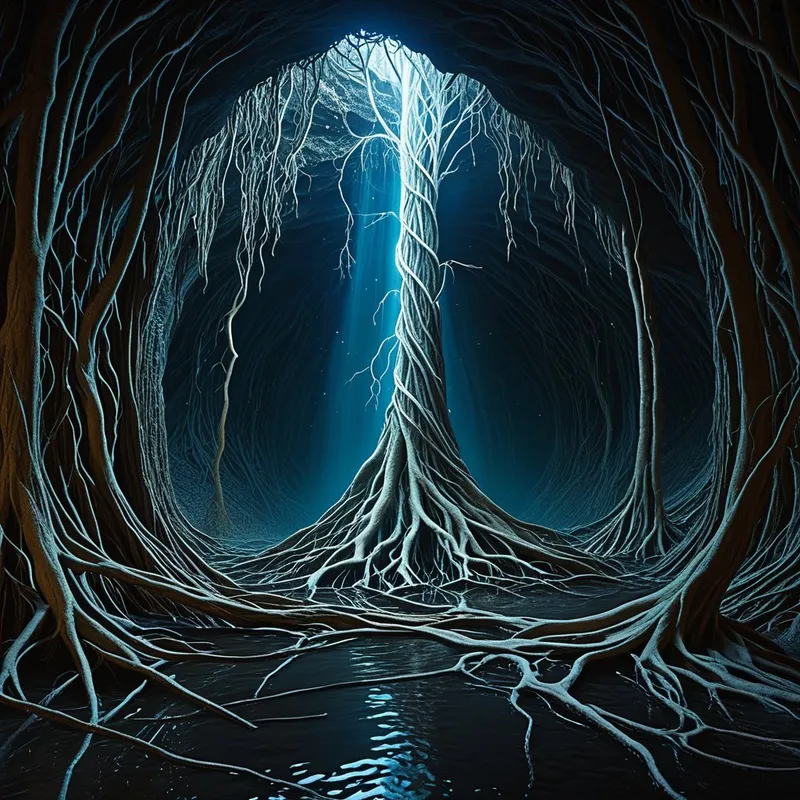
The somatic experience is one of immense pressure and potential dissolution. The resolution in the dream—if it follows the myth’s pattern—comes not from stopping the flood, but from finding or becoming the “container.” This might appear as a vast network (like roots, neurons, or webs), a calm, unmoving figure, or simply the discovery that one’s own inner structure can absorb and channel the deluge. The dream process is one of moving from terror of the power to a relationship with it, where the once-destructive force becomes a source of profound cleansing and renewal.
Alchemical Translation
For the individual on the path of individuation, the Ganges myth is a masterclass in psychic alchemy. It outlines the stages of transmuting leaden, unresolved karma (the ashes of the ancestors) into the gold of liberation.
The first stage is the Bhagiratha Phase: the recognition of a deep, ancestral, or karmic pattern that binds us. This creates a “thirst,” a focused longing for a solution that lies beyond ordinary means. It requires the discipline of tapas—withdrawing energy from outer distractions to fuel an inner petition.
The second is the Shiva Phase: the crucial work of developing the vas, the vessel. Before we can integrate a great truth, love, or creative power, we must cultivate the inner container—the calm awareness, the psychological complexity (the “matted hair”), the ability to hold tension without shattering. This is the capacity to not act out, but to hold and transform.
Liberation flows not from the power received, but from the vessel formed to receive it.
The final stage is the Ganga Phase: the descent of the transformed energy. What was once a torrent of anxiety becomes a stream of insight. Crushing grief becomes a river of compassion. Unbridled creative fury becomes a steady flow of inspiration. This energy then moves through the landscape of our life, purifying old wounds (the ashes) and nourishing new growth. The myth teaches that the goal is not to avoid the divine flood, but to become the sacred geography through which it can flow, turning destruction into sustenance, and leading the forgotten parts of ourselves home.
Associated Symbols
Explore related symbols from the CaleaDream lexicon: