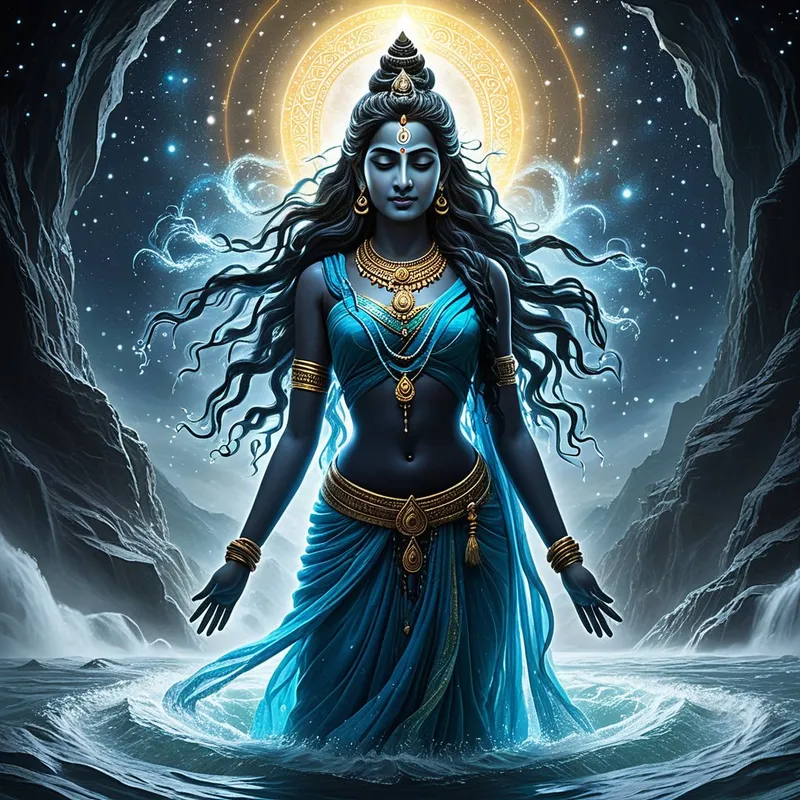
Ganga's Descent Myth Meaning & Symbolism
The celestial river Ganga descends to Earth, tamed by Shiva's matted locks, to purify the ashes of ancestors and bring life to the world.
The Tale of Ganga's Descent
Hear now the tale of a river born not of rain, but of grace; a descent not of water, but of mercy. In the high, silent halls of Svarga, flowed the celestial Ganga, a river of purest amrita, the nectar of immortality itself. Her waters were song, her currents were light, and her dwelling was the foot of Vishnu. Yet, far below, on the dusty, mortal Earth, a terrible silence lay upon the land. It was the silence of sixty thousand sons, the princes of the Sagara clan, reduced to ashes by the wrath of a sage. Their souls could find no rest, for they had died impure, and only the touch of Ganga’s sacred flow could wash their ashes and carry them to peace.
For this impossible task, a king was born: Bhagiratha. He renounced his throne, his comforts, his very life, and walked into the burning forests of the south. For a thousand years he stood on one foot, arms raised to a pitiless sky, his penance a pillar of fire that scorched the earth and shook the heavens. The gods, disturbed, sent Indra to ask his desire. “Bring Ganga down,” whispered the parched king. Brahma was pleased, but issued a warning: “The Earth is soft. The force of Ganga’s fall from the highest heaven would shatter its bones. Only one can break her descent.”
And so Bhagiratha turned his penance north, to the icy fastness of Kailasha. For another age, he prayed to the great ascetic, Shiva, the lord of wildness and stillness. Finally, the mountain trembled. Shiva opened his eyes, a smile touching his lips. “Let her come.”
From the toe of Vishnu, Ganga leapt. She fell with the arrogance of divinity, a deluge meant to drown creation, to prove her supremacy. She roared toward the crown of the world, a tsunami of celestial pride. And Shiva, calmly, raised his tangled, matted locks—the Jata. What seemed a nest of hair became a cosmic net, an infinite labyrinth of space and time. Into that vast, gentle snare, the furious river plunged. She raged and twisted, seeking an outlet, but the locks were without end. For years, she swirled in that divine captivity, her fury humbled, her force dissipated into a million gentle streams.
Satisfied, Shiva released a single, silken strand from his hair. And Ganga, now tamed, now sacred, followed the steadfast footsteps of King Bhagiratha. She flowed across the plains, washing the ashes of the sixty thousand, their souls rising like sparks. She followed him to the ocean, and from there, to the netherworld, to bless the Pitrs. Finally, purified of her celestial arrogance and consecrated by her earthly duty, she became what she is: the holiest of rivers, the Ganga Ma, mother and liberator of all.

Cultural Origins & Context
This myth, primarily found in the Ramayana and the Mahabharata, and elaborated in the Puranas, is far more than a celestial origin story. It is a foundational narrative of dharma, ecology, and sociology. Passed down for millennia by bards, priests, and grandmothers, it served to explain the supreme sanctity of the Ganges River, making its geography a sacred map of India itself.
The myth functioned as a powerful social and theological tool. It validated the practices of ancestor worship (shraddha) and the seeking of salvation through ritual bathing. It established a hierarchy of divine intervention: the desperate human (Bhagiratha) appeals to the cosmic regulator (Brahma), who directs the plea to the ultimate transformative power (Shiva). This narrative reinforced the idea that grace is earned through fierce, unwavering discipline (tapas), and that even divine energy requires a container to become beneficial on Earth.
Symbolic Architecture
At its heart, this is a myth of the necessary mediation between transcendent power and earthly need. Ganga represents pure, undifferentiated divine energy—potentially creative, potentially destructive. She is consciousness in its raw, unbounded state.
The uncontained spirit shatters the world it seeks to bless; it is in the binding that it becomes a blessing.
Bhagiratha symbolizes the focused will of the ego, the part of the psyche that identifies a profound lack (the unrest of the ancestors, our own unresolved past) and commits to a grueling, single-pointed quest to address it. His penance is the discipline required to attract the attention of the deeper Self.
Shiva’s matted hair, the Jata, is the master symbol. It represents the intricate, often chaotic-looking network of the unconscious mind, the cosmic web that can receive and transmute raw archetypal energy. The locks do not destroy Ganga; they diffuse her, slow her, and transform her catastrophic fall into a life-giving flow. Shiva is the archetype of the transformer, the one who can hold the tension of opposites—destruction and preservation, wildness and stillness—and alchemize them.
The ancestors’ ashes are the unresolved karma, the psychic residue of past actions and traumas that haunt the present. The river’s final descent to the ocean symbolizes the integration of this purified energy back into the collective unconscious, completing the cycle.
The Dreamer's Resonance
When this myth stirs in the modern dreamer, it often signals a profound process of emotional or spiritual inundation. To dream of a terrifying, beautiful flood from the sky may point to an overwhelming influx from the unconscious—a creative idea, a surge of grief, or a spiritual awakening that feels too powerful to integrate.
The somatic experience is key: the dreamer may feel the awe and terror of the descent, the pressure of an unstoppable force. If the dream features a figure (a wise old man, a dense forest, a tangled net) that safely contains this flood, it mirrors Shiva’s Jata. This indicates the psyche’s innate capacity to mediate the influx. Conversely, dreams of being shattered by the water suggest a fragile ego-structure unable to handle a current of change or insight. The dream may also present the arduous, lonely journey of Bhagiratha—a feeling of prolonged striving toward a seemingly impossible goal, where the only fuel is unwavering faith.
Alchemical Translation
For the individual on the path of individuation, Ganga’s descent models the critical phase of receiving and integrating contents from the Self. The “descent” is the arrival of a powerful new conscious attitude or a deep, often disruptive, realization from the unconscious. The initial experience can be egotistical (like Ganga’s pride) or simply overwhelming.
The alchemical vessel is not forged in comfort; it is woven from the tangled experiences of a lifetime, the very knots we seek to undo.
The ego’s role, like Bhagiratha’s, is one of devoted petition. It must practice the “tapas” of attention—holding space, listening, and persevering through the dryness of doubt. The crucial alchemical vessel, however, is not the ego. It is the Shiva-principle within: the capacity of the deeper psyche to receive, contain, and slow down the raw revelation. This is the function of reflection, of art, of therapy, of meditation—to provide the “matted locks” that prevent the brilliant insight from becoming a manic episode, or the upwelling of grief from becoming a destructive flood.
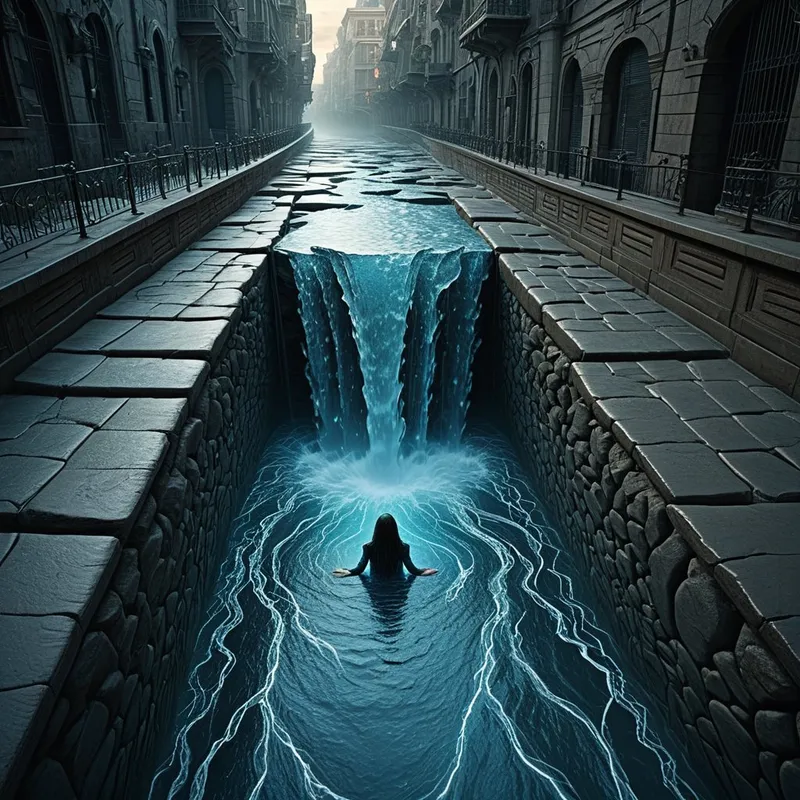
The purification of the “ancestors’ ashes” is the healing of personal and ancestral trauma. The flowing river, once tamed, then performs its sacred work automatically, washing clean the calcified patterns of the past. The final integration is the river reaching the ocean—the individual consciousness realizing its source in the vast, impersonal Self. The myth teaches that grace is not a gentle rain; it is a cataract. Our task is not to stop it, but to become the vessel that can transform its devastating force into a sustaining, liberating flow.
Associated Symbols
Explore related symbols from the CaleaDream lexicon: