
Ganga Myth Meaning & Symbolism
A celestial river goddess descends to Earth, her torrential power tamed by the god Shiva, to purify the ashes of ancestors and grant liberation.
The Tale of Ganga
Hear now the story of the river that flows from heaven. In the time when kings were sages and the gods walked close to the world, there lived a great and noble king named Sagara. He performed a mighty sacrifice to claim dominion over the earth, but his sacred horse was stolen by Indra himself, who hid it deep within the underworld. Sagara sent his sixty thousand sons to find it. They scoured the earth, digging with fury and pride until they reached the netherworld. There, they found the horse grazing peacefully beside a meditating sage, Kapila. Blinded by arrogance, the princes accused the sage of theft. Kapila, disturbed from his deep tapas, opened his eyes. The fire of his gaze, pure spiritual power, flashed forth and reduced all sixty thousand princes to ashes.
Their souls could not ascend. They were trapped, haunted and earthbound, by the violence of their end. Generations passed. The burden of this ancestral sin weighed upon the lineage until the birth of a pious descendant, Bhagiratha. He could bear the lament of his ancestors no longer. He renounced his throne and journeyed to the Himalayas. For a thousand years he stood on one foot, then for another thousand he stood on his toes, his arms raised to the frozen sky, praying, burning, pleading. He sought not wealth or power, but a grace so profound only the heavens held it. He prayed to Brahma.
Moved by this unbearable penance, Brahma appeared. “Your wish is granted, noble king. But my boon is a problem. The only force that can wash the ashes of your ancestors and grant their souls release is the Ganga. But she flows in the heavens. If she falls to earth directly, her cosmic weight will shatter the world. Only one can break her fall. You must now please Shiva.”
And so Bhagiratha prayed again. For another age, he turned his fierce devotion to the great ascetic, the lord of mountains and ghosts. Finally, Shiva, the compassionate destroyer, agreed. On the peak of Mount Kailash, he prepared. Bhagiratha then prayed to Ganga herself, the proud and powerful goddess of the celestial stream. She agreed to descend, but with arrogant force, believing she could sweep even Shiva away.
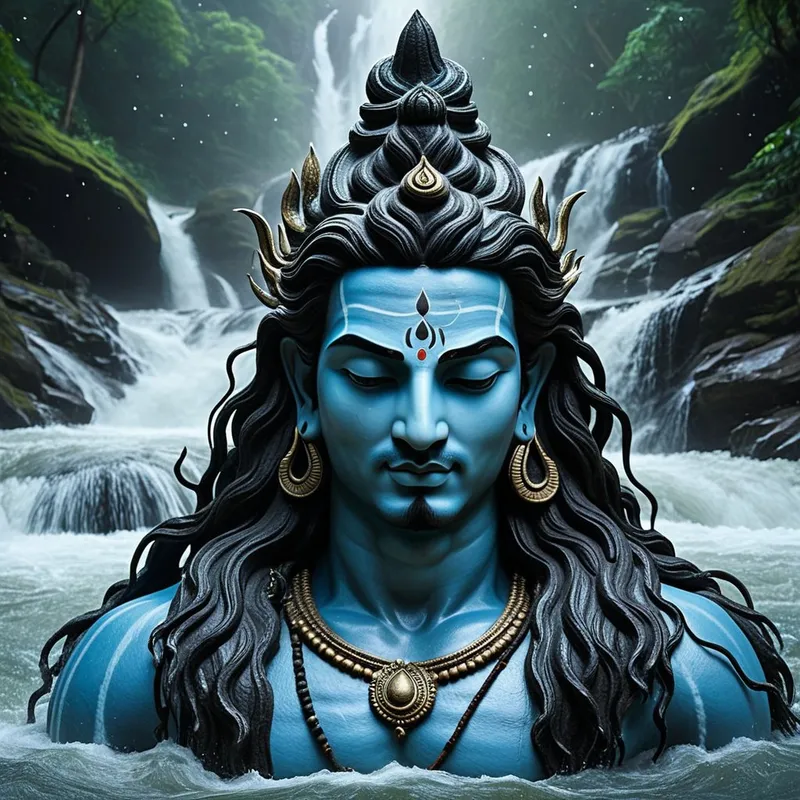
The moment arrived. From the toe of Vishnu, Ganga plunged toward the earth, a thunderous, furious deluge meant to drown creation. As the cataclysm fell, Shiva, serene and still, merely raised his matted, tangled locks. The river, with all her roaring might, crashed into his hair. She was lost. The labyrinth of his jata swallowed the universe-shattering flood. She twisted, turned, and struggled, but could not escape. Humbled, she slowed, and was divided into seven gentle streams. Then, and only then, did Shiva release a single, graceful stream to follow the patient footsteps of King Bhagiratha, who led her across the plains to the ocean, and to the ashes of his ancestors. The waters touched the pyres. A great sigh rose from the earth as sixty thousand spirits were cleansed, purified, and lifted into light. The river that was heaven’s pride became the earth’s salvation, flowing ever since as the sacred Ganga.
Cultural Origins & Context
This myth, primarily found in the Ramayana and Bhagavata Purana, is not merely a story of origin. It is a living map of sacred geography and a cornerstone of dharma. For millennia, it has been recited by priests, sung by bards, and enacted in rituals, connecting the physical river to a divine narrative. Its societal function is multifaceted: it sanctifies the landscape, turning a geographical feature into a theological entity. It provides a framework for the crucial Hindu practices of ancestral rites (shraddha) and the longing for liberation (moksha). The river becomes the ultimate purifier, capable of washing away not just physical dirt, but the karmic stains of the soul. The myth legitimizes pilgrimage and establishes a model of kingly duty—dharma—where the ruler’s ultimate responsibility is the spiritual welfare of his lineage and land, even at the cost of immense personal austerity.
Symbolic Architecture
At its core, the myth of Ganga is an alchemical diagram of consciousness. Ganga represents raw, undifferentiated cosmic energy—pure potential, but also chaotic and destructive if unmetabolized. She is the unconscious in its primordial, overwhelming form.
The divine descent is always a crisis; grace, to be received, must first be broken by a container strong enough to hold its fury.
Bhagiratha represents the focused, disciplined human will and intention (sankalpa). His penance is the concentrated effort of consciousness seeking to integrate a profound, transformative power from a higher plane. The ancestors’ ashes symbolize the accumulated, unresolved karma of the past—the psychic burdens, traumas, and unfinished patterns we inherit, both personally and collectively. They are the “sins of the fathers” that haunt the present.
Shiva is the essential transformative principle. His matted hair (jata) is the perfect symbol of the complex, labyrinthine structure of the psyche—the conscious mind—that must receive and mediate the unconscious. He does not block Ganga; he receives her fully, slows her, and breaks her into manageable streams. He is the archetypal container, the transformative function that turns potential catastrophe into life-giving order.
The Dreamer's Resonance
When this myth stirs in the modern psyche, it may manifest in dreams of overwhelming floods, of finding sacred springs in unexpected places, or of trying to guide a powerful, dangerous force to a specific destination. Somatically, one might feel a rising, chaotic energy—anxiety, creative fury, or unresolved grief—that feels like it will “shatter” one’s world. This is Ganga’s unmediated descent.
The dreamer in this pattern is Bhagiratha, bearing a profound responsibility to heal something ancestral. This could be a family trauma, a deep-seated personal pattern, or a calling that requires immense sacrifice. The conflict is between the raw power of the emerging feeling or insight and the fear that it is too much to handle. The dream asks: What in your life requires a descent of grace? And what part of you must play the role of Shiva—not to suppress, but to receive, contain, and transform that torrent into a nourishing flow?
Alchemical Translation
The psychic transmutation modeled here is the individuation process of integrating a powerful complex or archetypal energy. First, one must perform the “penance” of Bhagiratha: the honest, sustained focus on the deep need or wound (the “ancestral ashes”). This is the discipline of therapy, meditation, or any profound inner work.
Then comes the descent of the complex—the eruption of emotion, memory, or inspiration. The critical, alchemical stage is the “Shiva function.” This is the ego’s task not to identify with the flood (“I am overwhelmed”) or to reject it (“This is too much”), but to develop a witnessing consciousness that can contain it.
Individuation is the art of becoming a catchment for the heavens, allowing the furious waters of the unconscious to be tangled, slowed, and made conscious in the labyrinth of the self.
The final stage is the guided flow—the released stream that follows Bhagiratha’s path. This is the conscious channeling of that now-integrated energy toward its purposeful end: cleansing the past, nurturing creativity, or watering the “parched earth” of one’s life. The myth teaches that liberation (moksha) is not an escape from power, but the sacred grounding of it. The river does not return to heaven; she becomes the sacred ground of earth itself, showing that our highest spiritual task is to bring the divine current into the mundane world, transforming chaos into a sustaining, purifying flow.
Associated Symbols
Explore related symbols from the CaleaDream lexicon: