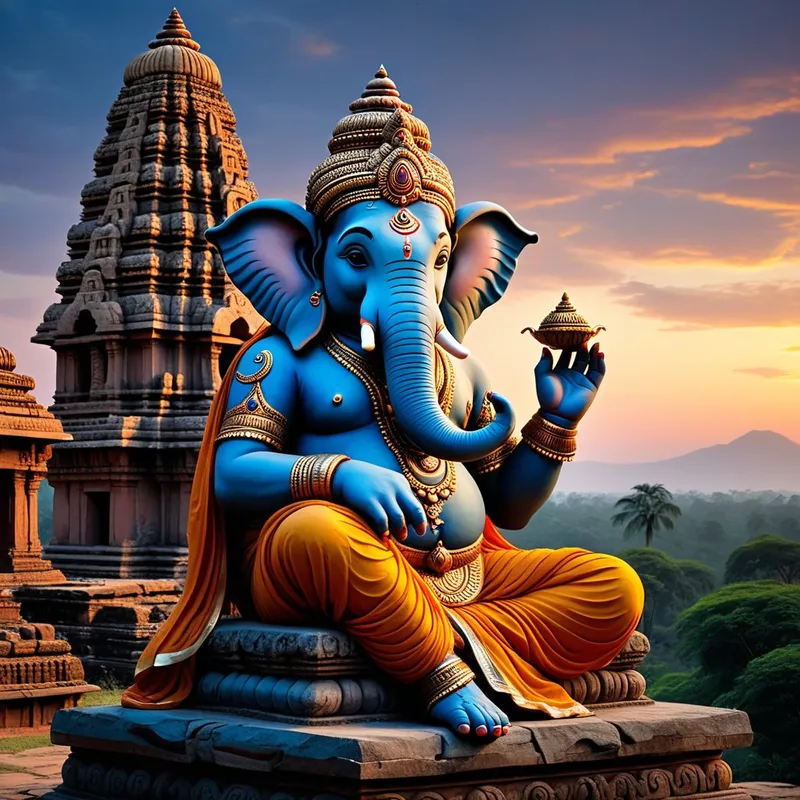
Ganesha's Vahana Myth Meaning & Symbolism
The story of how the mighty elephant-headed god Ganesha tamed a celestial mouse, transforming it into his humble and powerful vehicle.
The Tale of Ganesha's Vahana
Listen, and let the story settle in your bones. It begins not in the heavens, but in the dust. In the court of Indra, a celebration was in full bloom. Nectar flowed, and the air shimmered with the music of the Gandharvas. Yet, beneath the marble floors, in the unseen cracks of paradise, a seed of chaos grew. It was Krauncha, a celestial musician, cursed by a sage for his arrogance. His form twisted, his melody turned to a screech, and he became a monstrous mouse—a Daitya in rodent form.
This was no ordinary pest. Krauncha grew to the size of a mountain, his fur like black storm clouds, his teeth like ivory daggers. He became a terror, a devourer. He rampaged through the fields of the gods, gnawing at the roots of the Kalpavriksha, swallowing whole harvests meant for sacred offerings. The earth trembled with his scurrying. The gods, for all their splendor, were confounded. Their thunderbolts and discuses could not strike what moved with such frantic, subterranean speed. Despair hung in the celestial air.
Then, a figure stepped forward. Not with a roar, but with a calm, deep breath that smelled of earth and wisdom. It was Ganesha, son of Shiva and Parvati. His large ears listened to the panic of the world. His single tusk gleamed with resolve. He did not reach for a weapon. Instead, he took a single, humble strand from the sacred grass, the Kusha. He infused it with a mantra, a vibration of absolute order.
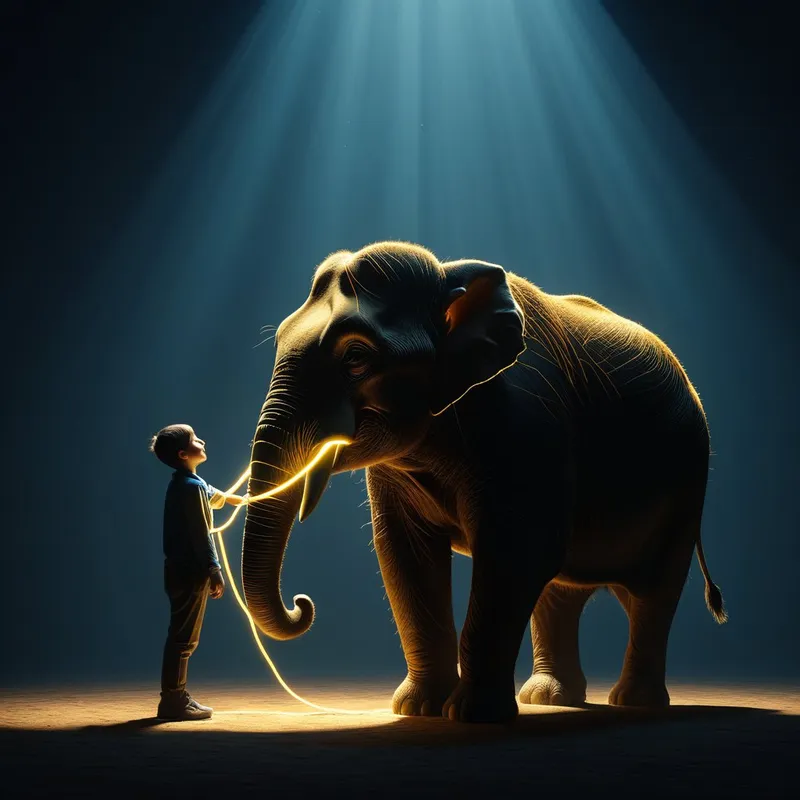
He found the demon-mouse in a ravaged field, its eyes burning with insatiable hunger. Ganesha stood before the colossal beast, a paradox of immense stillness. He cast the enchanted blade of grass. It did not pierce, but looped, becoming a lasso of light. It settled around the mouse's neck, not as a chain, but as a sacred thread, the Yajnopavita. The moment it touched Krauncha's fur, the monstrous form shuddered. The rage dissolved like mist in sunlight. The mountain-sized creature shrank, not in defeat, but in relief, becoming a small, humble mouse. The fire in its eyes softened to a gentle, intelligent gleam.
Ganesha, the lord of all thresholds, then placed his foot upon the mouse's back. A great truth was enacted in that gesture. The massive weight of the god did not crush the tiny creature; instead, it was borne with perfect ease. The mouse bowed its head, not in servitude, but in recognition of its true master. From that day, the mouse, once a demon of chaos named Krauncha, became Mushika, the vahana. Where Ganesha goes, Mushika scurries ahead, clearing the path of unseen obstacles, guided by the gentle pressure of the divine foot upon his back.
Cultural Origins & Context
The myth of Ganesha and his vahana is woven into the vast tapestry of the Puranas, particularly the Shiva Purana and the Ganesha Purana. These texts, composed and expanded over centuries beginning around the 4th century CE, were not dry scriptures but living narratives performed by storytellers, or Sutas, in temple courtyards and village squares.
The function of this specific tale was multifaceted. On one level, it is an etiological myth, explaining the iconic form of one of Hinduism's most beloved and ubiquitous deities. Every child asking, "Why does the big elephant god ride a tiny mouse?" is led into a story about cosmic order. Societally, it reinforced a core dharmic principle: that no power, however chaotic or base, is beyond integration into the divine order when approached with wisdom (Jnana) rather than brute force. It served as a narrative anchor for the worship of Ganesha at the start of any venture, reminding devotees that the first step to overcoming great obstacles is to master the small, scurrying anxieties within.
Symbolic Architecture
The relationship between Ganesha and Mushika is one of the most exquisite symbolic equations in world mythology. It is a complete map of the psyche.
Ganesha, with his elephant head, represents the macrocosm: vast intellect (Buddhi), cosmic memory, and the power to remove large, apparent obstacles. The mouse, Mushika, represents the microcosm: the subconscious, the desires that gnaw at the foundations of our resolve (Kama), the small, incessant, unseen anxieties that can devour our inner peace. The mouse is our propensity to scurry into dark, hidden places of fear and desire.
The greatest wisdom does not annihilate the instinctual self; it rides it. The god does not destroy the mouse; he directs it.
The mouse's demonic form, Krauncha, symbolizes the ego-inflation of the unconscious—when our repressed desires and fears grow to monstrous proportions and run amok, destroying the "gardens" of our potential. Ganesha's blade of grass is the power of mindful attention, the subtle but unbreakable thread of consciousness that, when applied, reduces the monstrous to the manageable. His foot upon the mouse's back is not domination, but the gentle, constant pressure of awareness that transforms chaotic energy into directed movement. The mouse, now Mushika, becomes the vehicle, meaning our mastered instincts and subconscious drives become the very force that carries our conscious will (Sankalpa) forward, sniffing out and clearing the path.
The Dreamer's Resonance
When this mythic pattern stirs in the modern dreamer, it signals a critical phase of inner reconciliation. To dream of a giant, destructive rodent—gnawing at the walls of one's house, devouring precious belongings—is to experience the "Krauncha state." It is the somatic feeling of one's own untamed anxieties, appetites, or resentments growing to a scale that feels uncontrollable, threatening to undermine one's psychological and even physical structure.
Conversely, dreaming of a calm, guiding presence (often not seen clearly) that leads or calms a small animal, particularly a mouse, indicates the active engagement of the inner Self-archetype, the Ganesha within. The dreamer is not fighting their nature but learning to "lasso" it with awareness. The psychological process is one of containment and redirection. The immense psychic energy previously wasted on frantic worry or compulsive behavior is being harnessed. The dream ego may feel the profound relief of the mouse as it shrinks—the relief of an obsession losing its power, a fear becoming a manageable concern. This is the dreamwork of building inner authority.
Alchemical Translation
The alchemy of this myth models the individuation journey with stunning clarity. Our initial state is often that of Krauncha: a divine potential (the celestial musician) cursed into a monstrous, hungry, destructive form by the "sage" of our own neglected conscience or unintegrated trauma. We rampage through our own lives, gnawing at our foundations with self-sabotage and insatiable craving.
The first stage of transmutation is the appearance of the "Ganesha principle"—the awakening of a witnessing consciousness that does not judge from afar but engages. This is the Self observing the ego. The sacred grass is the tool of focused introspection, perhaps meditation, therapy, or creative expression—a simple, disciplined practice that casts a loop of awareness around the chaotic impulse.
The obstacle is not the demon-mouse, but the absence of the god's foot. The transformation occurs not in the slaying, but in the bearing.
The crushing weight of the god's foot is the alchemical opus contra naturam—the work against nature. It is the conscious application of discipline, of choosing integrity over impulse, again and again. This pressure is what transmutes leaden instinct into golden service. The monstrous "I want" becomes the humble "I serve a higher purpose." The energy of desire is not eliminated; its direction is altered. The individuated person is not one who has killed their mouse, but one whose mouse has become Mushika. Their once-debilitating sensitivity now scouts for opportunity. Their restless mind now chews through complex problems. Their primal drives now carry them steadfastly toward their true north, guided by the gentle, unwavering pressure of their own integrated wisdom. The vahana is the testament that the journey to wholeness is ridden upon the very beasts we once feared.
Associated Symbols
Explore related symbols from the CaleaDream lexicon: