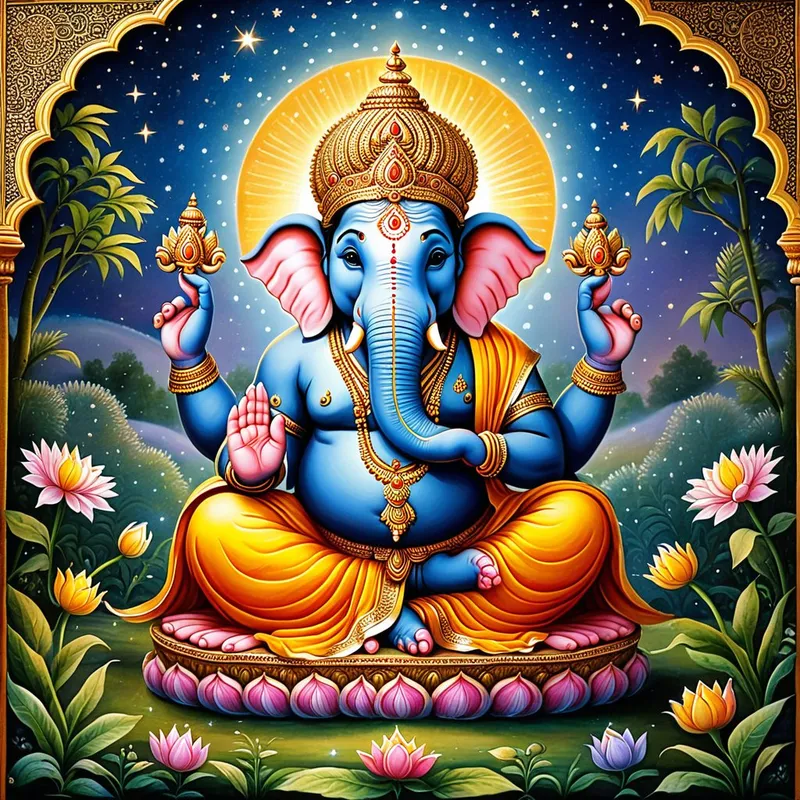
Ganesha's Mouse Myth Meaning & Symbolism
The elephant-headed god Ganesha rides a tiny mouse, embodying the divine paradox of immense wisdom taming the restless, gnawing mind.
The Tale of Ganesha's Mouse
Listen, and let the story settle in your bones. In the celestial realms, where the air hums with the music of creation, there lived a god unlike any other. He was Ganesha, son of the great Parvati and the mighty Shiva. His form was a divine paradox: the immense, wise head of an elephant upon a human form, a being of profound stillness and gentle strength. He was the scribe of the gods, the opener of ways, the one who blessed all beginnings.
Yet, his mount was not a lion, nor a tiger, nor a celestial bull. It was a creature of the earth, of shadow and scurrying haste. A mouse.
But this was no ordinary mouse. Once, in a forgotten age, this creature was a celestial being named Gandharva named Kroncha. Puffed with pride, he once carelessly flew over the hermitage of a great sage. In his arrogance, he disturbed the sage’s deep meditation. The sage’s wrath was a force of cosmic law. With a single, thundering curse, the soaring Gandharva was flung from the sky, his form shrunk and twisted. His wings became tiny claws, his celestial music a desperate squeak. He was made into a mouse—but a mouse of monstrous, insatiable hunger. His new nature was to gnaw, to consume, to reduce everything to dust. He became a terror, a devourer of crops, of hopes, of entire villages, a shadow that grew with every bite.
The world cried out in despair. The chaos of this boundless hunger threatened the very order of things. The plea reached the ears of Ganesha. The remover of obstacles did not raise a weapon of destruction. He descended, a mountain of calm amidst the storm of consumption.
The great mouse, seeing this new, massive form, saw only the grandest feast imaginable. With a shriek that split the earth, it charged, a tidal wave of teeth and shadow. Ganesha did not move. As the monstrous creature lunged, he simply lifted his foot, heavy with the weight of cosmic patience, and placed it upon the mouse’s back.
Not to crush. To still.
The weight was not of stone, but of infinite compassion. The mouse thrashed, squealed, gnashed its teeth against the divine foot, but could not move it a hair’s breadth. In that struggle, something broke—not its bones, but its frenzy. Exhausted, humbled, it lay still, feeling for the first time not the itch of hunger, but the profound weight of presence. Ganesha, with a grace that softened the very air, lifted his foot. The mouse, now small and trembling, looked up into the god’s deep, knowing eyes. In that gaze, it saw not a master, but a purpose. Ganesha smiled, and with a gentle nod, invited the creature to serve as his vahana, his sacred mount.
From that day forth, the elephant-headed god rode the mouse. Where the mouse once brought famine, it now carried the god of abundance. Its restless energy, once a force of chaos, was now directed, a vehicle for grace. The devourer had become the conduit.
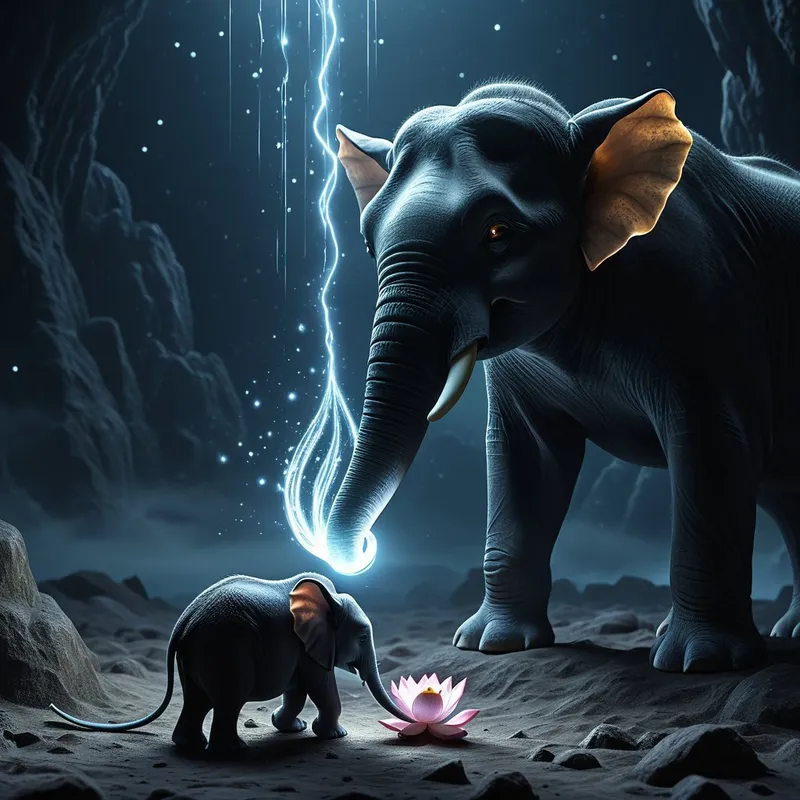
Cultural Origins & Context
This myth is woven into the vast tapestry of the Puranas, particularly the Shiva Purana and the Mudgala Purana. It was not merely a story for children, but a teaching parable recited by priests and storytellers (kathakars) in temples and village squares. Its function was multifaceted: to explain the iconography of one of Hinduism’s most beloved deities, to illustrate a core philosophical tenet—that divinity encompasses and masters all opposites—and to offer a model of social and spiritual order.
In a culture deeply attuned to symbolic resonance, every detail of a deity’s form carries meaning. The question of why the massive Ganesha chose the smallest of vehicles was a natural one for devotees and philosophers. The story provided the answer, grounding divine symbolism in narrative cause and effect. It taught that no being, however fallen or chaotic, is beyond redemption through divine grace and the proper application of “weight” or discipline. Societally, it mirrored the ideal of the wise ruler (the archetypal king) who does not destroy disruptive forces but integrates and directs them for the good of the whole.
Symbolic Architecture
The myth is a perfect mandala of symbolic opposites held in dynamic, creative tension.
Ganesha, with his elephant head, represents the macrocosm: immense wisdom (large brain), memory, strength, and the ability to remove the biggest obstacles. He is the fully integrated Self, consciousness itself.
The Mouse represents the microcosm: the restless, ever-busy, desiring mind. It is the shadow and the ego in its untamed state—gnawing with anxiety, scurrying with distraction, insatiable in its hunger for more. Its transformation from a prideful Gandharva underscores that our most destructive tendencies often stem from a corrupted or misguided sense of self.
The greatest power is not in conquering the external dragon, but in placing a conscious foot upon the internal mouse.
The act of riding is the key alchemical image. Ganesha does not eliminate the mouse; he mounts it. He directs its energy. The mouse’s speed and ability to slip into tiny spaces becomes an asset for the god who must navigate the labyrinthine paths of human endeavor to remove obstacles. This symbolizes the psychological truth that we cannot eradicate our base instincts or restless thoughts, but we can learn to “ride” them—to use the energy of anxiety as fuel for preparedness, or the hunger of desire as a guide toward authentic need.
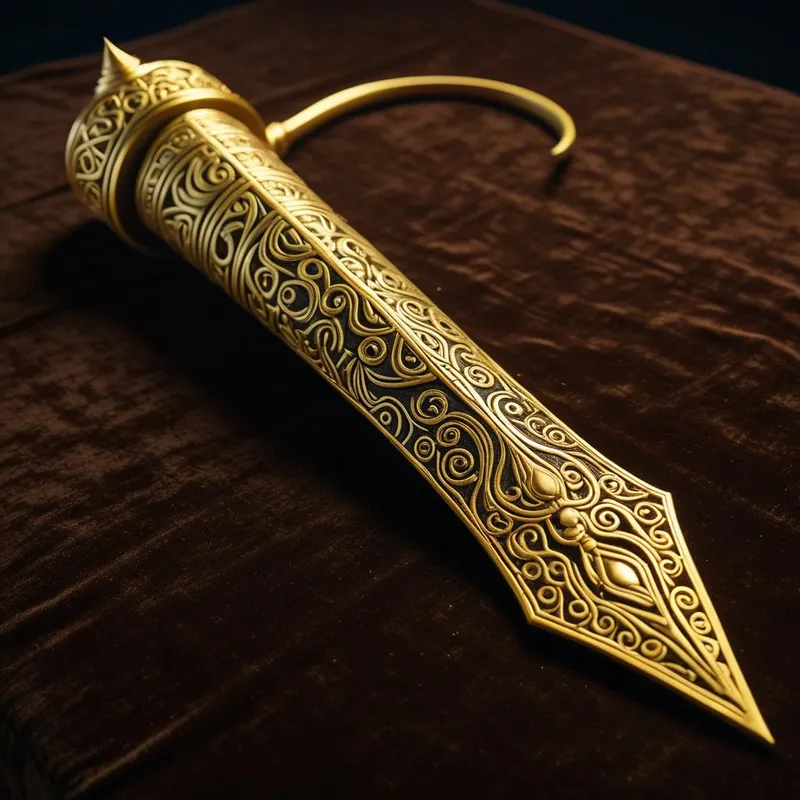
The goad (ankusha) Ganesha often holds is the tool of this mastery. It is not a weapon of punishment, but an instrument of subtle guidance—a nudge to keep the mind-vehicle on the path.
The Dreamer's Resonance
When this myth stirs in the modern unconscious, it often surfaces in dreams of paradoxical scale and restrained power. You may dream of a tiny, frantic animal—a mouse, an insect, a scurrying lizard—that somehow holds you paralyzed with fear, or that is destroying something vital. Conversely, you may dream of feeling immense, yet burdened by something small and persistent you cannot shake off.
These dreams signal a somatic process of integration. The psyche is wrestling with a “mouse”—a gnawing anxiety, a compulsive thought pattern, a “small” addiction or fear that feels disproportionately powerful. The body may respond with a sense of restless energy, a tightness in the chest (the feeling of being “ridden” by anxiety), or a compulsion to move without purpose.
The dream is presenting the raw material of the myth: the untamed, hungry, shadow aspect that feels like it controls you. The psychological process underway is the initial confrontation with this force. The ego (the dreamer) is experiencing its own powerlessness against the scurrying chaos of a mind or habit it has not yet learned to direct.
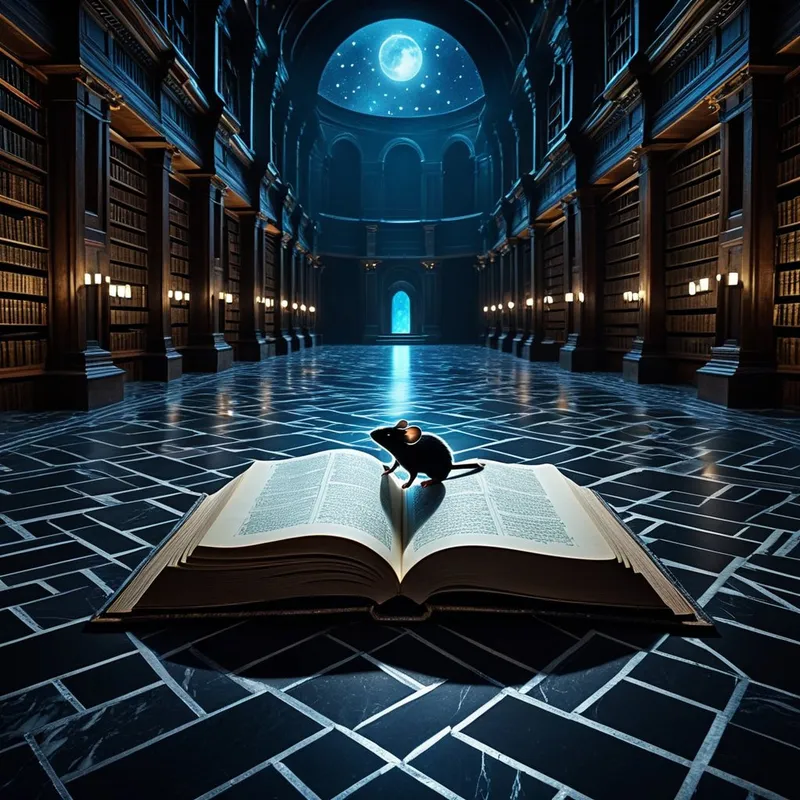
Alchemical Translation
The journey from cursed Gandharva to divine vahana is a precise map for individuation. It models psychic transmutation in three stages.
First, The Curse of Identification: We all have our “Gandharva” moments—where a part of us (pride, desire, fear) operates unchecked, leading to a “fall.” We become identified with a negative complex: “I am an anxious person,” “I am my greed.” This identification shrinks our vast potential into a single, hungry, destructive pattern—the monstrous mouse.
Second, The Divine Weight: This is the conscious intervention of the Self (the inner Ganesha). It is not an aggressive battle, but the application of mindful, compassionate awareness—the “foot” placed upon the frenzy. In practice, this is the moment we stop running from our anxiety and simply observe it. We feel its weight, its texture, without feeding it or fighting it. This conscious attention is the weight that stills.
Individuation is the process by which the elephant of the Self learns to ride the mouse of the mind, transforming aimless scurrying into purposeful pilgrimage.
Finally, Sacred Mounting: Integration. The energy is not discarded but repurposed. The anxious mind, once stilled by awareness, becomes keenly perceptive, able to “navigate tight spaces” of complex problems. The hunger for distraction becomes a guided hunger for knowledge. The mouse’s nature remains—it is still a creature of desire and movement—but it is now oriented by a higher intelligence. The individual no longer is their restlessness; they have a restless energy that serves their journey.
Thus, Ganesha’s mouse is not a quaint detail, but the heart of the teaching. It proclaims that enlightenment is not the absence of desire or thought, but the profound mastery where the largest wisdom finds its perfect vehicle in the smallest, most humble, and once-chaotic parts of our being. The obstacle, truly understood and mastered, becomes the very vehicle for its own removal.
Associated Symbols
Explore related symbols from the CaleaDream lexicon: