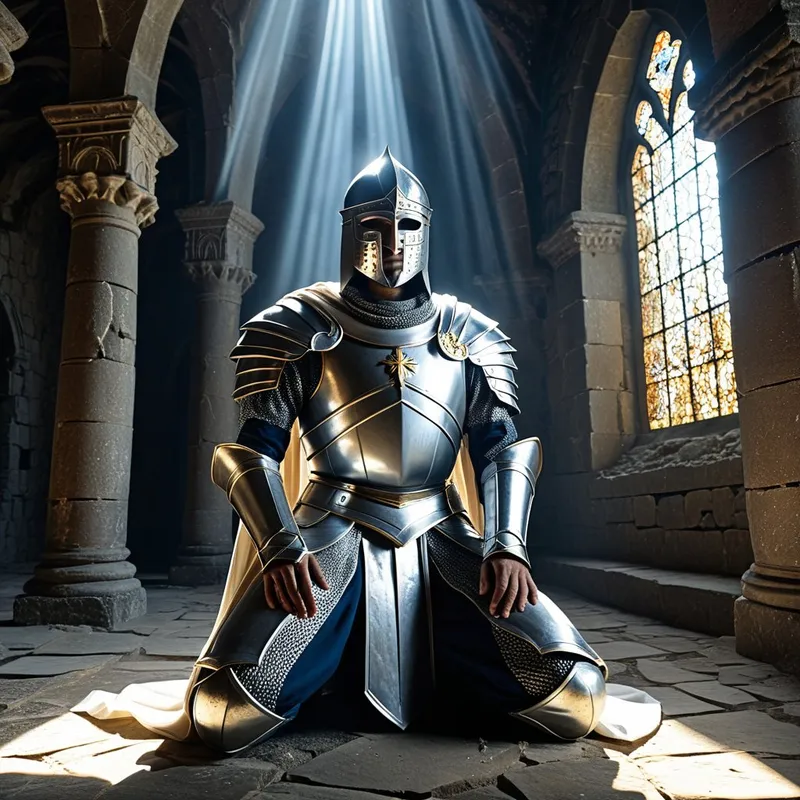
Galahad Myth Meaning & Symbolism
The story of the knight whose perfect purity allows him to achieve the Grail, a myth of ultimate spiritual attainment and its profound psychological cost.
The Tale of Galahad
Listen, and hear a tale not of might, but of light. In the twilight of Camelot, where glory was already tinged with shadow, a prophecy whispered through the stone halls: a knight would come, born of the purest and the fallen, who would achieve what all others could not. He would heal the Fisher King and behold the Holy Grail itself.
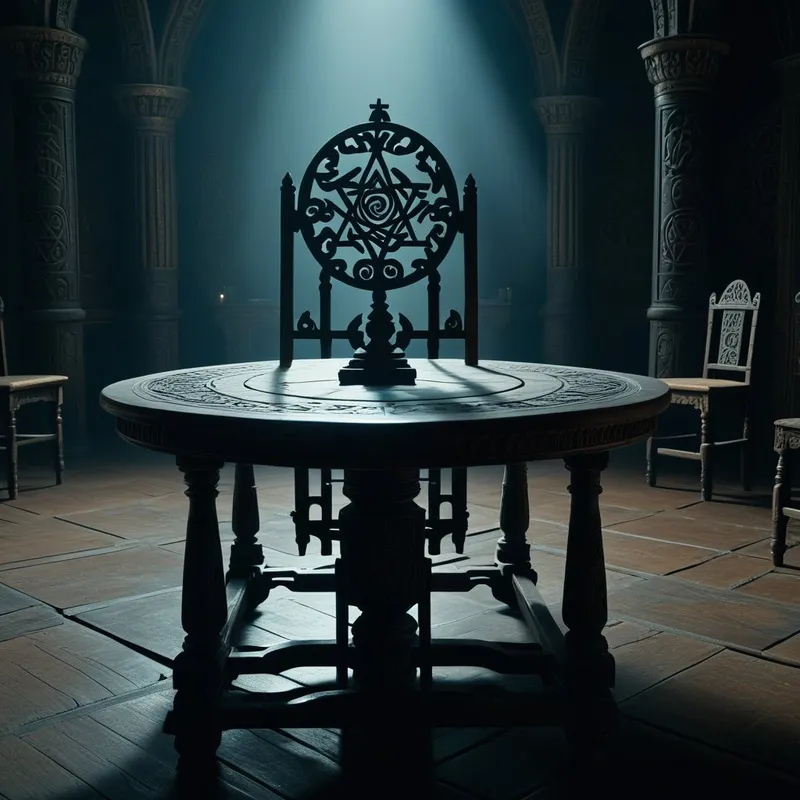
From a lineage of both sanctity and sin—son of the great Lancelot and the saintly Princess Elaine—the boy was named Galahad. He was raised not for war, but for a different kind of strength. When he came of age, he was brought to the great Round Table. There, a seat stood empty, carved with silver letters: The Siege Perilous. For years it had remained vacant, for any but the destined one who sat upon it would be consumed. Without a word, the young knight walked through the hushed assembly. The very stones of the hall seemed to hold their breath. He sat. The chair did not shudder; no fire consumed him. Instead, the letters upon it glowed with a soft, golden light, and his name appeared. A collective gasp, then a profound silence, deeper than any cheer.
Thus began the final, sacred quest. While other knights rode out seeking adventure or renown, Galahad moved with a quiet, unshakable purpose. He performed miracles not through force, but through presence. He healed the sick with a touch, calmed beasts with a glance, and his shield, bearing a crimson cross, turned aside blows as if by grace. He was joined by the noble Percival and the steadfast Bors, but his path was singular.
Their journey led them to the mystical castle of Corbenic. In a chamber that smelled of ancient incense and cold stone, the Grail appeared, veiled in a blinding, unbearable light. To Percival and Bors, it was a vision of profound mystery. But to Galahad, it was a homecoming. He approached the radiant vessel. From it, a hand of light extended, offering not wine, but a communion of pure spirit. He drank, and his human form seemed to become translucent, filled with the same celestial radiance.
His task was complete. The Fisher King was healed, the land began to green. But Galahad’s story did not end in Camelot’s hall. Guided to the faraway city of Sarras, he became its king for a single year. Then, kneeling in prayer, he beheld the Grail once more. He asked, in a voice both human and divine, to be released from this world. His request was granted. As his companions watched, his soul was seen to be borne away by angels, leaving behind not a corpse, but an empty shell that held the faint scent of sanctity. The Grail, its purpose fulfilled with his passing, ascended from the earth, never to be seen by mortal eyes again.
Cultural Origins & Context
The myth of Galahad is a late and deliberate creation within the Arthurian cycle, crystallizing in the early 13th century within the French Vulgate Cycle, specifically the Queste del Saint Graal. This was not a tale born from pagan Celtic soil, but one crafted in the heart of high medieval Christian monastic and chivalric culture. Its authors were likely Cistercian monks, who infused the popular chivalric romance with a rigorous, almost austere, spiritual theology.
The societal function of the Galahad narrative was twofold. For the knightly class, it presented an impossible, transcendent ideal—a model of chivalry divorced from earthly passion, political ambition, or martial pride, redirecting the warrior’s ethos toward a purely spiritual crusade. For the religious establishment, it was a powerful piece of narrative theology, co-opting the potent symbols of Celtic myth (the cauldron of plenty becomes the Grail) and Arthurian heroism to illustrate doctrines of grace, predestination, and the necessity of divine purity for salvation. Galahad is less a traditional folk hero and more a theological argument in the form of a man, passed down not by bards in mead halls, but by scribes in scriptoria, designed to inspire and admonish in equal measure.
Symbolic Architecture
Galahad represents the archetype of the perfect vessel. He is not a hero who struggles with and integrates his shadow; he is a hero who, by divine grace, is born without one. His symbolism is that of the sine macula—without stain.
The ultimate spiritual attainment is not a victory over darkness, but a state of being where darkness finds no purchase, a condition that renders the hero alien to the human world he redeems.
The Siege Perilous symbolizes the terrifying space reserved for wholeness in a world of fragmentation. It is the vacuum that demands perfection, the existential seat that annihilates the unworthy. The Grail itself, in Galahad’s context, transforms from a symbol of communal nourishment (the Celtic cauldron) into one of exclusive, ecstatic communion. It is grace made manifest, but a grace that requires absolute purity to receive. His ascension, rather than a return to Camelot, is the final, logical step: the perfectly pure vessel cannot remain in a corruptible world. He is the soul that achieves its purpose and is consequently dissolved back into the source, leaving no legacy but the echo of a miracle.

The Dreamer's Resonance
To dream of Galahad is to encounter the psyche’s own impossible standard. The dreamer may find themselves in a pristine, white room they feel unworthy to enter, or holding a perfect, glowing object that begins to dim at their touch. They may be tasked with a test of purity—crossing a bridge that only holds if their thoughts remain perfectly focused, or reading a text that blurs if they feel a flicker of doubt or desire.
Somatically, these dreams often carry a feeling of exquisite tension, a brittle stillness, or a chilling clarity. They speak to a psychological process of severe self-judgment, where the inner critic has been elevated to a divine tribunal. The dreamer is grappling with the "perfectibility complex," the crushing weight of an ideal self so lofty it denies the reality of the human shadow. The Galahad pattern in dreams points to a spiritual ambition that has become pathological, a quest for light so intense it threatens to burn away the necessary, grounding humus of human imperfection.

Alchemical Translation
The alchemical process modeled by Galahad is the sublimatio—the sublimation. It is the direct, vertical ascent of spirit, bypassing the messy nigredo (blackening) and albedo (whitening) stages of confronting and integrating the shadow. In psychological terms, it is a blueprint for transcendence without transformation.
For the modern individual, Galahad’s path warns that seeking to rise to the angelic without first acknowledging the animal is not individuation, but a form of spiritual bypassing that leaves the soul incomplete, if brilliantly lit.
The true alchemical challenge for us is not to become Galahad, but to undertake the quest of Percival or the loyal endurance of Bors. Galahad’s myth shows us the pinnacle, but it is a lonely peak where humanity cannot dwell. Our work is the coniunctio oppositorum—the conjunction of opposites. We must seat ourselves not in the Siege Perilous of perfect purity, but at the Round Table of our own conflicted, messy wholeness. We seek not to behold the Grail and ascend, but to find the Grail’s reflection in our own integrated being, and then, like Bors, return to the imperfect world to live within it, carrying a remembered glimpse of the divine. The myth of Galahad ultimately serves as a sublime, beautiful, and necessary reminder: the goal of the soul’s quest may be perfect light, but the path must, mercifully, wind through the fertile shadows of our shared human earth.
Associated Symbols
Explore related symbols from the CaleaDream lexicon: