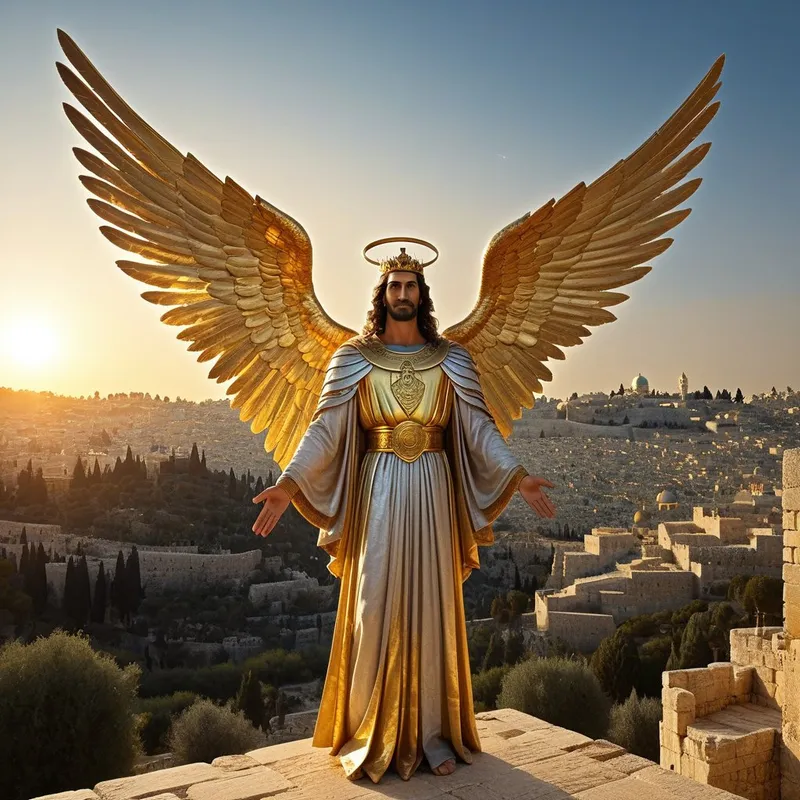
Gabriel Myth Meaning & Symbolism
The archangel Gabriel appears at history's hinge-points, delivering divine announcements that shatter old worlds and herald impossible, sacred beginnings.
The Tale of Gabriel
Listen. In the spaces between breaths, in the silence that follows a prayer and precedes an answer, there is a presence. It is not a place for mortal feet. It is the court of the Unseen King, a realm of living fire and perfect music, where will is deed and word is world. Here, among the seraphim and ophanim, stands one whose name means “Strength of God.” He is Gabriel.
His form is not for describing, but for witnessing: wings that are not feathers but architectures of light, a countenance that holds both the gentleness of dawn and the terror of the forge. He is a stillness within the eternal motion, a listener attuned to the one Voice. And when that Voice speaks a word that must pierce the veil of earth, it is Gabriel who turns.
He does not walk. The fabric of creation folds. A desert road, bleached white by a merciless sun. A priest, Zechariah, tending the sacred incense. The air, thick with myrrh and silence, suddenly crystallizes. Gabriel is there, beside the altar of gold. Zechariah’s heart seizes, a animal fear. The angel’s voice is not sound but a vibration in the marrow: “Do not be afraid. Your prayer is heard.” He speaks of a son, a prophet, a forerunner. Zechariah, bound by the logic of dust and barren years, stammers his doubt. The angel’s gaze, which had held galaxies, rests upon him. “You will be silent,” Gabriel declares, and the word is a seal upon the priest’s tongue. The promise is given, but the capacity for disbelief is taken. Gabriel is gone, leaving only the scent of ozone and a man struck mute, cradling an impossible future.
Time bends again. Not to a temple, but to a simple room in Nazareth. The light is ordinary, the dust motes dance in a sunbeam. A young woman named Mary is at her prayers, or her weaving—the stories differ on the chore, but never on the essence: a soul in quiet readiness. Then, the light in the room changes. It does not brighten; it deepens, becomes substantial. And he is there. Not in thunder, but in a presence that fills the space without displacing the air.
“Greetings, favored one. The Lord is with you.”
Mary is troubled, not by a monster, but by the sheer weight of the address. Gabriel’s voice softens, becomes a river of assurance. “Do not be afraid, Mary.” He unfolds the impossible: a child, conceived not by man but by the Holy Spirit, a child who will be called Son of the Most High. He speaks of a throne, of a kingdom without end.
Mary, in her profound humility, asks not for proof, but for process. “How can this be?” It is a question of wonder, not doubt. And Gabriel, the messenger of strength, offers not a punishment of silence, but an explanation that stretches the limits of understanding. “The Holy Spirit will come upon you… For no word from God will ever fail.” He offers a sign: her aged kinswoman Elizabeth is also with child. The final words hang in the sanctified air: “For with God nothing will be impossible.”
And Mary, in an act of courage that echoes through eternity, breathes her answer into the space between them: “Let it be to me according to your word.” The annunciation is complete. The hinge of history turns on a young woman’s fiat. Gabriel, his task accomplished, departs from her. The ordinary light returns to the room, but nothing within it will ever be ordinary again.
Cultural Origins & Context
The figure of Gabriel emerges from the rich tapestry of Second Temple Judaism, a period of intense theological reflection and apocalyptic expectation. While angels populate the Hebrew Bible, Gabriel is named explicitly only in the later, exilic, and post-exilic writings: the Book of Daniel. Here, he is not a generic messenger but an interpreter of terrifying visions, one who “flies swiftly” to bring understanding of empires and end times. He is a creature of the apocalyptic imagination, bridging the chasm between the ineffable divine plan and the bewildered human prophet.
By the first century, in the cultural milieu that birthed the Christian texts, angelology had become more elaborate. Gabriel’s role crystallizes in the Gospel of Luke, which draws upon this apocalyptic tradition but transposes it into a deeply intimate, historical key. The annunciations to Zechariah and Mary are not public spectacles but private, world-shattering encounters. The myth was passed down orally within early Christian communities before being codified in scripture, functioning as sacred backstory—the divine prelude to the stories of John the Baptist and Jesus. It served to anchor these figures in a cosmic narrative, asserting their births were not accidents but eruptions of the divine will into linear time, delivered by heaven’s premier herald.
Symbolic Architecture
Gabriel is the archetype of the Annunciating Principle. He is not the source of the message, but its perfect, terrifying, and beautiful vessel. He represents the moment the unconscious, the transpersonal, or the divine breaks into the conscious, personal sphere. His appearances are never casual; they are tectonic.
The annunciation is not an invitation to debate; it is the arrival of a new fact within the soul’s geography. The old world is already gone; the only choice is how one meets the new.
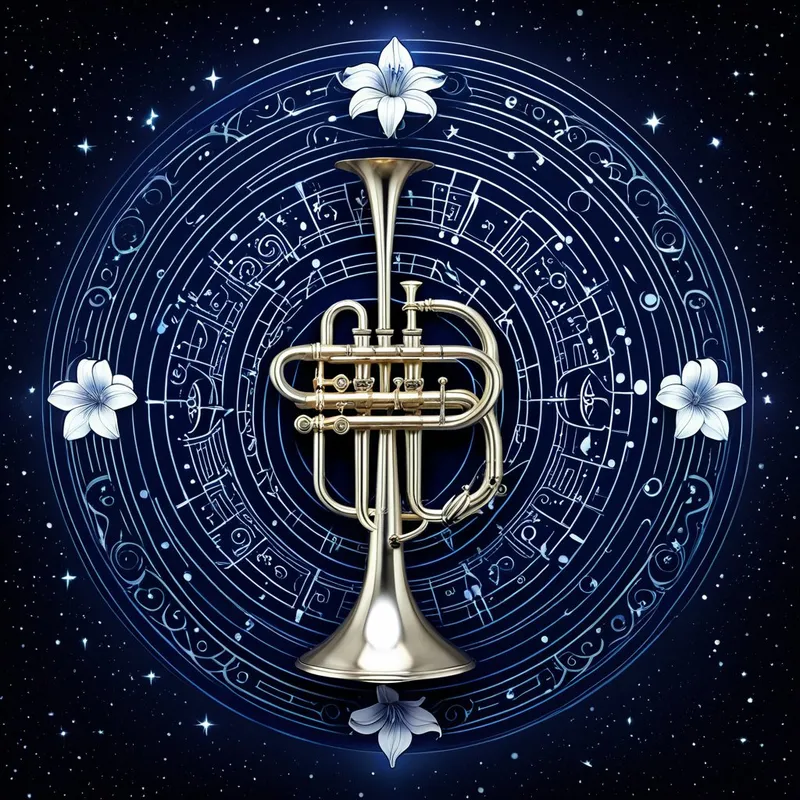
His traditional attributes are a lexicon of this symbolic function. The trumpet is the sound that shatters complacency, the call that cannot be ignored. The lily (often shown in Marian annunciations) symbolizes the purity of reception, the untainted vessel necessary for a sacred birth. The scroll or book contains the logos, the formative word that will become flesh. Gabriel’s greeting, “Do not be afraid,” is perhaps the most profound element. It acknowledges that contact with the numinous, with one’s own deepest destiny, is inherently terrifying. It scours away the trivial. The fear is not pathological; it is the sane reaction of the ego to its own imminent expansion or overthrow.
Psychologically, Gabriel symbolizes the autonomous complex of revelation. He arrives unsummoned, bearing content that reorganizes the psyche’s entire orientation. He is the personification of the “aha!” moment, but on a cosmic scale—the insight that reorders a life.
The Dreamer's Resonance
To dream of a Gabriel-figure is to experience the psyche in a state of profound reception. The dream setting is often liminal: a threshold, a empty room suddenly filled with light, a landscape where the air itself seems to vibrate. The messenger may not appear as an angel, but as a mysterious stranger, a voice on the wind, a phone call with an impossible message, or even a radiant animal. The core somatic experience is one of arrest. The dream-ego is stopped, frozen in a moment of awe-filled attention.
This dream signals that the unconscious is preparing to deliver a seminal piece of information—a calling, a diagnosis of the soul’s condition, a revelation about one’s true direction or creative potential. The accompanying fear is not of an external threat, but of the impending death of an old self, an old way of being. The dream is the psyche’s way of administering the shock treatment necessary for transformation, softening the ego’s resistance by presenting the annunciation in symbolic form. The emotional tone upon waking—whether terror, exhilaration, or solemn peace—indicates the dreamer’s readiness to accept or integrate the coming change.

Alchemical Translation
The myth of Gabriel models the alchemical stage of mortificatio and conceptio—the death of the old psychic substance and the impregnation with the new. The conscious personality (Zechariah, Mary) is going about its opus (the temple service, the daily life) when the spiritus (Gabriel) descends. The first operation is always the nigredo, the blackening: the terror, the doubt, the silencing of the old, chattering mind (Zechariah’s muteness).
The ego must be humbled, its certainties dissolved, to create the vas hermeticum—the sealed vessel—capable of containing the divine child, the nascent Self.
Mary’s response, “How can this be?” represents the crucial albedo, the whitening. It is not a rejection, but a seeking of understanding from within the mystery itself. Her final fiat is the rubedo, the reddening: the full-bodied, conscious assent of the ego to serve the purposes of the greater Self. This is individuation in its most sacred form: not self-aggrandizement, but self-surrender to one’s own deepest, most transpersonal destiny.
For the modern individual, the “Gabriel moment” arrives when life, synchronicity, or inner voice delivers a message that demands a complete reorientation—a career change, the end of a relationship, the birth of a child, the summons to create. The struggle is not to conjure the message, but to create the inner silence to hear it, and the courage, like Mary, to say “Yes” to the impossible thing that is, paradoxically, one’s own most authentic life. Gabriel is the mythic proof that such moments are not interruptions of our path, but its very definition.
Associated Symbols
Explore related symbols from the CaleaDream lexicon: