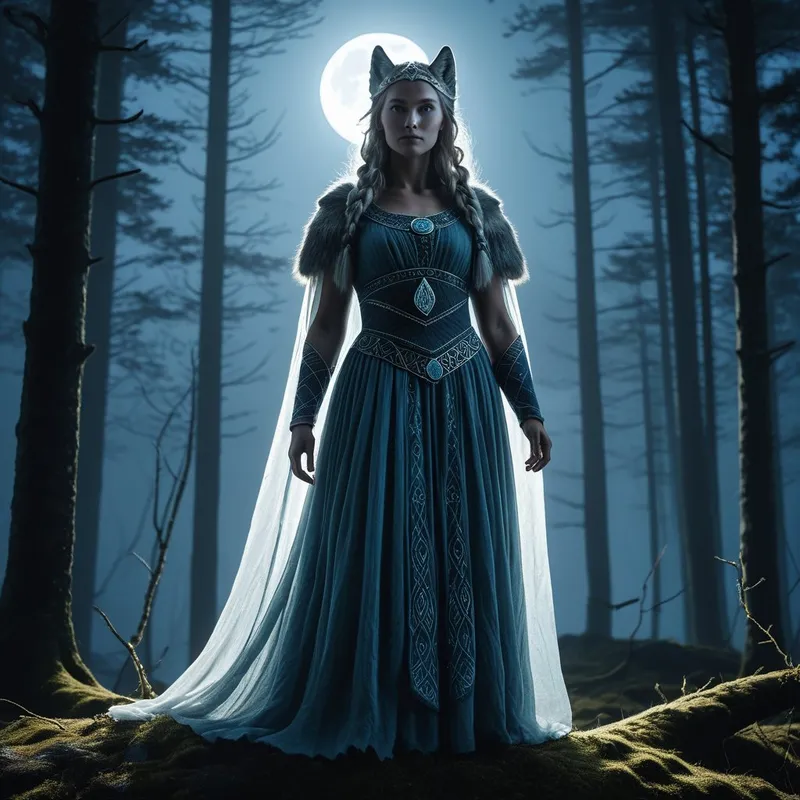
Fylgja Myth Meaning & Symbolism
A profound Norse concept of a spiritual companion, a fetch or follower, that embodies one's fate, fortune, and essential nature.
The Tale of Fylgja
Hear now a truth whispered on the wind that cuts through the fjords, a knowledge not carved on runestones but felt in the marrow. It is the tale of the One Who Follows.
In the deep of a winter’s night, when the Æsir sleep and the Jötnar breathe frost upon the world, a man named Bjorn lay dreaming. He was a warrior of renown, his arms strong, his heart fierce, yet a hollow wind sang through his spirit. He journeyed home across the high, lonely fells, the snow swallowing all sound but the crunch of his own boots and the ragged draw of his own breath.
The world was a monochrome of white and shadow, the sky a lid of iron-grey. As dusk bled into the absolute dark of the north, a feeling crept upon him—a sensation of being watched not from without, but from within the very landscape. It was a pressure at the nape of his neck, a second rhythm beneath his heartbeat. He saw no one. Yet, when he halted, ears straining, he heard the soft, sure pad of a great weight in the snow behind him. He spun, axe raised, to meet only his own trail and the silent, watching pines.
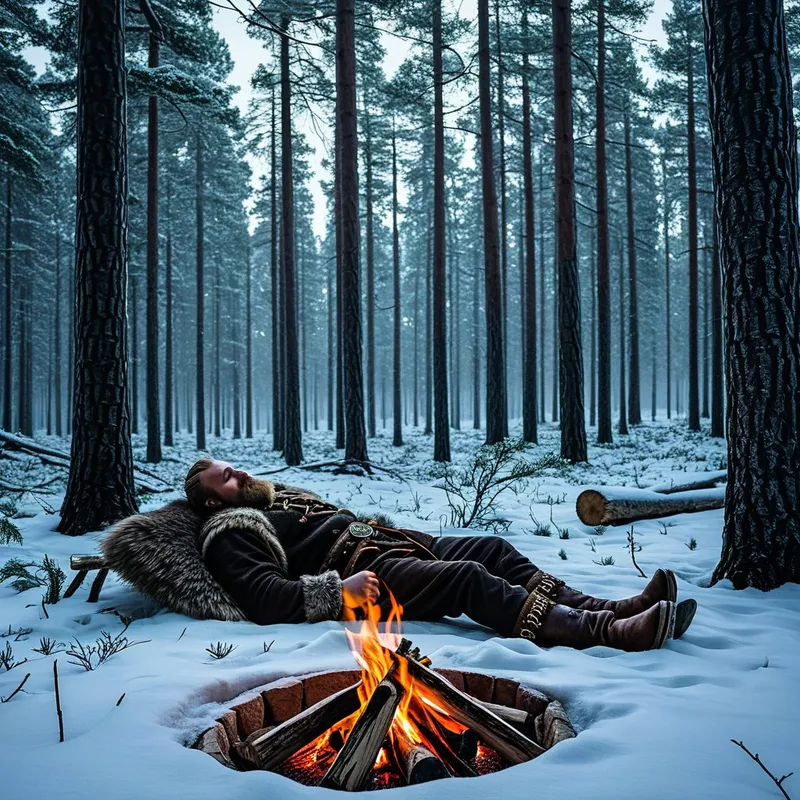
That night, as he kindled a meager fire in the lee of a granite outcrop, sleep took him like a thief. And he dreamed. Not of feasts or battles, but of a presence. He stood in a forest of silver birch, and before him was a she-bear of immense size, her fur the colour of aged amber and shadow. Her eyes were not the eyes of a beast, but pools of ancient, knowing stillness. She did not threaten; she simply was, as fundamental as the mountain. She turned and walked into the trees, and Bjorn, compelled by a longing deeper than fear, followed.
He followed her through root-tangled paths and across streams of black water. He followed until the dream-forest melted, and he awoke with a start, the fire embers dying. The feeling was stronger now. The follower was no longer behind—it was beside him, a warmth in the chill, a solidity in the void. He did not see her, but he knew her shape, her breath, her intent. She was his shadow cast by a hidden moon.
Days passed. The feeling became companionship. In a skirmish with mountain bandits, a fury descended upon him, a clarity of strength that was not his own. He moved with a ponderous, irresistible force, his defense an unbreakable wall, his strikes like falling stone. His foes fled from the man who seemed not to fight alone. In a blizzard that stole all sight, a certainty in his gut pulled him unerringly toward a scent of smoke and safety he could not physically smell.
He understood then. The follower was not separate. The she-bear in the dream, the presence on the fell—it was his own fortune walking, his own hidden nature made manifest. His Fylgja had shown herself. To see her fully was to stare into the mirror of one’s soul and to know one’s fate woven into its gaze. He was no longer just Bjorn the warrior. He was Bjorn-and-his-Fylgja, a whole being, walking with his destiny embodied at his shoulder.
Cultural Origins & Context
The concept of the Fylgja (plural: fylgjur) is not a single myth with a plot, but a pervasive and deeply personal strand of belief woven into the Old Norse worldview. These narratives lived in the hearth-smoke of the longhouse, in the sagas told during the long dark, and in the unspoken understandings between kin. They were passed down not as sacred doctrine, but as experiential truth—the kind explained by a grandmother to a child who spoke of a strange dream, or by a veteran warrior recounting the uncanny luck that attended a comrade in battle.
The Fylgja was an attendant spirit, a fetch, a part of the soul-complex that existed outside the individual yet was intrinsically tied to their fortune and character. It could appear in dreams or visions, often as an animal (a fylgja in animal form was a fylgjukona or fylgjudyr), or as a woman of striking, sometimes foreboding, appearance. Its arrival, especially if seen awake, was a potent omen, frequently presaging major life events—birth, death, or a turning of fate. The Fylgja belonged to the realm of ørlög, the inescapable web of destiny. It did not command, but revealed. It was the shape of one’s luck and the embodiment of one’s innate nature.
Symbolic Architecture
Psychologically, the Fylgja represents the autonomous, guiding intelligence of the unconscious. It is the part of the psyche that knows our trajectory before our conscious ego has plotted the course.
The Fylgja is the self that walks ahead, the blueprint of the soul that the conscious personality must spend a lifetime discovering.
The animal form speaks to our instinctual core, our untamed nature that holds wisdom beyond language. A bear Fylgja might signify immense strength, solitude, and healing (hibernation); a wolf, fierce loyalty, strategic intelligence, and connection to the pack; a falcon, far-seeing vision and decisive action. The female form connects to the anima (in men) or the Self (in women), representing the soul-guide, the connective tissue to the deep feminine mysteries of fate and intuition.
The critical drama of the Fylgja myth is the moment of recognition and integration. To encounter it is to be confronted with one’s own essence. The “follower” is, paradoxically, the leader. The ego’s journey is to turn and acknowledge this internal other, to follow it.
The Dreamer's Resonance
When this pattern stirs in the modern dreamer, it signals a profound somatic and psychological process: the emergence of the guiding Self from the depths of the unconscious. It is often a time of fateful crossroads or deep inner questioning.
You may dream of a specific animal that feels profoundly significant, not as a pet, but as a sovereign presence—a guide through a dream landscape. You might dream of a mysterious figure, often at the periphery of the dream, whose gaze holds immense meaning. The somatic experience is one of recognition—a deep, bodily “knowing” that bypasses logic. There may be feelings of awe, dread, or profound comfort. This is the psyche’s way of presenting the Fylgja, your internal compass, as it becomes active. The process is one of aligning your conscious life with this deeper current. Ignoring it can feel like walking against a powerful tide; acknowledging it brings a sense of being carried, of your actions having a weight and truth they lacked before.
Alchemical Translation
The alchemical work modeled by the Fylgja is the coniunctio, the sacred marriage, between the conscious ego and the autonomous spirit of the unconscious. It is the core of individuation.
The initial state is the lonely journey of the ego (Bjorn on the fell), aware of a lack, sensing an unseen companion. The confrontation is the dream-vision, the nigredo where the hidden content surfaces in its raw, symbolic form. The integration is the waking realization and the changed mode of being—no longer fighting alone, but moving with the strength of the integrated instinct.
To know your Fylgja is to stop searching for your destiny and to start embodying it. The quest becomes a following.
For the modern individual, this translates to deep self-observation. What patterns, instincts, or “lucky” intuitions have followed you throughout life? What animal or figure symbolizes your deepest strengths? The alchemical translation is the conscious cultivation of a relationship with this inner guide. It is listening to the gut feeling, honoring the recurring dream symbol, and having the courage to follow the path that feels fated, even when it defies conventional logic. The Fylgja does not promise ease, but authenticity. It leads you not to safety, but to the battle or the blizzard that is uniquely yours, gifting you the innate resources to meet it. You are tasked with building a hearth within, where both the warrior and the she-bear are welcome, and from whose fire your true fortune is forged.
Associated Symbols
Explore related symbols from the CaleaDream lexicon: