Frigg's Distaff Myth Meaning & Symbolism
The myth of Frigg's Distaff weaves the clouds and fate, a story of divine craft, cosmic order, and the hidden power of creation.
The Tale of Frigg's Distaff
Listen, and hear the whisper of the clouds. In the high halls of Asgard, where the roots of the Yggdrasil drink from deep wells, there sits a queen whose silence holds the weight of knowing. Her name is Frigg, All-Mother, and her home is Fensalir. It is a place of still waters and deep thought, where the air is thick with the scent of wet earth and loom-oil.
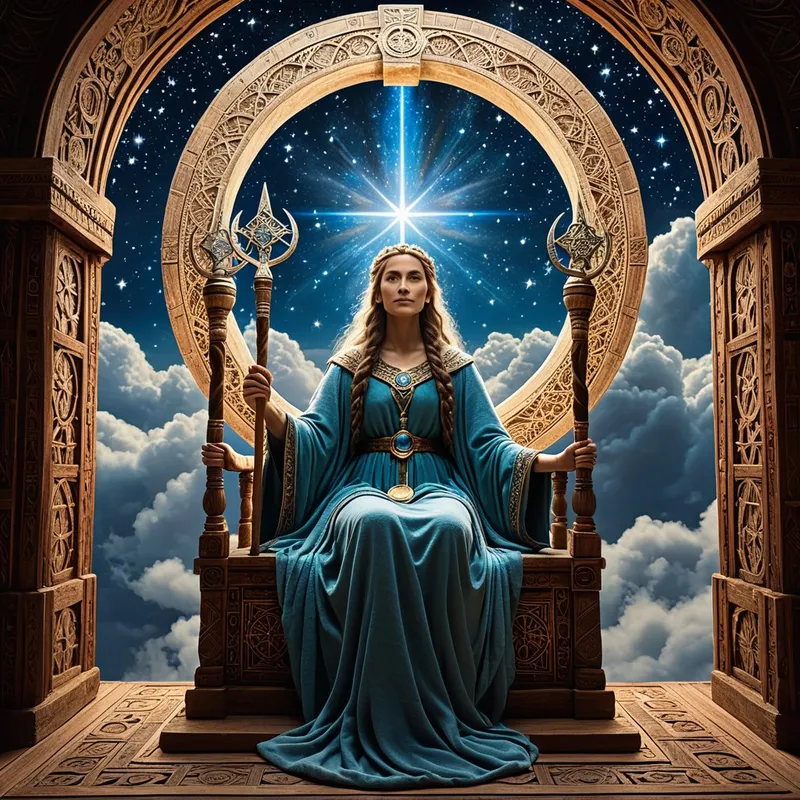
Before the sun’s chariot is loosed, before the cocks of the worlds crow, Frigg rises. She does not go to the bustling courts or the feasting tables. She climbs to her high seat, Hlidskjalf, a throne of observation and quiet power. In her hands, she does not hold a sword or a scepter. She holds her distaff.
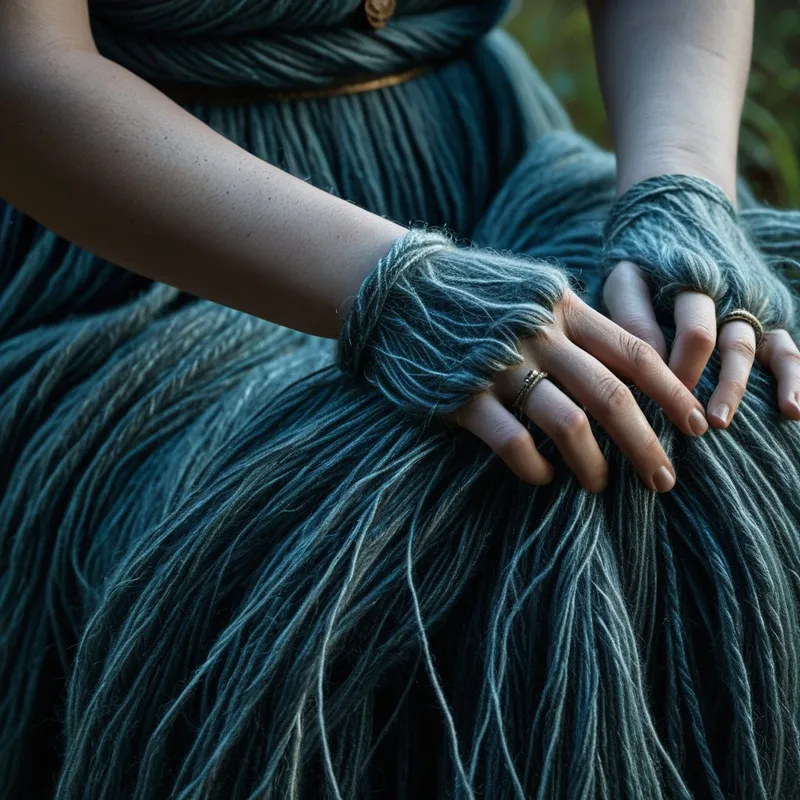
It is no common tool. This distaff is of silver and ancient ash, tall as a spear, and upon it is wound a fleece not of this earth—a cloud-wool, raw and unformed, spun from the breath of the giants and the sighs of the sea. With a spindle of polished bone, she begins her work. Her fingers, which have stroked the hair of her son Baldr and woven the fates of kings, move with a rhythm older than the gods themselves.
She draws the thread. It is not linen or wool, but the very stuff of the sky. As she spins, the unformed mist upon her distaff becomes the high, thin cirrus, the soft blanket of stratus, the towering, anvil-headed cumulus. Each pull of her hand, each twist of the spindle, lays another cloud upon the dome of the world. This is her daily craft: to clothe the naked sky, to give form to the formless air. It is said that when she works with particular care, the clouds arrange themselves into patterns that wise women below can read, seeing omens of weather, of fortune, of the subtle shifts in the web of ørlög.
Yet her work is a bulwark, a sacred ordering. For in the churning void of Ginnungagap, there is always the pull back to chaos, to the unmade and the unshaped. Frigg’s distaff is a axis mundi, a pillar that holds the chaotic potential at bay, transforming it, thread by patient thread, into a tapestry of habitable order. She weaves the very atmosphere in which life breathes. And when she sets her tool aside, resting in the knowledge of a sky properly arrayed, the clouds themselves drift in the patterns of her silent, sovereign will—a testament to the power that creates not with a shout, but with a spin.
Cultural Origins & Context
The image of Frigg with her distaff is not the center of a grand, surviving epic, but a luminous fragment. It comes to us from the Eddas and later folk tradition, often in kennings—poetic circumlocutions—where clouds are called “Frigg’s distaff” or “Frigg’s wool.” This tells us the myth was deeply embedded in the poetic and perceptual world of the Norse.
This was not a priestly myth, but a domestic and cosmic one. It would have been told by women at the loom, by farmers reading the weather, by skalds seeking the beautiful, hidden connection between hearth and heaven. Its societal function was twofold. First, it sacralized the daily, essential, and traditionally feminine labor of spinning and weaving, elevating it to a cosmic principle. The woman at her hearth, creating cloth from raw fleece, was mirrored by the All-Mother in her hall, creating the sky from primal mist. Second, it provided a model of sovereignty that was not based on conquest, but on craft—on the patient, skillful imposition of order onto chaos. Frigg’s power is quiet, pervasive, and fundamentally creative. She manages the fabric of reality itself, a role as crucial as Odin’s quest for wisdom or Thor’s defense of the walls.
Symbolic Architecture
At its core, the distaff is an instrument of differentiation. It takes the undifferentiated mass—the cloud-wool, the chaotic potential—and draws from it a single, coherent thread. This is the primal act of consciousness.
The distaff is the axis of the world turned to a domestic purpose; it is the spine upon which the formless is given a direction.
The spindle represents the turning of time and fate. As it spins, it twists the thread, making it strong, giving it purpose. The clouds are the manifest result—the visible, tangible reality born from unconscious potential. They are not solid, permanent things, but ever-changing, beautiful, and functional manifestations of the work. Psychologically, Frigg represents the ordering principle of the psyche. She is not the wild inspiration (that is more the domain of Odin or the Norns), but the faculty that takes raw inspiration, emotion, or psychic material and patiently, skillfully, gives it a usable form. She is the ego-function that mediates between the chaotic unconscious and the need for a structured, livable inner world.
The Dreamer's Resonance
To dream of a distaff, a spindle, or of spinning clouds is to dream of this Frigg-principle awakening within. It often surfaces when the dreamer’s inner world feels chaotic, foggy, or without direction—a time of depression, confusion, or creative blockage.
The somatic sensation is often one of a gentle, insistent pull. There may be a feeling of weight in the hands, or a focus on breath (drawing the thread). The psychological process is one of gathering and defining. The unconscious is presenting raw material—the cloud-wool—in the form of powerful emotions, half-formed ideas, or fragmented memories. The dream is an enactment of the psyche’s innate drive to take that material and begin to spin it into a thread of narrative, understanding, or intention. If the thread breaks or the wool is tangled, it speaks to resistance or a lack of the necessary skill or patience for this inner work. The dream calls for a return to basics, to the slow, rhythmic, hands-on process of making sense of oneself.
Alchemical Translation
The alchemical process mirrored here is coagulatio—the making solid, the bringing down to earth. In the journey of individuation, we are constantly inundated with the prima materia of the unconscious: fantasies, shadows, complexes. The modern temptation is to either be overwhelmed by this chaos (drowning in the fog) or to reject it entirely (a barren, clear sky with no life-giving rain).
Frigg’s Distaff presents the third way: the alchemical translation. The chaotic psychic content (the cloud-wool) is not denied, but engaged. It is taken up onto the distaff—accepted and held in awareness. Then, through the conscious, disciplined, daily work of reflection, journaling, therapy, or artistic practice (the spinning), it is transformed. It is given a thread, a continuity. It becomes part of the evolving tapestry of the self.
The goal is not to spin the entire void, but to trust that each day’s conscious work adds another thread to the sky of your being, making it a habitable, weather-rich, and beautiful domain.
The triumph is not a dramatic slaying, but a quiet, sovereign achievement: a self that is not a rigid structure, but a living, breathing, ever-changing creation. You become the weaver of your own atmosphere, the spinner of your own fate, learning that true power lies not in controlling the storm, but in knowing how to spin the very clouds from which it is born.
Associated Symbols
Explore related symbols from the CaleaDream lexicon: