Freyr Myth Meaning & Symbolism
A god of sunshine and plenty sacrifices his sword for love, securing a future but leaving himself vulnerable to the coming darkness.
The Tale of Freyr
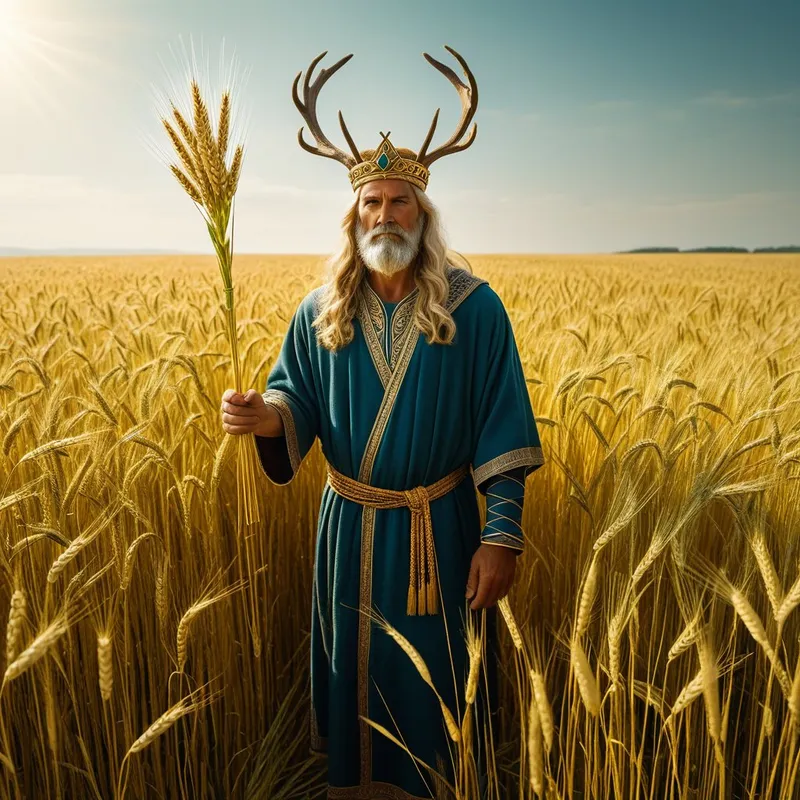
Hear now of Freyr, the lord of Álfheimr, he who commands the sunshine and the gentle rains. His is the face that smiles upon the first green shoots piercing the thawing earth, the hand that fills the barley heads with gold. He rides the boar Gullinbursti, whose bristles shine like the dawn, and his ship, Skíðblaðnir, finds fair wind even when the seas are still. He was content, a god of peace and abundance, until the day he ascended the high seat of Odin.
From that lofty throne, he gazed out across all the worlds. His sight traveled over Midgard, over the frothing seas, and into the mist-shrouded realm of the Jötnar. There, in a courtyard of grey stone, he saw her. Gerðr. The sight struck him like a physical blow. The sunlight seemed to dim around him; the very song of growth in his fields fell silent. Her hair was like a frozen waterfall caught in moonlight, her arms pale as the birch, and a fierce, untamed spirit burned in her gaze. In that moment, the god of plentiful harvest knew a want so profound it felt like famine.
He fell into a silence that worried all of Asgard. His light dimmed. The god who was summer itself began to wither with longing. Seeing his lord's torment, Skírnir stepped forward. "Give me your horse that fears no magic fire, and give me your sword," he said. "The sword that fights of its own accord if the wielder is wise. I will go to Jötunheimr and win her for you."
A shadow crossed Freyr's face. The sword was his might, his defense in the final battle all knew was fated. Yet, he looked inward at the desolation Gerðr's absence caused, a winter in his soul. He handed the sword to Skírnir. "With this, you will succeed. But without it…" He did not finish the thought.
Skírnir rode through worlds, to Gymir's high-walled hall. He offered Gerðr treasures: eleven golden apples of immortal youth, the ring Draupnir. She refused. He threatened her with the edge of Freyr's own sword. She was unmoved. Finally, Skírnir carved runes of terrible coercion onto a whalebone wand. He sang a curse of unending longing and desolation, a life frozen in eternal, joyless isolation, should she refuse Freyr. Confronted with this magical doom, Gerðr's resistance broke. She agreed to meet Freyr in the sacred grove of Barrí, nine nights hence.
When Skírnir returned with the news, summer returned to Freyr's face. But the servant held out the empty scabbard. The sword was given as a gift to Gymir, a bride-price, a token of peace and a sacrifice of war. For nine nights, Freyr waited, and the poetic verse says: "Long is one night, long are two; how shall I bear three? Often a month to me seemed less than this half of a bridal eve." The god of patience learned the agony of time.
In Barrí, they met. Gerðr, no longer under threat but bound by fate and perhaps a spark of curiosity for the god who had upended worlds for her, came to him. He, who had traded his surety for his desire, took her hand. Their union was the reconciliation of fertile earth and frozen mountain, of sunshine and stored potential. But as they walked from the grove, a cold wind blew from the north. Freyr, unarmed, felt it keenly. He had secured his heart's desire, but the shadow of Ragnarök grew longer. He had bought love with the very metal meant to defend the future.

Cultural Origins & Context
The myth of Freyr and Gerðr is preserved primarily in the Skírnismál (The Lay of Skírnir), found in the 13th-century Poetic Edda, and referenced in the Prose Edda. Freyr, originally of the Vanir, was a central deity in the Norse world, not as a distant sky-father but as an immanent, earthly power. His worship was deeply tied to agrarian cycles, kingship, and societal well-being.
This story was not mere entertainment. It was a sacred narrative performed, likely at seasonal festivals or royal inaugurations, linking the fertility of the land to the rightful, prosperous rule of the chieftain (an earthly reflection of Freyr). The myth models a critical social and cosmic contract: abundance and peace (Freyr's domain) require negotiation, exchange, and often a costly sacrifice (the sword) with the wild, untamed, and potentially hostile forces of the world (the Jötnar). The successful union ensures continued fertility, but the cost is acknowledged—security is compromised for the sake of generative life.
Symbolic Architecture
At its heart, this is a myth of the individuation imperative, where a conscious identity must engage with its profound, often "other," counterpart to achieve completion.
The god of the cultivated field must court the maiden of the untamed mountain. Wholeness demands a dialogue between the persona and the anima, between the tamed and the wild within.
Freyr represents the conscious ego in its state of prosperous, sunny stability. Gerðr is the anima, the soul-image, residing in the frozen, distant land of the unconscious (Jötunheimr). His longing is the psyche's call toward integration. Skírnir, whose name may relate to "shining one," is the mediating function—the intuition or will that ventures into the unconscious on the ego's behalf.
The sword is the critical symbol. It is Freyr's discriminating intellect, his capacity for decisive action, his psychological defense, and his link to his warrior fate. To win the anima, he must give it up. This is not a defeat but a necessary sacrifice.
One cannot approach the depths armed for battle. The sword of judgment and separation must be laid down to embrace the other. The price of connection is vulnerability.
The nine nights of waiting symbolize the gestational period of any profound psychological change—a necessary, agonizing incubation where the old state dies and the new union is prepared.
The Dreamer's Resonance
When this myth stirs in the modern dreamer, it often signals a pivotal moment of choice between security and desire, between defended autonomy and vulnerable connection.
You may dream of a potent, magical tool or weapon you must reluctantly give away to cross a threshold. You may find yourself in a lush, sunny place that suddenly feels empty, while a compelling figure stands frozen in a distant, wintery landscape, pulling your gaze. The somatic feeling is one of aching longing mixed with acute anxiety—a "winter in the soul" despite external summer. There is a profound sense of something missing that logic cannot fill.
This dream pattern indicates the psyche is ready to trade a well-honed but isolating strength (the independent, self-sufficient ego) for the risky promise of deeper relatedness, creativity, or soulful engagement (the anima/animus). The dreamer is in the "nine nights" phase, enduring the tension of anticipation and the fear of having made oneself defenseless.

Alchemical Translation
The alchemical process mirrored here is the Coniunctio Oppositorum—the sacred marriage of opposites. Freyr's journey is a map for psychic transmutation.
First, the Nigredo: The joyful god falls into melancholic despair upon seeing Gerðr. This is the initial blackening, the recognition of lack, the end of naive contentment. The conscious attitude is rendered insufficient.
Second, the negotiation: Skírnir's journey is the Albedo, the whitening or purification. He attempts bribery (the apples, the ring), then threat (the sword), before resorting to runic magic—the deep, symbolic language of the unconscious itself. This reflects the ego's attempts to integrate the unconscious: first through ego-inflation (buying it off), then through force (repression), and finally, only through submitting to the transformative power of the symbolic, archetypal realm.
The final, effective agent is not force or treasure, but a spell—a poetic, symbolic truth that reveals the deeper, more terrifying fate of remaining isolated.
The sacrifice of the sword is the ultimate act of the Rubedo, the reddening. The conscious mind surrenders its primary weapon of separation and analysis. It makes itself vulnerable. This is not weakness, but the supreme strength required for union. The sword given as a bride-price transforms from an instrument of division into a token of covenant, seeding the potential for new life from the very metal of old defenses.
For the modern individual, the myth asks: What is your "sword"? What formidable capacity for analysis, criticism, independence, or control are you clutching so tightly that it prevents a sacred union with your own deeper, wilder, creative, or relational nature? What future battle are you so busy preparing for that you are missing the present grove? Freyr teaches that the ultimate fertility—of life, love, and soul—is purchased not with what we gain, but with what we courageously, irrevocably give away.
Associated Symbols
Explore related symbols from the CaleaDream lexicon: