Freyja's Tears Myth Meaning & Symbolism
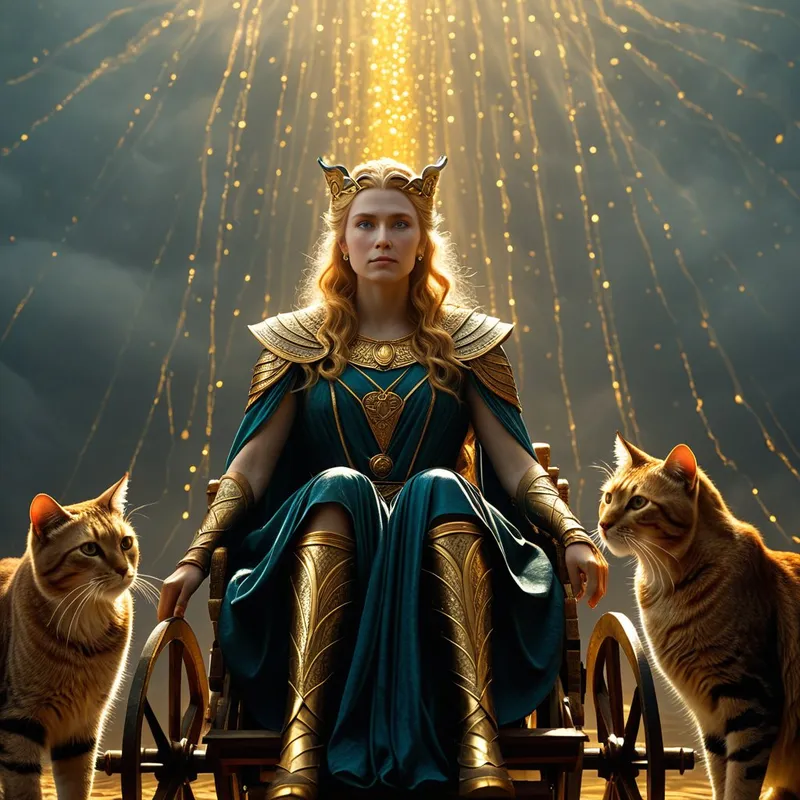
The goddess Freyja weeps tears of red gold for her lost husband, Óðr, a sorrow that becomes a sacred, generative force in the world.
The Tale of Freyja's Tears
Listen, and hear the tale of the golden sorrow.
In the high halls of Asgard, where the mead flows like rivers and the light is eternal, there lived a goddess whose beauty was a force of nature. She was Freyja, of the Vanir, she who chooses half the slain and wears the cloak of falcon feathers. But her heart belonged to one: her husband, Óðr. With him, her laughter shook the stars; in his presence, the very air of Fólkvangr was sweet. Yet Óðr was a wanderer, his spirit a restless flame that could not be contained. One day, as the long shadows of prophecy gathered, he kissed her brow, whispered a promise to the wind, and was gone.
The silence that followed was a living thing. Freyja’s chariot, drawn by her two great grey cats, stood still. Her famed necklace, Brisingamen, felt cold against her skin. She walked the rainbow bridge Bifröst until her feet ached, searching the horizons of Midgard. She descended into the roots of the world, to the dark, dripping halls of Hel, but he was not among the silent shades. She called his name into the howling winds of Jötunheimr, but only echoes answered.
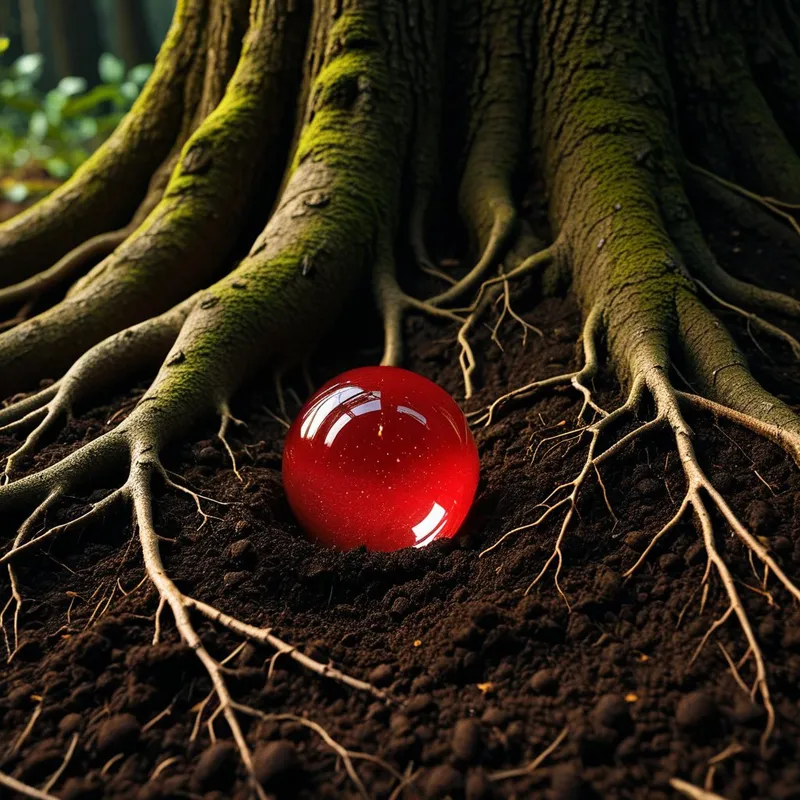
Then came the weeping. It did not begin as a storm, but as a slow, relentless seepage of the soul. She would sit upon her high seat, Hlidskjálf, gazing over all the worlds, and the longing would overwhelm her. The tears that fell were not of clear water. From her eyes, born of divine love and fathomless grief, came tears of pure, red gold. They traced paths of burnished fire down her cheeks, falling to the earth below. Where they landed on the soil of Midgard, they did not vanish. They hardened into nuggets and flakes of the most precious metal, sinking into riverbeds, catching in the roots of ancient oaks, glittering in the mountain streams—a scattered treasure born of a broken heart.
The gods whispered of her sorrow. The dwarves in their stone halls marveled at the new gold in the rivers. And Freyja wept on, a goddess defined not by her power or her beauty in that moment, but by the profound, generative truth of her loss. Her tears became a legend among mortals: the source of all gold, the physical proof that even a goddess’s heart can break, and that from such breaking, new wonders are born into the world.
Cultural Origins & Context
The fragments of Freyja’s story are preserved primarily in the Poetic Edda and the later Prose Edda of Snorri Sturluson. These texts, compiled in Christianized 13th-century Iceland, are our main windows into a much older, oral tradition. The myth of her tears is not a full, narrated saga but a poignant detail woven into her characterization, mentioned in poems like Hyndluljóð and Snorri’s descriptions.
This was a story told in the longhouses, by firelight, in a world where the sea could take a husband and the winter could steal a child. Freyja’s grief was not a weakness; it was a cosmic fact. In a culture that valued stoic endurance, her very public, fertile sorrow provided a divine template for human experience. It legitimized grief as a powerful, natural force. Her tears producing gold also tied her intimately to concepts of wealth, fortune, and the sometimes-painful fertility of the land itself. The myth functioned as an etiological tale (explaining the origin of gold) while simultaneously offering a deep psychological consolation: what is most precious often comes from what is most deeply felt and lost.
Symbolic Architecture
Freyja’s tears are a master symbol of alchemical paradox. They represent the sacred transformation of inner, subjective experience into outer, objective reality.
The most profound transmutations begin not in the fire of the forge, but in the saltwater of the soul.
Freyja herself embodies the union of opposites: love and war, beauty and battle magic, fertility and death (as chooser of the slain). Her tears for Óðr—whose name is etymologically linked to Óðinn and means ecstasy, fury, inspired mind—represent the longing of the embodied soul (Freyja) for its transcendent, animating spirit (Óðr). His absence is the condition for her creative sorrow. The red gold is the perfect symbol for this process: gold, the metal of the sun, kings, and immortality, tinged with red, the color of blood, life, passion, and mortality. It is divine substance filtered through a heart of flesh.
Psychologically, Freyja is the archetype of the Anima in its fullest expression—not just as an object of desire, but as a subject who desires, who feels profound connection and profound loss. Her tears are the Anima’s creative power, which can only be activated through the courageous acceptance of deep feeling.
The Dreamer's Resonance
When this myth stirs in the modern unconscious, it often manifests in dreams of searching, of precious loss, and of unexpected fertility. A dreamer might find themselves wandering endless, beautiful landscapes (the Nine Worlds) looking for a face they cannot quite see. They may dream of crying, only to discover their tears are pearls, crystals, or coins. They might dream of a cherished possession—a ring, a locket—that is lost, only to later find it transformed into something even more valuable but different.
Somatically, this can correlate with a tightness in the chest, a feeling of "golden" warmth amidst sadness, or a creative urge that arises directly from a period of mourning or longing. The psychological process is one of valuing the wound. The dream psyche is initiating a Freyja-process: it is taking a current, personal experience of loss, abandonment, or deep yearning and beginning the alchemical work of turning that raw, painful emotion into a source of inner wealth and creative power. The dream says, "This feeling is not worthless. It is the ore from which your gold will be smelted."
Alchemical Translation
The individuation journey modeled by Freyja’s Tears is not one of heroic conquest, but of sacred dissolution and recombination. It is the path of the Lover.
The first stage is the Acknowledgment of the Lack. Óðr departs. In our lives, this is the conscious experience of loss, longing, or the sense that a vital part of our spirit (ecstasy, inspiration, deep connection) is absent. We must, like Freyja, refuse to numb this pain. We must sit in Hlidskjálf and gaze squarely at the emptiness.
The second stage is the Weeping Itself—the solve (dissolution) of the alchemical process. This is the surrender to grief, to longing, to the full, unmediated feeling. It is not wallowing; it is the necessary liquefaction of a hardened psychic state. This is where modern individuals often falter, seeking to bypass the tears to get to the "gold." But the gold is the tears in their transformed state.
Individuation requires that we learn the art of weeping gold—of allowing our deepest vulnerabilities to become the substance of our strength.
The final stage is the Coagula—the coagulation of the golden tears into a new, enduring form within the world. This is the integration. The grief for a lost relationship transforms into a deeper capacity for compassion. The longing for a forgotten passion crystallizes into a new art form. The sense of spiritual abandonment becomes the fuel for a truly personal, inner search for meaning. The "red gold" is the new psychic substance—a self that has metabolized its deepest sorrow into a source of enduring value, resilience, and generative power. We become, in our own small way, a source of Freyja’s gold in the world.
Associated Symbols
Explore related symbols from the CaleaDream lexicon: