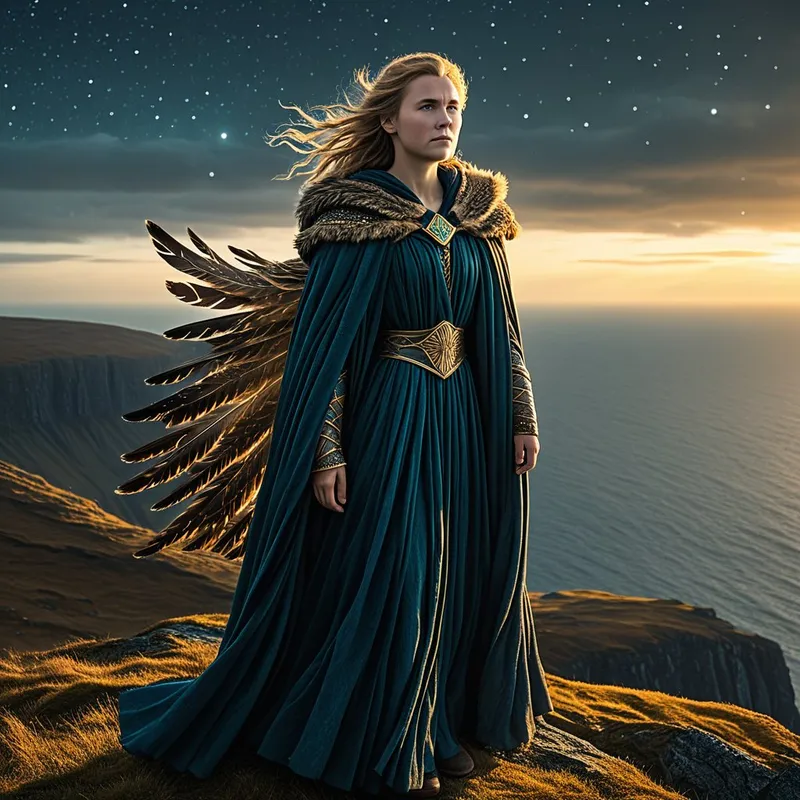
Freyja's Cloak Myth Meaning & Symbolism
The myth of the goddess Freyja's magical falcon cloak, a tale of desire, cunning, and the high price of retrieving what the heart truly longs for.
The Tale of Freyja's Cloak
Listen, and hear the whisper of feathers in the high, cold air. This is a tale not of thunder, but of longing; not of brute force, but of cunning desire. It begins with Freyja, she of the falcon-feathered cloak, whose tears are red gold and whose heart is a vast, unquiet sea.
In Fólkvangr, where she chooses half the slain, Freyja walked in a garden of twilight. But her spirit was restless. A hunger, sharp and gleaming, had taken root in her breast. It was a hunger for Brisingamen, a torque of such craftsmanship that its beauty was a song and its worth a kingdom. It lay in the smithy of four dwarven brothers, deep in the stone-veined earth, and its fire called to her.
She descended, leaving the scent of meadowsweet and blood behind, and entered their realm of soot and forge-light. The dwarves—Álfrigg, Dvalinn, Berlingr, and Grér—hammered at their masterpiece. They named their price: not gold, not silver, but a night with the goddess, each in turn. And Freyja, her eyes fixed on the necklace’s molten glow, agreed. For four nights, the earth held its breath. She paid the price and emerged, Brisingamen cold and perfect against her skin, its weight both a triumph and a secret.
But secrets in Yggdrasil’s branches are like ravens; they find a way to fly. The trickster Loki learned of it, and with a liar’s tongue, he carried the tale to Odin. The Allfather’s one eye burned with displeasure. A goddess had bartered herself? The order of things was threatened. He commanded Loki to steal the necklace back, to restore balance through theft.
Loki, in his element, slithered into Sessrúmnir as Freyja slept. She lay curled around her treasure, the room humming with her power. But she slept deeply, the weight of her desire a kind of exhaustion. Loki, in the form of a fly, pricked her cheek, and when she stirred, he stole the necklace from her throat and fled into the night.
Dawn found Freyja enraged, her hall shaking. She went to Odin, her fury a storm. He looked upon her, this goddess of contradictions, and laid his judgment: she could have her heart’s desire returned, but only if she performed a deed to match the scale of her longing. She must sow strife between two kings, mighty rulers who lived in peace. She must cloak their lands in war, so that the fallen would fill her hall. And to do this, she would need her most precious tool: her cloak of falcon feathers.
With a heart heavy as stone, Freyja agreed. She took the cloak from its chest. As she fastened it, the feathers became alive, stitching themselves to her spirit. She was no longer just a goddess; she was a thought, a purpose, a predator on the wind. She flew over the peaceful kingdoms, and where she passed, whispers of envy and visions of glory seeded the minds of men. Battle was joined. The earth drank blood. And from the chaos, Brisingamen was returned to her neck, now cold with a new understanding. The cloak was not just for flight, but for fulfilling the terrible, beautiful costs of desire.
Cultural Origins & Context
This myth survives primarily in the later Prose Edda of Snorri Sturluson, a Christian scholar recording a fading pagan worldview. It is a story told in the voice of the skalds, the poet-historians, who wove together divine drama and human psychology. Freyja, a deity of the Vanir, embodies forces both vital and terrifying to the Norse mind: erotic love, material wealth, magical prowess (seiðr), and the choosiness over the slain.
The tale functions as an etiological myth, explaining the origins of perpetual war—a grim reality of their world—through divine causality. More importantly, it serves as a complex moral and social narrative. It explores the tension between personal desire and social order, the high price of coveted objects, and the ambiguous role of the feminine divine, who holds power both to create life and to summon death. The cloak itself, a shamanic tool of transformation, roots Freyja in an ancient stratum of spirituality where the boundaries between human, animal, and divine were permeable.
Symbolic Architecture
The cloak is not merely a garment; it is an extension of Freyja’s sovereign self. Made of falcon feathers, it symbolizes the elevated perspective, the predatory focus, and the swift mobility of consciousness itself. The falcon sees the pattern in the field below—the hidden movements, the vulnerable points. To don the cloak is to gain this transcendent, yet detached, viewpoint.
The cloak represents the necessary distance we must take from our own passions to truly understand their cost and consequence.
Brisingamen, the object of desire, is equally potent. Crafted in the dark earth by elemental forces (the dwarves), it symbolizes a beauty forged in the unconscious, a "treasure hard to attain" in Jungian terms. Freyja’s transaction for it is a profound allegory: what we most desire from the depths often requires a payment from the depths—a piece of our innocence, a confrontation with our shadow, an engagement with the raw, creative/destructive forces (the dwarves) within us.
The entire narrative is an alchemical vessel containing the cycle of Desire → Acquisition → Loss → Required Action → Retrieval. Loki, the agent of chaos and exposure, ensures that no desire remains a private affair; it must be integrated into the wider web of fate and responsibility, overseen by Odin, the archetypal ruler who demands order.
The Dreamer's Resonance
When this myth stirs in the modern dreamer, it often manifests as dreams of flying with great effort, of searching for a lost jewel in labyrinthine places, or of making a fraught bargain. Somatically, one might feel a constriction around the throat (the necklace) or a thrilling, anxious lightness in the shoulders (the cloak).
Psychologically, this signals a process where a deeply held personal desire—for a relationship, a creative project, a status—has been attained, but at a cost that has remained unconscious or unacknowledged. The "Loki" aspect of the psyche has exposed the shadow side of the achievement, leading to a feeling of theft or loss. The dreamer is now in the phase Freyja enters when she accepts Odin’s task: the necessary, often painful, work of integrating that desire into the larger structure of their life and values. It is the work of earning back one’s treasure not through possession, but through meaningful action that acknowledges the wider consequences of one’s wants.
Alchemical Translation
The individuation process modeled here is not one of renunciation, but of conscious embodiment. Freyja does not reject her desire for Brisingamen; she is forced to understand it within the totality of her being and her role in the cosmos. The cloak is the key.
The alchemical work is the weaving of the cloak itself—crafting the ability to shift perspective from the identified ego (the one who wants) to the observing Self (the one who sees the whole pattern).
First, we descend (to the dwarves) to engage with our primal, creative instincts, paying their price in self-knowledge. Then, we suffer the inevitable "theft" by the trickster, which is the disillusionment that follows raw acquisition. This crisis forces us to seek our "Odin," the inner authority that sets a condition for wholeness. The condition is always an act of creation that channels the energy of the initial desire into a form that serves something beyond the ego. We must "sow strife"—not literally, but by courageously differentiating, making conscious the conflicts and costs our desire implies, and engaging with the world actively rather than possessively.
Finally, we retrieve the treasure. But it is not the same. Brisingamen, once a symbol of external beauty and status, now rests on the neck as a symbol of hard-won integration. The cloak, once a mere tool, is now part of our skin. We become the sovereign who can both feel the deep pull of desire and, with a feather’s shift, ascend to see the vast, interconnected tapestry where that desire lives and dies and is reborn. We become, in essence, both the lover and the seer.
Associated Symbols
Explore related symbols from the CaleaDream lexicon: