Freyja's Chariot Myth Meaning & Symbolism
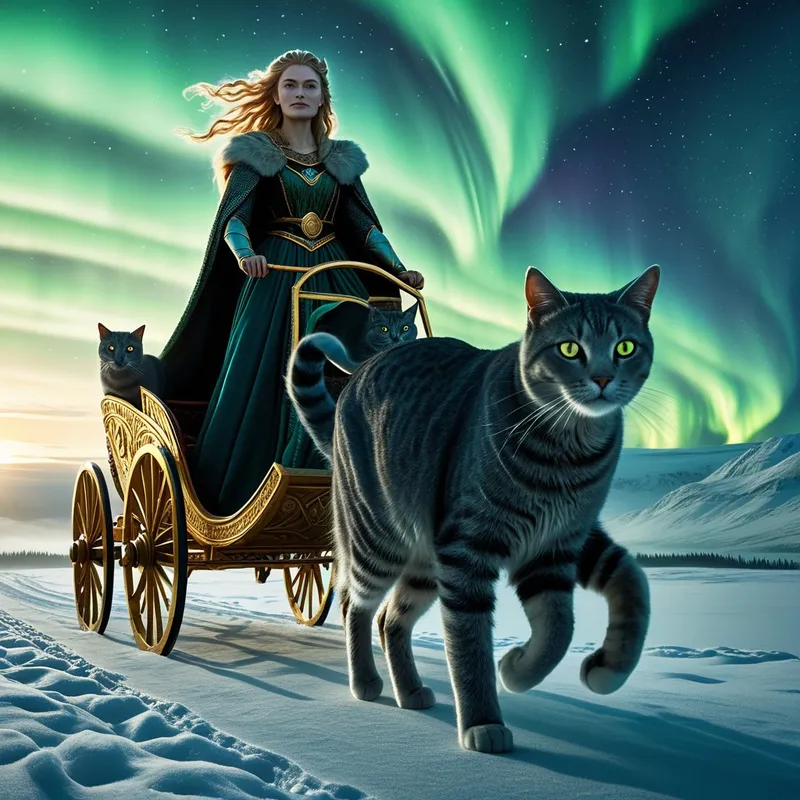
The goddess Freyja, cloaked in falcon feathers, harnesses her chariot to two great cats, journeying across the heavens in search of her lost husband Óðr.
The Tale of Freyja's Chariot
Hear now a tale not of thunder, but of tears that water the roots of the world. It begins in Ásgarðr, in the hall of Freyja. Her hall is Fólkvangr, and its seats are many, but one stands perpetually empty. The air, usually sweet with the scent of her apple orchards, hangs heavy. Her famed necklace, the Brísingamen, feels cold against her skin, a mere trinket in the absence of its appreciator.
For Óðr, her husband, whose name means “frenzy” and “poetry,” is gone. He has wandered, as is his nature, but this time he has not returned. His absence is a silence that swallows song. Freyja’s gaze turns from her fields to the far horizons. The laughter of her daughter Hnoss fades into the background of a deeper, driving need. She cannot wait. She must seek.
She does not call for horses, those beasts of thunder and plain. Her power is of a different essence. To the great forests and rocky heights she sends her will, and to her come her cats. Two massive grey cats, beasts of silent step and luminous eyes, creatures of the hearth and the wild hunt alike. They rub against her legs, a rumble in their throats that is both purr and promise.
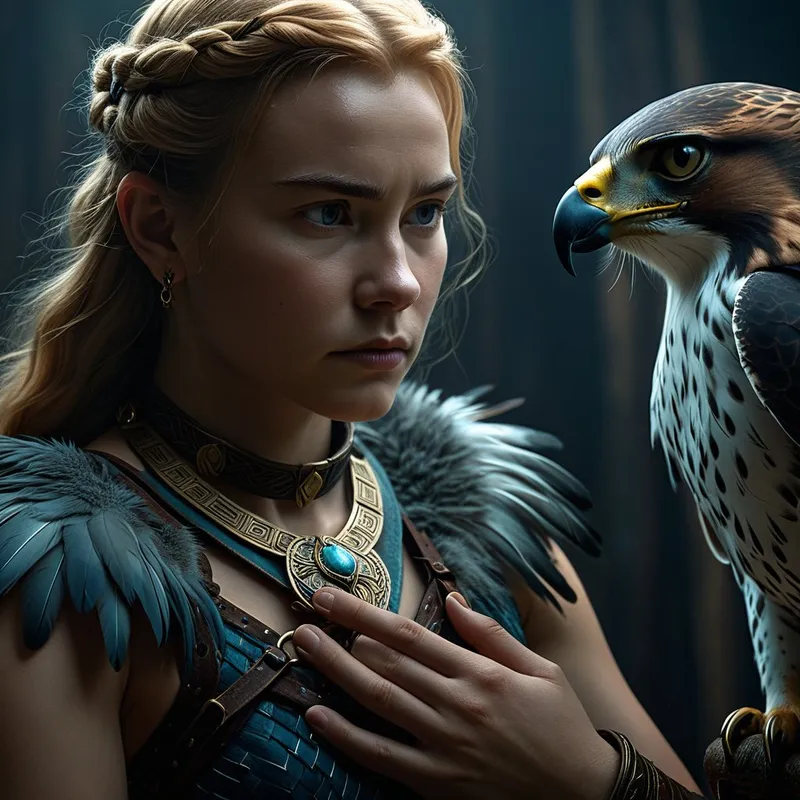
Then, from a great chest, she draws not wood or iron, but feathers. The feathers of a falcon cloak, a garment of seiðr. With skilled hands, she weaves and binds them, not into a garment for her shoulders, but into harness and traces, into the very form of a chariot. It is a vessel not built, but summoned—a chariot of intention and longing. As the last feather is secured, the structure shimmers, holding its shape through magic and will.
She steps into the feather-light basket. A word, a touch, and the great cats tense. Then they leap. Not along the earth, but into the sky itself. The chariot of feathers rises, borne aloft by feline strength and divine sorrow. They race across the dome of the heavens. By day, Freyja scans the mortal realms below, her eyes missing nothing. By night, she journeys through the stars, and her golden tears fall to the earth as dew, and to the sea as amber.
Her search is relentless, a celestial patrol born of heartache. She is the goddess of love in its most desperate aspect: not possession, but pursuit. The chariot becomes her mobile hall, her realm of action. In this vessel of feathers and determination, Freyja is no longer just the lady of Fólkvangr; she is the seeker in the sky, a beacon of unwavering desire cutting through the cosmic dark, forever searching for the missing half of her soul.
Cultural Origins & Context
This myth reaches us primarily through the Poetic Edda, compiled in the 13th century but preserving much older oral traditions. Freyja’s search for Óðr is not a grand epic of gods and giants, but a poignant, recurring motif that colored the Norse understanding of divinity. It was a story told not only in great halls but perhaps in quieter spaces, reflecting a worldview where even the gods were subject to ørlǫg and deep yearning.
The image of Freyja’s chariot pulled by cats is uniquely hers, setting her apart from the goat-drawn chariot of Thor or the horse-drawn chariots of the sun. Cats in the Norse world were creatures of mystery, associated with fertility (being prolific breeders) and the home, yet also with independence and a latent, potent wildness. They were fitting steeds for a goddess who presided over both the fertility of the field and the fury of the battlefield. This myth served to explain natural phenomena—the dew and amber were her tears—but more importantly, it presented a model of feminine power that was active, autonomous, and emotionally complex. Freyja was not pining passively; she was conducting a systematic, cosmic search, wielding her magic and her sovereignty in service of her heart.
Symbolic Architecture
The chariot is the central symbol, a masterpiece of symbolic fusion. It is not a war chariot, but a vehicle of the soul's imperative. The cats represent the harnessed instincts—the powerful, often silent, and potentially untamed forces of emotion, intuition, and sensual longing. They are not slaves, but willing companions in her quest, suggesting that our deepest drives, when acknowledged and directed, can carry us toward our purpose.
The chariot is the conscious self, the 'I' that must harness the powerful, often contradictory, instincts of the soul and direct them toward a meaningful destination.
The falcon-feather construction is crucial. The falcon is a symbol of heightened perception, of the spirit that can soar above the mundane to gain a broader view. Freyja’s chariot is thus a vehicle of seeing and seeking. It is psyche (soul) itself, constructed from the ability to perceive truly and to transcend immediate circumstances. Her search for Óðr, the ecstatic one, represents the soul’s longing for its own animating spirit, for the inspiration, passion, and poetic frenzy that gives life its depth and color. Without Óðr, she has all the trappings of power (Brísingamen, Fólkvangr) but lacks the essential inner fire.
The Dreamer's Resonance
When this myth stirs in the modern dreamer, it often manifests as dreams of urgent travel or search. One might dream of driving a car that transforms, of being pulled in a sled or carriage by animals, or of desperately seeking a person or object in a vast, unfamiliar landscape. The somatic feeling is one of restless momentum, a pressure in the chest that demands movement.
Psychologically, this signals that an essential part of the dreamer’s inner life—their Óðr, their creative passion, spiritual connection, or core vitality—has gone missing, often sacrificed to duty, routine, or trauma. The dreaming psyche is mobilizing its resources (the cats, the chariot) to initiate the search. The dream is an activation of the seeking function. It is the soul refusing to accept the barren status quo, beginning to harness its instinctual power and perceptual acuity (the falcon aspect) to look for what was lost. The tears in the myth point to the necessary grief that accompanies this realization—the acknowledgment of a profound absence that must be mourned before it can be found.
Alchemical Translation
The process Freyja models is the alchemy of longing into directed will, of grief into a journey. The first stage is the nigredo: the blackening, the recognition of the void where Óðr should be—the depression, the creative block, the emotional numbness. Freyja does not deny this; she feels it fully, and her tears are the first solvent.
The construction of the chariot is the albedo: the whitening. Here, conscious insight (falcon feathers) is woven together with available inner strengths (the cats, her inherent magic) to create a vehicle for change. It is the ego structuring itself not for defense, but for a quest.
The journey itself is the rubedo, the reddening or culmination: the sustained application of this forged self to the world, a persistent, courageous engagement with life in search of the missing gold.
For the modern individual, this myth does not promise a happy reunion (the myths are ambiguous on whether she finds him). Its gift is the model of the search itself. Individuation is not about achieving a static state of perfection, but about becoming the one who seeks. It is about building your chariot—integrating your instincts and your insight—and setting out, allowing your deepest longing to become the compass that guides you across the inner and outer worlds. We may not recover our Óðr in his original form, but in the relentless, tear-streaked journey across the sky of our own awareness, we become something whole: a seeker, sovereign in our sorrow, powerful in our pursuit.
Associated Symbols
Explore related symbols from the CaleaDream lexicon: