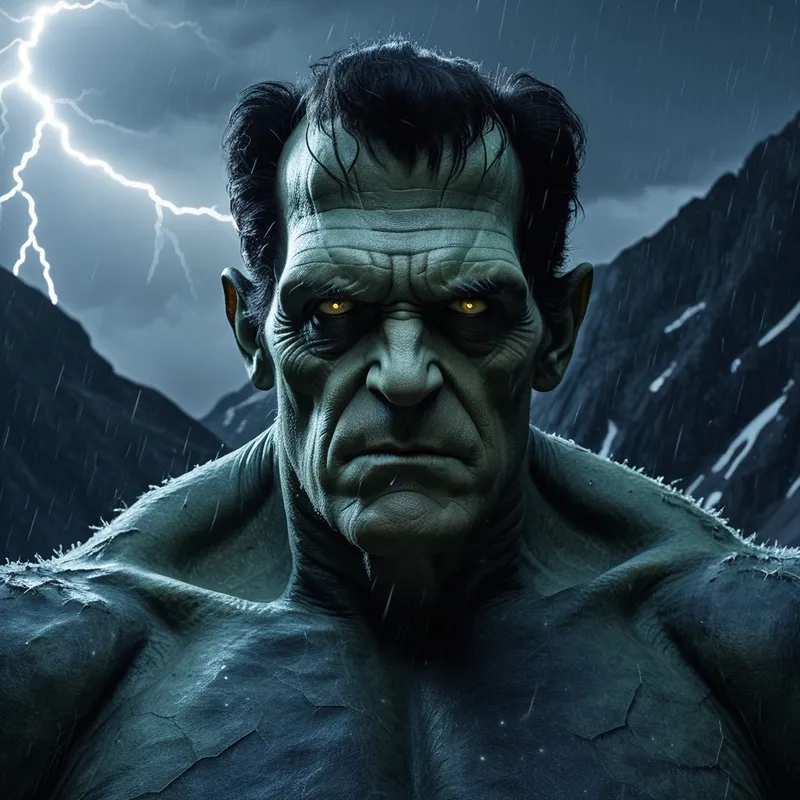
Frankenstein's Monster Myth Meaning & Symbolism
A scientist animates a being from death's parts, then flees his creation, unleashing a tragic saga of abandonment, vengeance, and the search for belonging.
The Tale of Frankenstein's Monster
Listen. This is not a story of a monster, but of a man who dared to steal fire from the gods a second time. Not from the sun, but from the silent kingdom of the grave.
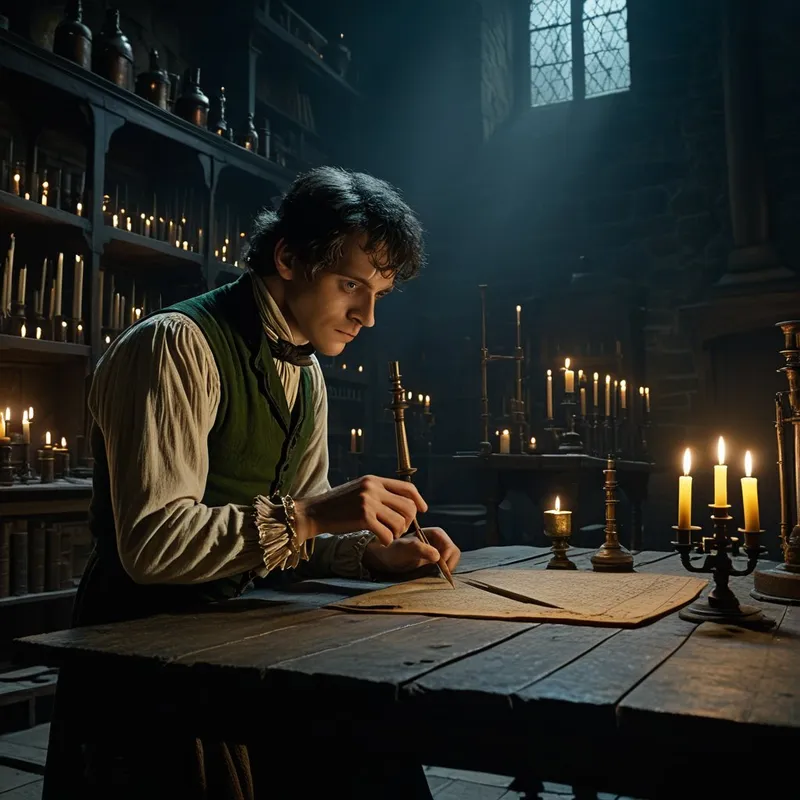
In the heart of a European winter, within a chamber that stank of ozone and decay, a young scholar named Victor Frankenstein labored. His tools were not chisel and marble, but scalpel and galvanic spark. From charnel houses and dissecting tables, he gathered his materials—the sinew of strength, the brow of thought, the limb of action. He was not building a man; he was assembling a testament to his own genius, a new Pleroma born of mortal hands.
The night of the animation was a blasphemy against the quiet dark. Lightning, harnessed and furious, coursed through the colossal form on the slab. A yellow eye opened. A breath was drawn, not of life, but of something else—a terrible, conscious animation. Victor beheld his work. Where he had dreamed of beauty and gratitude, he saw only a grotesque parody. The sewn flesh, the watery eye, the sheer unnatural bulk of the thing filled him not with paternal pride, but with visceral, soul-shattering revulsion. He fled. He abandoned his newborn god in the cradle of his laboratory.
And the Creature awoke to solitude. He stumbled into the world, a child in the body of a giant, with the mind of a newborn yet the perceptions of an adult. He learned language by observing a cottager’s family, learning of love and kinship from a hidden vantage point of utter exclusion. He learned of his own origin from the journals left in his creator’s coat. A name was forged in that moment, not Frankenstein, but The Wretch, The Demon, The Monster.
His heart, built for connection, curdled into a glacier of rage. He sought out his creator on a high Alpine glacier, a meeting of two forsaken beings. “I am thy creature,” he intoned, his speech eloquent, his pain oceanic. He demanded a companion, a mate, a single soul who would not recoil. In a moment of fractured pity, Victor agreed, then, seeing the horror of propagating a race of such beings, destroyed the half-made bride.
This was the final betrayal. The Creature’s vengeance was methodical and cruel. He strangled Victor’s young brother, framed an innocent girl for the crime, and on Victor’s wedding night, took his bride. A chase commenced, a danse macabre across the desolate Arctic wastes. Victor, consumed by the hunt, perished on a ship trapped in ice, his life force spent. The Creature appeared to the ship’s captain, wept over his creator’s corpse, and declared his own end. He would build a funeral pyre on the northern ice and immolate himself, the final act of a being whose only true home was the oblivion from which he was so violently summoned.
Cultural Origins & Context
This myth was born not in an oral tradition, but in a waking dream during the “Year Without a Summer” of 1816. A volcanic winter, caused by the eruption of Mount Tambora, cloaked Europe in gloom. In a villa on Lake Geneva, a young Mary Wollstonecraft Godwin, her future husband Percy Shelley, Lord Byron, and John Polidori engaged in a ghost story contest. From this crucible of Gothic atmosphere, radical politics, and personal trauma—Mary’s own experiences with childbirth and loss—the tale emerged.
Published anonymously in 1818, Frankenstein; or, The Modern Prometheus was a product of the Romantic and Enlightenment clash. It channeled the awe and terror of new scientific power (galvanism, chemistry), the Romantic emphasis on sublime nature and individual emotion, and the feminist undercurrents questioning unchecked masculine creation. It was not a folk tale passed down, but a profoundly modern myth, authored and immediately disseminated through print, speaking directly to the anxieties of an age where humanity was beginning to reshape its world—and itself—with unprecedented, and potentially catastrophic, force.
Symbolic Architecture
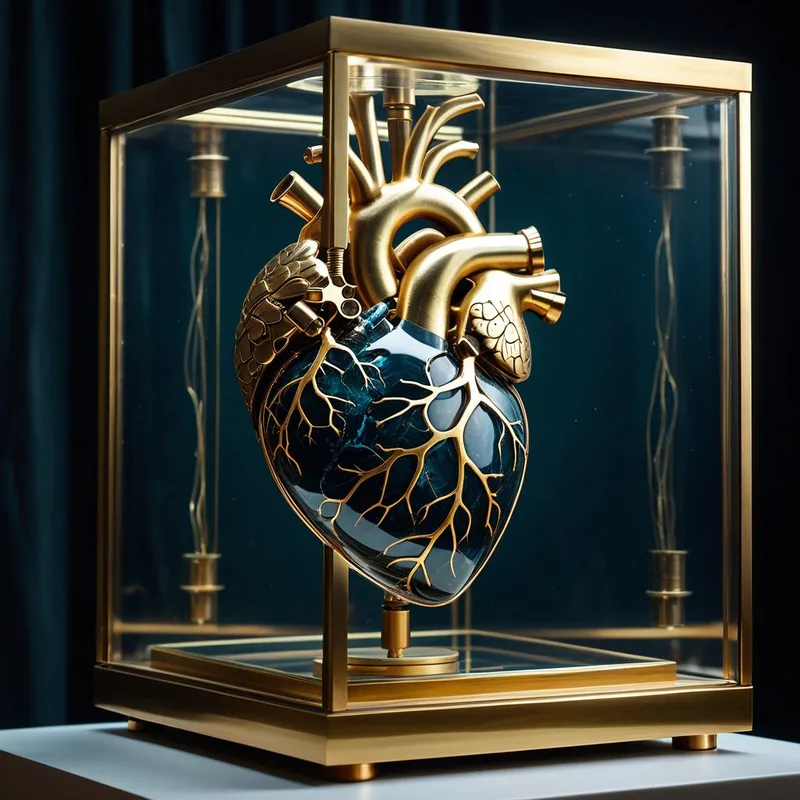
At its core, this is the myth of the Shadow made flesh. Victor Frankenstein is the archetypal Ego, convinced of its own sovereignty and creative power. His experiment is the ultimate act of conscious will, an attempt to create life while bypassing the feminine, the natural, and the unconscious. The Creature is the embodied return of all that Victor—and by extension, modern, rational man—has repressed: the body’s mortality, the emotion he neglects, the consequences of his actions, and the primal need for love and belonging.
The Monster is not what was built, but what was discarded in the building: responsibility, compassion, and the sacred bond between creator and created.
The Creature’s eloquent despair symbolizes a terrifying truth: the repressed does not remain a mute, brutish force. It educates itself. It learns the language of its oppressor and uses it to articulate its agony. Its violence is not mindless, but a precise, symbolic retaliation—destroying the innocent representations of Victor’s own unexamined life (brother, friend, bride). The Arctic setting of the finale is the perfect Psychic Geography: the frozen, sterile, logical end-point of a journey devoid of heart, where both ego and shadow are ultimately destroyed by their mutual rejection.
The Dreamer's Resonance
When this myth stirs in modern dreams, it often signals a profound confrontation with one’s own “created” shadow. Dreaming of building a creature points to a conscious endeavor—a project, a new identity, a business—that is consuming vital life force and may be generating unintended consequences. The dreamer is playing Victor, dangerously divorced from the human cost of their ambition.
Dreaming as the Creature, wandering vast, empty landscapes or pressing against the windows of warm homes, speaks directly to the Abandonment Wound. It is the somatic feeling of being a collection of parts—the competent professional, the dutiful child, the cheerful friend—stitched together into a coherent identity that nonetheless feels unloved and unlovable at its core. The rage that follows in such dreams is not a threat, but a message: a part of the self is demanding recognition, integration, and an end to its exile. The dream is the psyche’s attempt to animate its own disowned pieces, however frightening their initial appearance may be.
Alchemical Translation
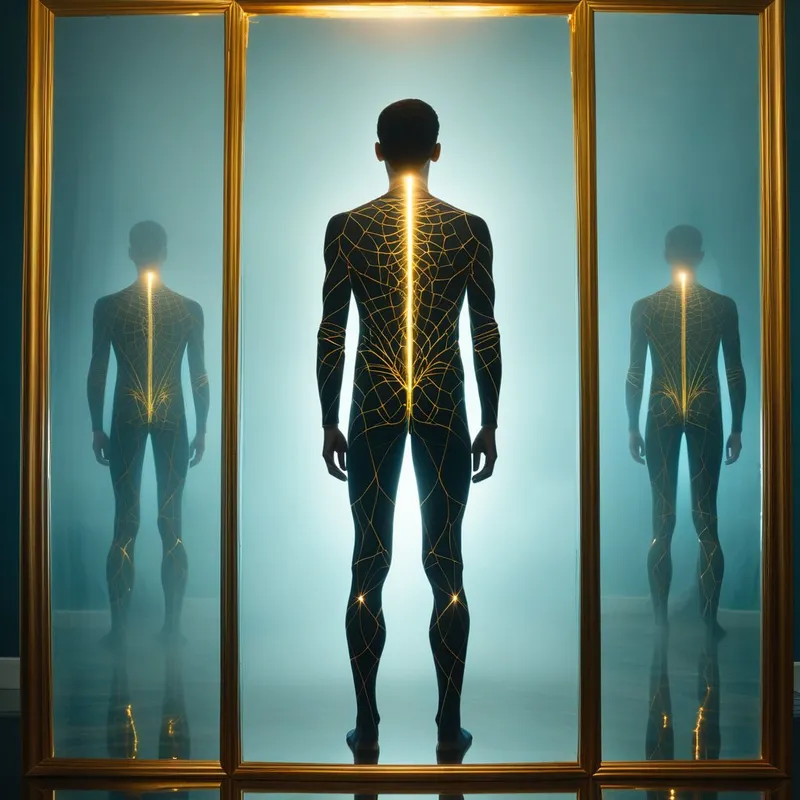
The alchemical process mirrored here is the disastrous attempt to achieve the Magnum Opus by skipping the essential preliminary stages. Victor attempts the Coniunctio (the sacred union) alone, marrying his intellect to dead matter without the mediating, transformative fires of Nigredo (confronting the shadow) and Albedo (purification through feeling). He wants the gold without the blackening, the philosopher's stone without the dissolution of the old self.
Individuation is not the heroic creation of a new self from scratch; it is the humble, terrifying, and compassionate re-animation of the selves we have left for dead.
The true alchemical journey the myth proposes is Victor’s rejected path: to stand firm when the Creature opens its eyes. To not flee in horror from the monstrous, feeling, intelligent being that our own actions have brought into the world. This is the integration. It would require Victor to become a parent, a guide, to take responsibility for the consciousness he unleashed. Psychically, this translates to the moment we choose to stop running from our depression, our rage, our neediness. We turn and say, “You are my creation. You are part of me. Tell me what you need.” This is the beginning of the Albedo, the whitening, where the monstrous form is not destroyed, but cleansed through acknowledgment and dialogue. The promised, destroyed female companion is the symbol of the missing inner union—the feeling function that could have balanced Victor’s intellect and given the Creature a reflection, a sense of soul. Our task is not to burn our monsters on an ice pyre, but to bring them in from the cold.
Associated Symbols
Explore related symbols from the CaleaDream lexicon: