
Francis of Assisi Myth Meaning & Symbolism
A wealthy youth renounces everything, embraces poverty, and communes with nature, becoming a vessel for divine love and a brother to all creation.
The Tale of Francis of Assisi
Listen, and hear the tale of the one who turned the world inside out.
In the sun-baked hills of Umbria, where the scent of cypress and wine hung heavy in the air, there lived a son of fortune. His name was Francesco, son of Pietro di Bernardone, a merchant whose wealth was woven from the finest silks of the East. Francesco was the prince of Assisi, a youth of boundless charm and reckless valor, his life a tapestry of feasts, fine clothes, and dreams of martial glory. His heart beat to the rhythm of troubadour songs and the clang of armor.
But the gods of war are fickle. A skirmish with a rival city left him broken, a year languishing in a cold, dark prison. The fever dreams that visited him there were not of conquest, but of emptiness. He returned to his father’s house a ghost, walking through gilded halls that now felt like a tomb. The silks chafed his skin; the laughter at banquets sounded hollow as a cracked bell.
The rupture came on a road outside the city. Riding in his finery, he encountered a leper—a living horror, a figure of rot and exile. The stench of decay filled his nostrils. Every fiber of his cultivated being screamed to flee. But a force greater than fear moved his limbs. Dismounting, he approached. He did not just give alms; he embraced the outcast. He kissed the ruined flesh. In that moment of ultimate revulsion and ultimate compassion, the world shattered. The leper’s face seemed to transform, and Francesco saw not disease, but a sacred countenance. When he looked again, the road was empty.
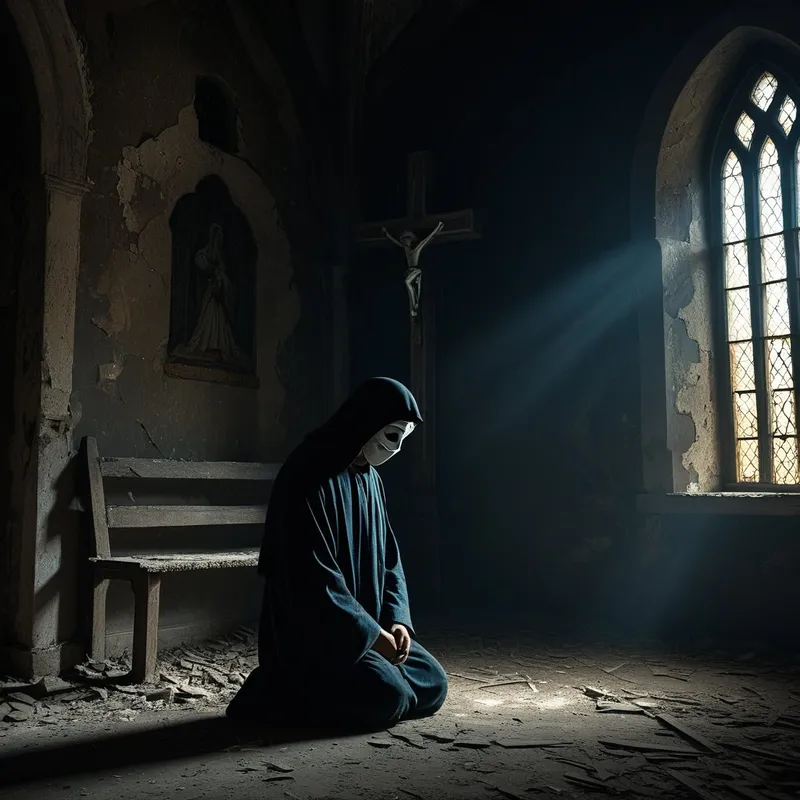
He was a man undone. He fled to the crumbling chapel of San Damiano, and before a painted crucifix, he poured out his confusion. And the icon spoke: “Francesco, go and repair my house, which, as you see, is falling into ruin.” He took the command literally. He stole bolts of his father’s precious cloth, sold them and his horse, and tried to give the money to the poor priest. His father, enraged, dragged him before the bishop to demand restitution and renunciation of his inheritance.
There, in the public square, before the eyes of God and man, Francesco performed the ultimate act. He stripped himself naked, casting the fine garments of his old life at his father’s feet. “Until now,” he declared, his voice clear in the stunned silence, “I have called Pietro di Bernardone my father. From now on, I say only, ‘Our Father who art in heaven.’” The bishop, moved, wrapped him in a rough peasant cloak.
Thus, the prince became a pauper. He wore a single tunic of coarse grey cloth, tied with a rope. He begged for his bread. He sang to the sun and preached to the birds, who, legend says, fell silent to listen. He called the fierce wolf of Gubbio “Brother,” taming its rage with gentle words. He composed a hymn to Brother Sun and Sister Moon, to fire, water, and “our sister, Bodily Death.” Wounds of sacred love, the stigmata, appeared on his hands, feet, and side, sealing his identification with the crucified Christ. He did not build an empire of stone, but a fraternity of the spirit—the Order of Friars Minor—founded on radical poverty, humility, and joy. He died naked on the bare earth, having asked to be laid upon the ground, his final sister.
Cultural Origins & Context
The myth of Francis is not a dusty legend but a living story born in the crucible of 12th-13th century Italy. This was a time of burgeoning mercantile capitalism, urban growth, and profound social tension between new wealth and traditional monasticism, which often seemed distant and corrupt. The story was crafted and propagated primarily by his early followers, most notably in the official Life of Saint Francis by Bonaventure, and the more intimate, anecdotal collections known as the Little Flowers of St. Francis.
These texts served a dual societal function. For the Church, they canonized and sanitized a potentially dangerous revolutionary, channeling his radical energy into a new, approved monastic order. For the common people, Francis was a folk hero—a saint who spoke their language, lived in their world of fields and animals, and embodied a Christianity of direct, heartfelt experience, unmediated by complex theology or ecclesiastical wealth. He was the “God’s juggler,” the holy fool who made the divine accessible. His myth offered a powerful critique of material excess and a vision of spiritual freedom available to anyone, from leper to knight.
Symbolic Architecture
At its core, the myth of Francis is a master narrative of enantiodromia—the Jungian principle where an extreme conscious position generates its unconscious opposite, leading to a transformative crisis. The conscious identity of “wealthy, worldly prince” became so inflated it collapsed into its shadow: the “divine pauper.”
The true revolution is not of politics, but of perception. Francis did not change the world; he changed his eyes, and thus the world was transfigured.
The pivotal embrace of the leper is the symbolic ingestion of the rejected shadow. The leper represents everything society—and Francesco’s privileged ego—fears, excludes, and finds repulsive: mortality, decay, vulnerability, and the raw truth of the flesh. By embracing it, he does not become diseased; he becomes whole. The act dissolves the boundary between “I” and “the other,” initiating a psychic state of radical unity.
His nakedness before the bishop is the ultimate symbol of the unmasked self. He sheds not just clothes, but persona, social status, familial legacy, and egoic armor. He stands in the vulnerability of the true, essential being, aligned only with the transcendent Father. The stigmata are the somatic signature of this alignment—the psyche’s profound identification with the archetype of the suffering and transforming deity made physically manifest.
Finally, his sermon to the birds and pact with the wolf symbolize the restoration of the human soul to its rightful place within, not above, the communion of creation. He becomes the mediating consciousness between the human and natural worlds, healing the archetypal rift.

The Dreamer's Resonance
When the pattern of Francis stirs in modern dreams, it signals a profound crisis of values and a call to radical simplification. The dreamer may find themselves in opulent, gilded rooms that feel suffocating, or may be desperately trying to discard heavy, ornate clothing. They might encounter a frightening or repulsive figure (a beggar, a monster, a filthy animal) that, upon embrace or closer inspection, transforms into a source of wisdom or peace.
These dreams point to a somatic and psychological process of shedding. The psyche is laboring to divest itself of an outgrown identity—perhaps a career persona, a burdensome material lifestyle, or inherited familial expectations that have become a “gilded cage.” The revulsion felt toward the “leper” in the dream is the ego’s resistance to integrating its own neglected aspects: weakness, need, simplicity, or wildness. The dream is an invitation to a terrifying yet liberating act of existential poverty: to let go of what one has in order to discover what one is.

Alchemical Translation
The Francis myth is a precise roadmap for the alchemical process of individuation. It begins with the nigredo, the blackening: the despair in the prison, the hollow feeling amid luxury, the confrontation with the leper/shadow. This is the necessary dissolution of the old, leaden ego.
The act of renunciation and nakedness is the albedo, the whitening. It is the purification, the stripping away of all impurities (attachments, personas) to reveal the prima materia—the naked, essential self. This is not an end but a beginning.
The goal is not poverty, but freedom; not renunciation, but attachment to the one thing necessary.
From this purified state emerges the citrinitas, the yellowing, seen in Francis’s joyful communion with creation. The soul, freed from projection and possession, now perceives the divine luminosity in all things. Brother Sun and Sister Moon are not metaphors but direct experiences of a participatory, ensouled world.
The final stage, the rubedo or reddening, is symbolized by the stigmata. This is the culmination: the total union of the human with the divine archetype, the “marriage” that produces the philosophical gold—the fully realized, useful life. Francis’s gold was not metal, but a living order and a timeless myth that continues to heal. For the modern individual, this alchemy translates to the courage to confront one’s deepest aversions, to simplify one’s life to its authentic core, and from that place of integrity, to engage the world not as a master or consumer, but as a sibling in a sacred, suffering, and astonishingly beautiful whole.
Associated Symbols
Explore related symbols from the CaleaDream lexicon: