Four Living Creatures Myth Meaning & Symbolism
A prophetic vision of four hybrid beings surrounding a divine throne, representing the foundational pillars of creation and the totality of consciousness.
The Tale of Four Living Creatures
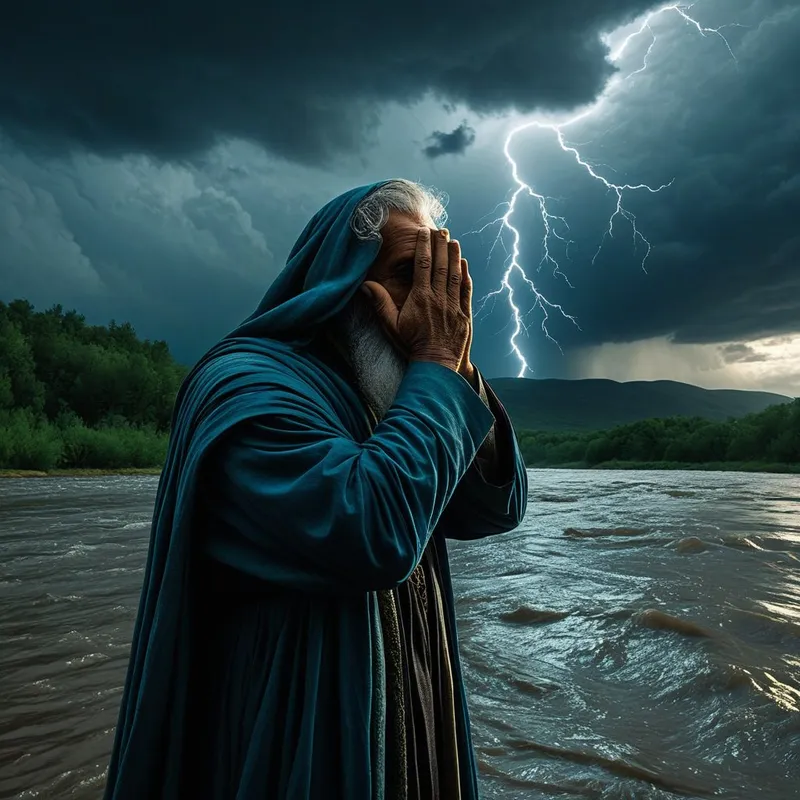
The sky over the Kebar River was the color of hammered bronze, heavy with a heat that promised nothing but more exile. The priest, Ezekiel, sat among the clay and reeds, the taste of dust and displacement thick on his tongue. Then, the wind changed.
It was not a wind of earth, but a wind of the firmament—a great rushing storm-wind from the north, tearing the fabric of the visible world. From its heart burst an immense cloud, flashing with contained lightning, its core a fire that glowed like molten metal. And within the fire… a shape.
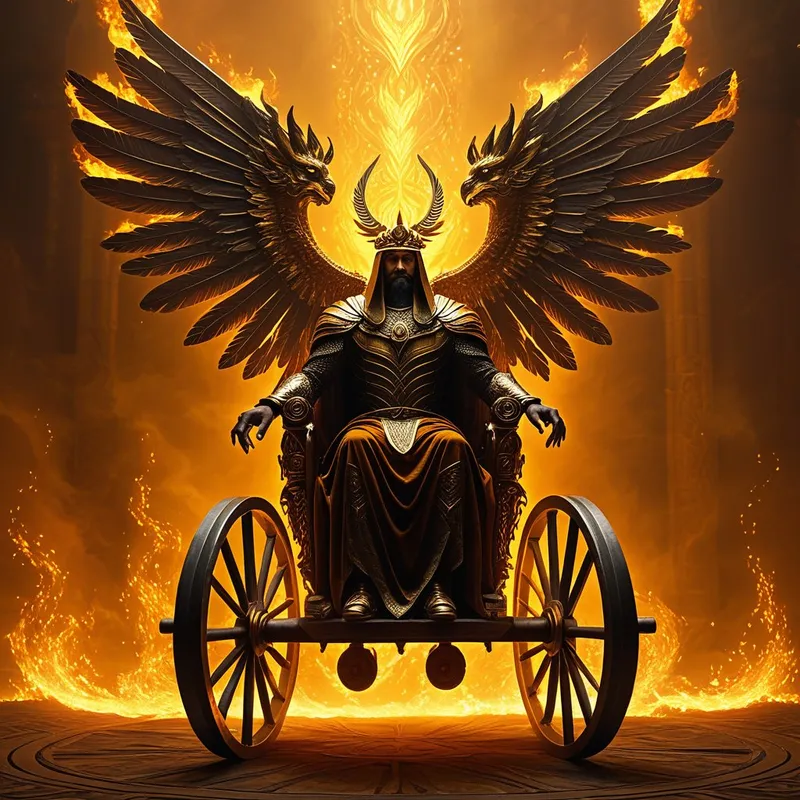
Out of the swirling amber and flame emerged four living creatures. They were not of any field or forest. Their forms were a terrible, glorious synthesis: each had the likeness of a human, but each bore four faces. To the front, the face of a man, looking forward with knowing eyes. To the right, the face of a lion, a silent roar in its majestic jaw. To the left, the face of an ox, patient and immense. To the rear, the face of an eagle, piercing and distant. Their legs were straight, gleaming like burnished bronze, and ending in calves' feet that sparkled. Under their wings, human hands shimmered.
And their wings! Each had four wings. Two stretched upward, touching wingtip to wingtip with its sibling beings, forming a canopy of living, moving feathers. Two covered their bodies, a gesture of awe or protection. The sound was the sound of many waters, the voice of the Almighty, a roar like an army on the march. When they moved, they did not turn; they went straight forward, toward wherever the spirit would go.
Beneath them, beside each creature, was a wheel. A wheel within a wheel, their rims full of eyes all around. Where the living creatures went, the wheels went beside them, for the spirit of the living creatures was in the wheels. When the creatures rose from the earth, the wheels rose. Above the heads of the living creatures was the likeness of a firmament, terrible as crystal. And above the firmament, a throne.
On the throne, a likeness with the appearance of a man, but made of fire and brilliant light from the loins up, and from the loins down, fire with a brightness like a rainbow in the clouds on a rainy day. This was the appearance of the likeness of the glory of the Lord. When Ezekiel saw it, he fell on his face. And he heard a voice.
Cultural Origins & Context
This vision is recorded in the first and tenth chapters of the Book of Ezekiel, a text composed in the 6th century BCE. Ezekiel was a priest among the Judeans exiled to Babylon after the destruction of Jerusalem. His prophecies emerged from the profound trauma of national collapse, the destruction of the Temple, and the disintegration of every familiar structure of cosmic order.
The vision of the Four Living Creatures (or Chayot HaKodesh, "Holy Living Creatures") served a critical function in this context. It was a radical re-imagining of divine presence. God was no longer localized in a ruined temple in a conquered land. Instead, the divine throne was mobile, borne on a cosmic chariot (Merkabah) by these composite beings, capable of appearing even in the heart of a foreign empire. This was theology as survival mechanism, offering a vision of a God whose sovereignty transcended geography and political catastrophe.
The imagery did not emerge in a vacuum. It bears the imprint of its Mesopotamian environment, echoing the colossal lamassu (winged bulls with human heads) that guarded Assyrian palaces and the four-regent deities associated with cardinal directions. However, Ezekiel’s vision synthesizes and subsumes these elements into a fiercely monotheistic framework. The creatures are not independent gods but a unified, awe-inspiring component of a single, overwhelming theophany. This vision became the cornerstone of later Jewish Merkabah mysticism, where contemplatives sought to spiritually ascend and witness this very throne-chariot.
Symbolic Architecture
The Four Living Creatures are not random monsters; they are a symbolic architecture of totality. They represent the pinnacle of the created order, the four "faces" of terrestrial and celestial reality gathered around the source of all being.
The four faces—Human, Lion, Ox, Eagle—are the four pillars of the world, the complete alphabet of creation's expression.
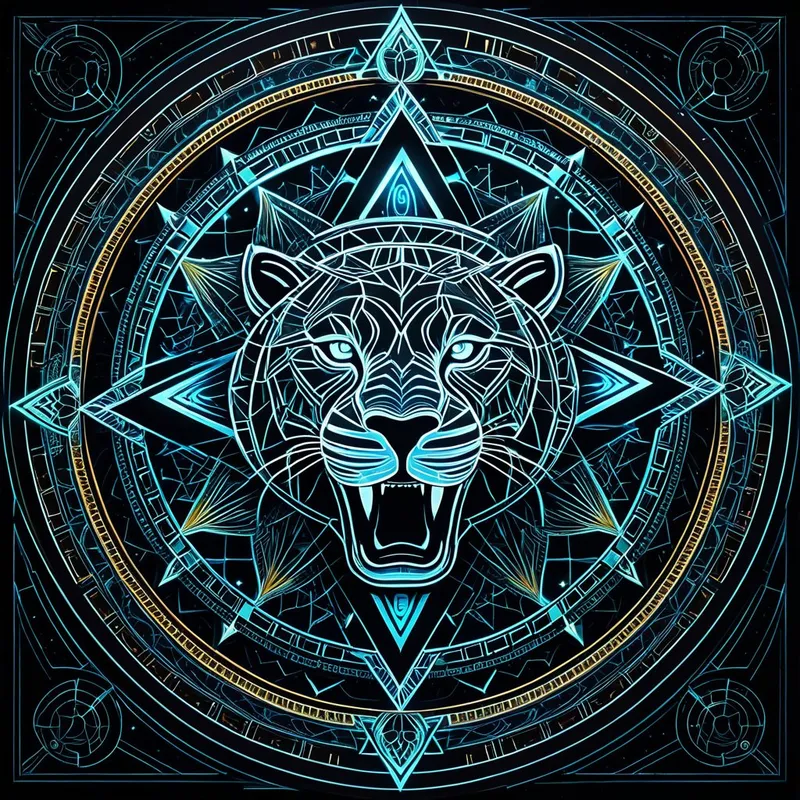
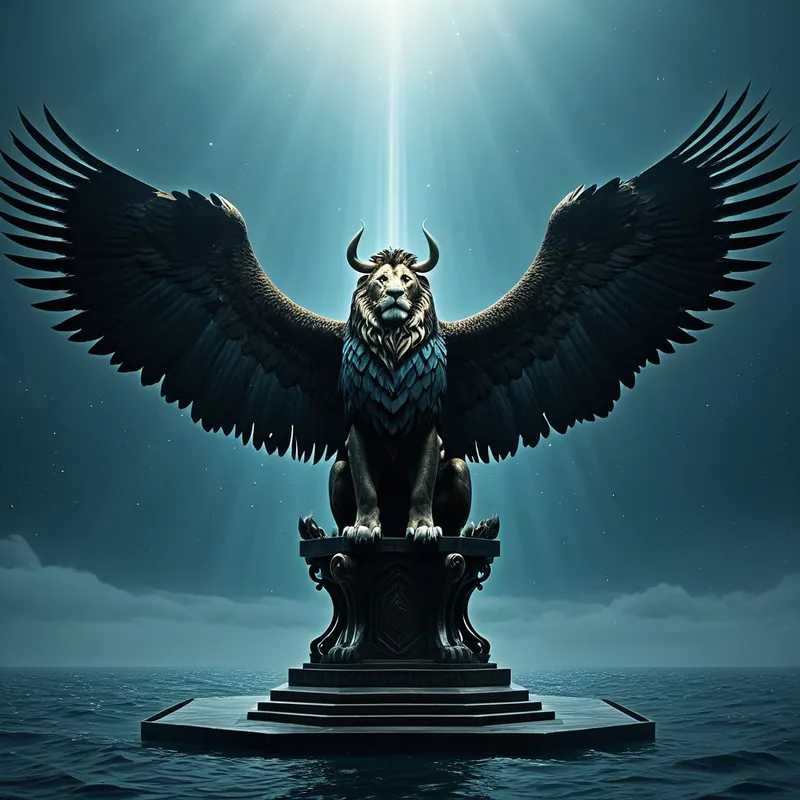
The Human face symbolizes intellect, consciousness, and the capacity for relationship. The Lion embodies royal power, ferocity, and untamed will. The Ox (or Cherub) represents steadfast strength, service, and earthy fertility. The Eagle signifies transcendence, perspective, and the spirit’s ascent. Together, they encompass the totality of life: the rational and the instinctual, the noble and the humble, the earthly and the celestial. Their unified, coordinated movement suggests that these seemingly opposing qualities are harmonized in the presence of the divine.
The wheels within wheels, full of eyes, symbolize the omniscient, all-encompassing motion of divine providence—the complex, interlocking mechanisms of fate and cosmos that are perpetually in motion and perpetually aware. The entire vision is a mandala of wholeness, a psychic map of a universe that is alive, conscious, and organized around a radiant, central mystery.
The Dreamer's Resonance
When this pattern stirs in the modern unconscious, it often signals a profound encounter with the archetype of totality, the Self. To dream of such composite, awe-inspiring beings—especially ones that are watching, moving in unison, or surrounding a central focus—suggests the psyche is attempting to integrate disparate parts of itself into a new, more complete order.
The somatic experience might be one of overwhelming awe, even terror, mixed with fascination—the "numinous" feeling described by Rudolf Otto as mysterium tremendum et fascinans. Psychologically, the dreamer may be processing a life situation that demands they bring together conflicting aspects of their nature: their intellect (Human) with their passion (Lion), their patient endurance (Ox) with their visionary insight (Eagle). The dream is an announcement from the deep psyche: a greater, more coordinated pattern is emerging from the chaos of your life. The central "throne" in the dream—whether empty, occupied, or represented by a luminous object—points to the emerging core of the individual's authentic Self.
Alchemical Translation
The journey of Ezekiel by the river is the journey of every individual facing the collapse of their personal "Jerusalem"—the structures, identities, and beliefs that once provided order and meaning. The alchemical process modeled here is the transmutation of perception.
First, the nigredo: the storm-wind of crisis, the heat of exile, the dissolution of the known world. Then, the albedo: the emergence of the dazzling, terrifying vision from the cloud. This is the revelation of the psychic substrate, the underlying archetypal patterns that were always there, hidden beneath the surface of ordinary consciousness. The Four Living Creatures represent the four essential, non-negotiable elements of the psyche that must be acknowledged and reconciled.
Individuation is not about becoming one thing, but about becoming the charioteer who can hold the reins of the fourfold creature within.
The final stage, the rubedo, is the integration. It is not about becoming the lion, the ox, the eagle, or the human, but about finding the throne—the centered Self—from which one can witness and direct their harmonious movement. The wheels within wheels suggest that this integrated Self is then capable of navigating the complexities of fate with awareness ("eyes all around"). The vision offers a blueprint: wholeness is achieved not by eliminating our animal nature or transcending our humanity, but by arranging all these powerful forces around a central, luminous point of consciousness. We are invited to construct our own Merkabah, our own vehicle of spirit, built from the reconciled totality of who we are.
Associated Symbols
Explore related symbols from the CaleaDream lexicon: