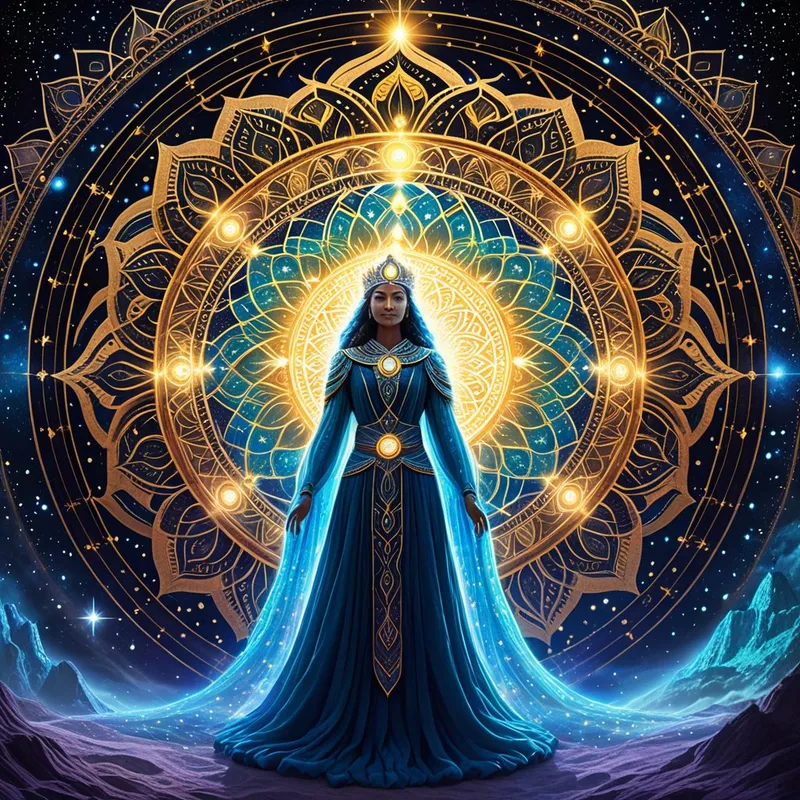
Four Functions of Consciousness Myth Meaning & Symbolism
A mythic tale of the Self's division into four sovereign functions, their conflict, and the arduous journey toward a sacred, balanced wholeness.
The Tale of the Four Functions of Consciousness
In the beginning, before the dawn of the first remembered dream, there was only the One. It was not a god, but the very ground of being, a silent, boundless awareness known as the Self. Within its infinite stillness, a longing stirred—a desire not for creation, but for knowing. To know itself, the One had to perceive itself, and for that, it needed instruments of perception.
And so, from the silent core of the Self, four sovereign beings were breathed into existence, each a perfect, radiant embodiment of a way of knowing.
First came Thinking, clad in robes of pure white logic. His realm was the crystalline mountain, where he built towers of reason and drew maps of cause and effect with unerring lines. He spoke in principles and sought the truth of what a thing is.
Next arose Sensation, a warrior rooted in the earth. His skin was bark and stone, his eyes missed no detail. He lived in the dense, vibrant forest, knowing the world through touch, taste, sight, and sound. He sought the truth of what a thing is, in its raw, tangible reality.
Then emerged Feeling, a queen whose heart was a vast, warm sea. She dwelt in a garden of deep connection, where every bloom responded to her touch. She weighed the worth of things, asking not "Is it true?" but "Is it valuable? Is it good or bad, beautiful or harsh?"
Finally, from the mists of possibility, appeared Intuition, a seer with stars in her eyes. She lived on the shifting sands at the edge of the known world, seeing not what is, but what could be, what lies behind. She perceived in flashes of insight, weaving threads of meaning from the whispers of the future.
For a timeless moment, they existed in a harmonious orbit around the central Self, a perfect mandala of consciousness. But the Self’s desire to know itself demanded more than harmony; it required experience. And so, a great psychic wind swept through the inner world, scattering the four sovereigns to the four corners of the psyche.
Thinking was exiled to his mountain peak, where he declared his logic the only valid king. Sensation was lost in the endless particulars of his forest, dismissing the mountain as an abstraction. Feeling, in her garden, felt betrayed by the coldness of the mountain and the brutishness of the forest. Intuition, from her distant dunes, saw their squabbles as petty distractions from the grand visions she alone could grasp.
A great Winter of the Soul descended. The Self, now fragmented, knew only conflict. The inner world became a battleground of partial truths, where each sovereign claimed supremacy and derided the others as fools or traitors. The Thinking king called Feeling irrational; the Sensing warrior called Intuition ungrounded; the Feeling queen called Thinking heartless; the Intuitive seer called them all blind.
This was the state of things for an age—a civil war in the kingdom of the soul. Wholeness was a forgotten dream, a faint memory of a lost center. The four functions, once instruments of knowing, had become fortresses of isolation, and the quest to know the Self seemed forever lost to the din of their discord.
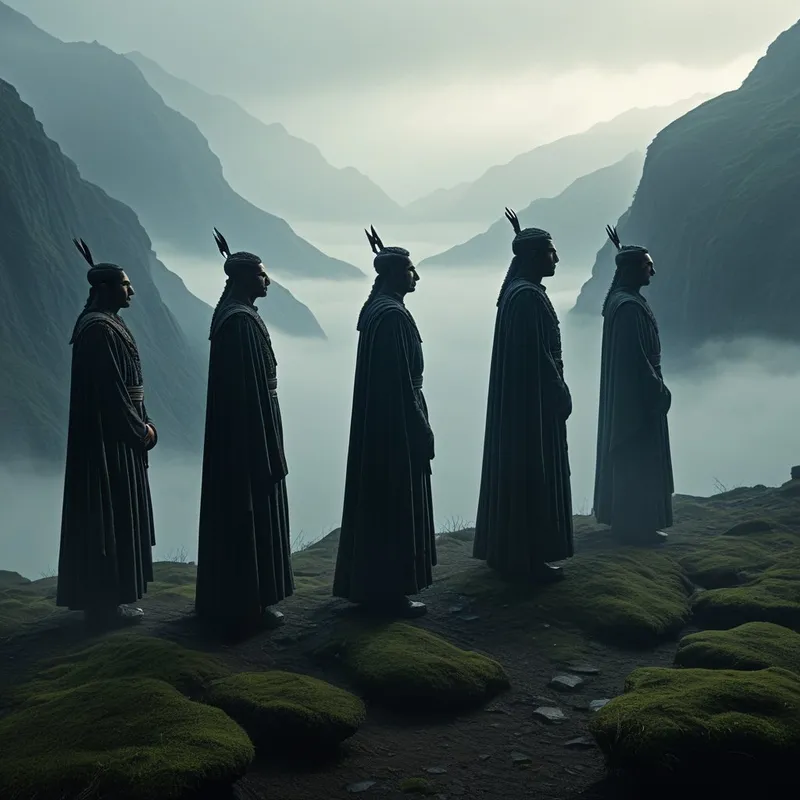
Cultural Origins & Context
This is not a myth carved on temple walls or sung in ancient epics. It is a modern archetypal narrative, born in the clinical consulting rooms and scholarly studies of the 20th century. Its primary "bard" was the Swiss psychiatrist Carl Gustav Jung. He did not present it as a story with characters, but as a psychological model derived from decades of observing the patterns of the human psyche in dreams, fantasies, and the conflicts of his patients.
Jungian "culture" is thus a culture of the interior—a shared language and map developed by therapists, analysts, artists, and seekers attempting to navigate the wilderness of the unconscious. The myth is passed down through texts like Psychological Types, through analytical training, and in the intimate space of therapy where personal material is interpreted against these universal patterns. Its societal function is diagnostic and integrative: it provides a framework to understand why people misunderstand each other and, more importantly, why we are at war with ourselves. It serves as a guide out of one-sidedness toward a more complete humanity.
Symbolic Architecture
The myth is a symbolic blueprint of the psyche's inherent structure and its central dilemma. Each sovereign is not a mere skill but a fundamental orientation of consciousness, a way the ego relates to both inner and outer reality.
Thinking and Feeling are the rational functions, the judging pair. They evaluate experience. Thinking does so impersonally, based on logical criteria; Feeling does so personally, based on values of acceptance or rejection. They are often in opposition, representing the classic conflict between head and heart.
Sensation and Intuition are the irrational (or perceiving) functions, the pair that take in information. Sensation does so through the concrete, physical reality of the present moment. Intuition does so through the unconscious, perceiving possibilities, meanings, and connections that lie beyond the senses. They represent the conflict between the tangible here-and-now and the visionary what-could-be.
The tyranny of the superior function is the prison of the personality; the redemption of the inferior function is the key to its liberation.
In every individual, one function typically becomes dominant (the "superior" function), its opposite is largely unconscious and undeveloped (the "inferior" function), and the other two operate in a supportive, auxiliary role. The myth dramatizes the inflation of the superior function—the Thinking king on his isolated mountain—and the repression or demonization of its opposite—the Feeling queen, exiled and scorned. The conflict is not a flaw, but the necessary engine of growth. The wholeness of the Self can only be approached through the integration of these warring parts.
The Dreamer's Resonance
When this myth stirs in the modern dreamer, it signals a crisis or opportunity in the structure of consciousness itself. One may dream of being trapped in a sterile, logical maze (Thinking inflated), overwhelmed by a chaotic flood of sensory data with no meaning (Sensation runaway), drowning in a tidal wave of emotional connections (Feeling possessed), or lost in a fog of vague, frightening possibilities (Intuition ungrounded).
More pointedly, dreams of the inferior function often appear in primitive, alluring, or terrifying forms. The logical thinker may dream of a captivating but utterly irrational lover or a destructive, emotional child—embodiments of their repressed Feeling. The sensible, grounded person may dream of a terrifying ghost or a mesmerizing, otherworldly guide—the face of their unknown Intuition. These dreams are somatic messages from the psyche, indicating that a one-sided adaptation to life is breaking down. The unconscious is demanding a more complete engagement with reality, pressuring the dreamer to acknowledge and develop what has been neglected.

Alchemical Translation
The myth models the alchemical individuation process. The initial state of unity (the Self) is the prima materia, the unformed potential. The separation and conflict of the four functions is the separatio and mortificatio—the necessary breaking apart and "killing" of naive unity, which leads to the suffering of inner conflict.
The hero's journey here is not to slay a dragon, but to depose the inner tyrant—the dominant function that claims to be the whole personality. The long exile is the stage of recognizing and making conscious the auxiliary functions. But the true alchemical gold is found in the encounter with the inferior function.
To integrate the fourth function is to make a pact with one's own opposite, to welcome the stranger who has always lived in the basement of the soul.
This is the coniunctio oppositorum—the sacred marriage of opposites. For the Thinking king, it means descending from his mountain to truly hear the Feeling queen's values, not as irrational noise, but as a different order of truth. For the Sensing warrior, it means leaving the safety of the known forest to trust the Intuitive seer's visions. This integration is never a smooth fusion, but a dynamic, tense partnership. The resolution of the myth is not a return to the original, unconscious unity, but the achievement of a complexio oppositorum—a conscious mandala where each function has its rightful place, oriented toward the rediscovered center of the Self.
The psyche's civil war ends not in the victory of one sovereign, but in the establishment of a council. The individual gains the capacity to think when thinking is needed, feel when feeling is required, sense the concrete facts, and intuit the hidden possibilities. They become, in a fleeting but real way, a living vessel for the wholeness they once only mythically inhabited.
Associated Symbols
Explore related symbols from the CaleaDream lexicon: