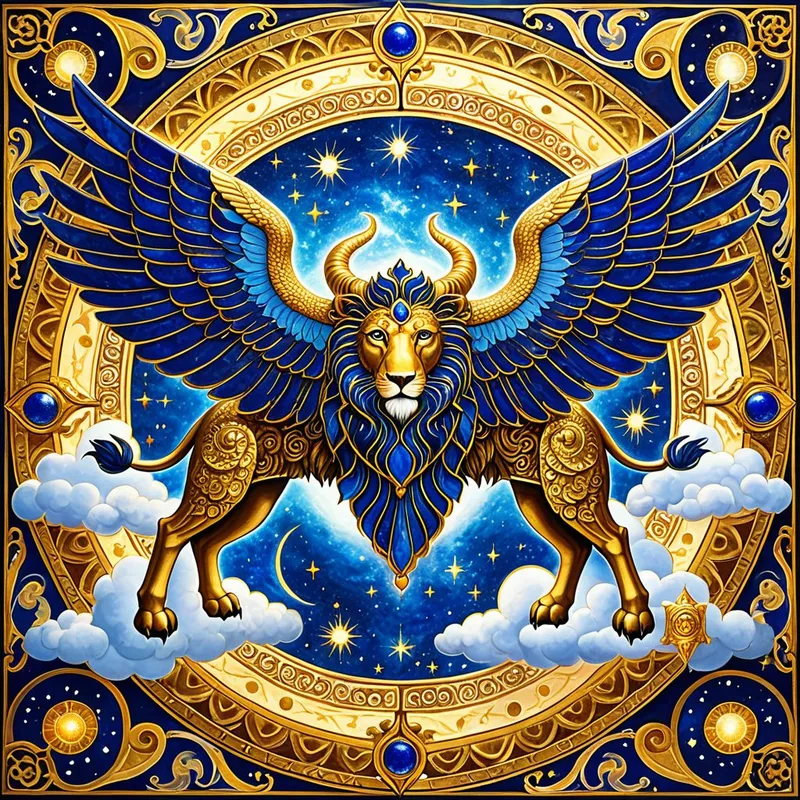
Four Evangelists Myth Meaning & Symbolism
Four celestial beings, four faces of one truth, recording the divine story from every corner of the soul's world, creating a gospel of wholeness.
The Tale of Four Evangelists
In the beginning of the end, when the Word had walked among the dust and the thorns, a silence fell upon the world. It was a silence of waiting, of breath held. The story had been lived, a fire had blazed across the land, and then was gone, leaving behind the scent of myrrh and the echo of a promise. But a story untold is a fire banked, destined to cool into forgotten ash.
From the four corners of the firmament, a wind began to stir. It was not one wind, but four, each carrying a different scent—the dry parchment of the desert, the hot breath of the wilderness, the rich soil of the tilled field, the thin, sharp air of the highest peak. And with the winds came the Watchers.
They were not men, though one wore a man’s face, etched with the compassion and intellect of a physician gazing upon a wound. They were not beasts of the field, though one bore the mighty, sun-gold head of a Lion, its roar the proclamation of a king. They were not beasts of burden, though one carried the patient, powerful visage of an Ox, its strength born of the earth. They were not birds of the air, though one was crowned with the piercing gaze of an Eagle, seeing from the sun to the depths of the sea.
They were the Living Ones, the Tetramorph, and they circled a throne of unapproachable light. Their wings beat a rhythm that was the very pulse of creation, and their bodies were covered in eyes, seeing all of time at once. They had witnessed the Alpha and the Omega. And now, they turned their gaze inward, to the hearts of those who had walked with the Word.
Into the soul of Matthew, the tax collector turned disciple, they breathed the wind from the east. His hand, once recording debts, began to move. He saw the story as a great lineage, a sacred genealogy connecting heaven to earth, the fulfillment of an ancient law. He wrote of the teacher, the rabbi, the promised son of David. His gospel was a bridge.
Into the spirit of Mark, the companion of Peter, they breathed the southern wind, hot and urgent. His narrative erupted onto the page—a story of mighty deeds, of immediate action, of a powerful servant moving swiftly through a world of conflict. “Immediately,” he wrote, again and again. His gospel was a roar.
Into the heart of Luke, the physician and historian, they breathed the western wind, rich and nurturing. He sought out every witness, every mother, every shepherd, every outcast. He wrote of tender parables, of lost coins and prodigal sons, of healing touch and universal mercy. His gospel was a healing balm.
Into the mind of John, the beloved disciple, they breathed the northern wind, clear and icy with truth. He saw not just the man, but the cosmic Word made flesh, the light shining in the darkness from before time began. He wrote of “I Am,” of deep mysteries, of vine and branches. His gospel was a soaring vision.
Four men, touched by four faces of one celestial truth, wrote one story in four harmonies. They did not contradict, but completed. They did not compete, but conversed. Where one ended, another began, until the life, death, and mystery were captured in a four-fold net of testimony. The silence was broken, not by a single shout, but by a perfect, resonant chord that would echo down all the corridors of time.
Cultural Origins & Context
This powerful symbolic constellation did not emerge fully formed from the early Christian community. Its roots dig deep into the prophetic soil of the Hebrew tradition, specifically the awe-inspiring visions of the prophet Ezekiel. In his exile, Ezekiel beheld the divine chariot-throne borne by four living creatures, each with four faces: man, lion, ox, and eagle. This Merkabah mysticism presented a complex image of God’s mobile, encompassing presence in the world.
This vision was later refracted through the apocalyptic lens of the Book of Revelation, where the four living creatures surround the heavenly throne, ceaselessly singing “Holy, holy, holy.” By the late 2nd century, early Church Fathers like Irenaeus of Lyons began the work of firm association, linking each creature to a specific Gospel account. This was not mere fancy; it was a hermeneutic necessity. In a world of diverse and sometimes conflicting testimonies, the fourfold Gospel needed a unifying, divine logic—a sign that these four perspectives were not random, but the essential, God-ordained facets of a single diamond-like truth.
The myth was passed down through the most potent mediums of the age: illuminated manuscripts, where evangelist portraits showed each author accompanied by his symbolic creature; stone carvings on cathedral facades; and the soaring stained glass of clerestory windows. It was a teaching myth for a largely illiterate populace, a visual and symbolic creed that said: “Truth is not simple. To know it fully, you must approach it from all sides.”
Symbolic Architecture
At its core, the myth of the Four Evangelists is a profound map of consciousness, a blueprint for apprehending wholeness. It asserts that any complete revelation—of the divine, of the self, of reality—must be perceived through multiple, simultaneous modes of being.
The one truth requires four witnesses, for the psyche knows itself through the mind that reasons, the heart that feels, the body that acts, and the spirit that intuits.
The Man/Angel symbolizes the intellectual and historical dimension. It is our human reason seeking order, lineage, and logical fulfillment of promise. The Lion embodies the passionate, active principle—raw power, courageous action, and regal authority that cuts through hesitation. The Ox represents the somatic, sacrificial, and patient aspect. It is the grounded strength of service, the fertility of empathy, and the quiet endurance of the body. The Eagle signifies the spiritual and visionary capacity—the ability to soar above the literal, to see with panoramic clarity, to grasp the metaphysical essence.
Together, they form a complete circuit of perception. To have only the Lion is to be a brute force of unchecked action. To have only the Ox is to be mired in passive suffering. To have only the Man is to be a dry academic, and only the Eagle, an ungrounded mystic. The myth insists that wholeness—and a whole testimony—requires the integration of all four.
The Dreamer's Resonance
When this fourfold pattern stirs in the modern dreamscape, it rarely appears as biblical figures. Instead, the dreamer may encounter four distinct animals in a significant sequence, or four doors of different colors and textures, or four voices offering conflicting advice on a single problem. One may dream of trying to assemble a broken statue that has four key pieces, or of looking into a fractured mirror and seeing four different reflections of oneself.
Psychologically, this signals a process of psychic differentiation pressing toward integration. The dream ego is confronting the fact that its identity or a crucial life situation cannot be understood from a single angle. The somatic feeling is often one of being pulled in different directions, yet with an underlying sense that these tensions are necessary. The dream is highlighting compartmentalized aspects of the self: perhaps the driven professional (Lion) is estranged from the nurturing parent (Ox), while the intellectual planner (Man) dismisses the intuitive, visionary hunches (Eagle). The dream presents the four as separate to show the dreamer the pieces that must be acknowledged and brought into conscious relationship.

Alchemical Translation
The alchemical journey of individuation is precisely the work of the Four Evangelists mythologized. It is the process of creating one’s own “gospel”—a coherent, lived testimony of one’s life—from the raw, often contradictory, data of experience.
Individuation is the writing of one's gospel with four pens held in a single hand.
The initial stage is the Nigredo, the blackening, where the unified, innocent “truth” of childhood shatters. This is the moment the four creatures separate, representing the fragmentation of the psyche into competing complexes: the critical inner judge (Man), the raging inner tyrant (Lion), the burdened inner martyr (Ox), and the dissociated idealist (Eagle). The work begins by witnessing each, as the Evangelists witnessed Christ. This is the Albedo, the whitening: observing one’s intellectual narratives without fusion, honoring one’s anger without acting it out, feeling one’s suffering without collapse, and acknowledging one’s spiritual yearnings without inflation.
The crucial alchemical operation is then the circularis, the rotation. One learns to apply the right face to the right situation. The Lion’s courage is summoned to set a boundary, the Ox’s patience to care for the body, the Man’s reason to plan a course, the Eagle’s vision to find meaning in suffering. They no longer war but take turns leading the chariot of the self.
The final stage, the Rubedo or reddening, is the achievement of the Anthropos, the whole human. The four faces, now fully conscious and coordinated, turn outward not as fragmented reporters, but as a unified instrument of perception. The individual no longer has a perspective but holds a multi-perspectival consciousness. They become a living Tetramorph, capable of engaging the world with full intelligence, passion, embodied compassion, and transcendent wisdom. Their life itself becomes a gospel—a single, complex, and redemptive story told in the harmonious language of four.
Associated Symbols
Explore related symbols from the CaleaDream lexicon: