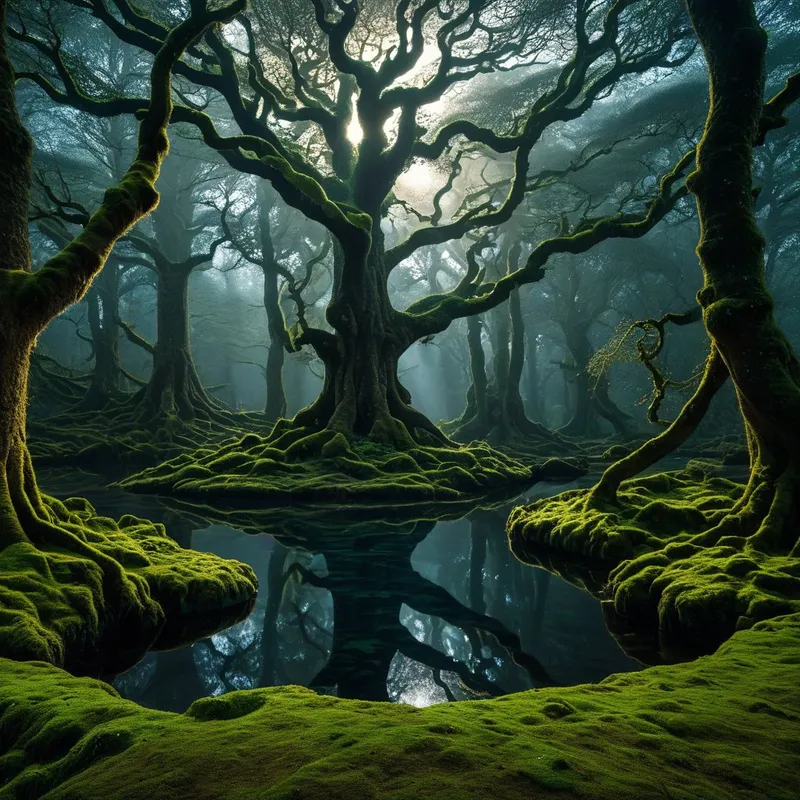
Forest of Brocéliande Myth Meaning & Symbolism
An enchanted forest of shifting reality, where heroes seek truth, face illusions, and are transformed by encounters with the sacred and the self.
The Tale of the Forest of Brocéliande
Listen. The wind in the high branches is not just wind. It is the breath of the genius loci, the ancient soul of the place. Step past the boundary stone, the moss-clad menhir, and you have left the world of men. This is the Forest of Brocéliande.
Here, light does not fall; it pools. It gathers in hollows like liquid gold, and in the clearings, it shimmers with the heat of unseen presences. The air is thick with the scent of damp earth, blooming hawthorn, and something older—ozone and stone. This is a realm where time braids upon itself. A knight may ride for a day and find a century has passed in the world beyond the oaks. A seeker may follow a path only to find it has looped back upon itself, or vanished entirely, leaving them standing before the same ancient, watching tree.
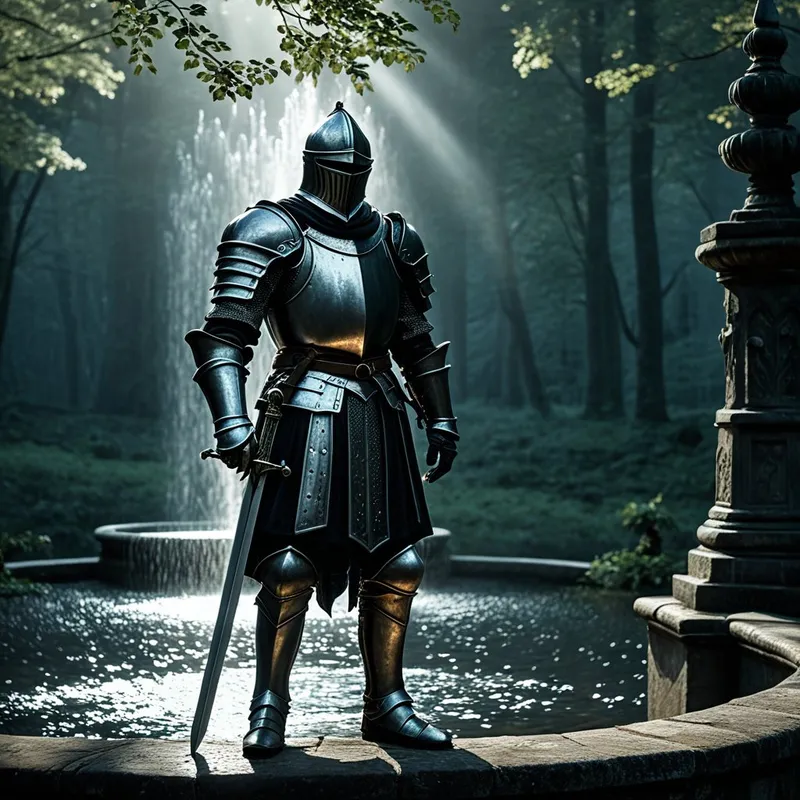
At the heart of this green labyrinth lies the Fountain of Barenton. Its waters are a plate of darkest silver, so still they seem to be a window into another sky. To pour its water upon the surrounding stones, as the ritual demands, is to summon the sky’s fury. Clouds gather from a clear blue, thunder rumbles from the very roots of the forest, and a tempest lashes the canopy. This is the forest’s voice, its raw, untamed power answering a mortal’s call.
And it is here the heroes come. Not to conquer, but to be tested. Morgan le Fay walks these paths, not as a mere sorceress, but as the sovereign of this liminal realm, weaving destinies with the threads of mist and shadow. The wizard Merlin is bound here, not in a prison of stone, but in a tower of air, woven from the song of a fay—a captivity born of his own deepest longing. The knight Yvain seeks the fountain, defeats its guardian, and wins a love that he must lose through pride and win again through madness and humility, becoming the Knight of the Lion, a beast of the forest guiding his redeemed heart.
The forest does not give up its secrets; it reveals them to those who are willing to be unmade. It offers not a quest, but an initiation. The path is never straight. The truth is never plain. To enter Brocéliande is to step into a story that was already being told about you, long before you ever took your first breath.
Cultural Origins & Context
The Forest of Brocéliande, known today as Paimpont Forest in Brittany, France, is not merely a literary setting. It is a topographic myth, a landscape that absorbed the spiritual imagination of the Celts and later, the Breton storytellers. For the ancient Celts, forests were not just resources; they were the sacred groves (nemeton) of the druids, the threshold of the Otherworld. They were places of law, learning, and profound mystery, where the veil between worlds was thin.
The tales of Brocéliande as we know them were crystallized in the 12th century, within the sprawling corpus of Arthurian romance, particularly in Chrétien de Troyes’s Yvain, the Knight of the Lion. These French poets drew upon older Celtic oral traditions, bardic tales carried by Breton conteurs. The function of these myths was multifaceted: they provided a narrative map for understanding the capricious, animistic power of the wild; they encoded social values of courage, loyalty, and wisdom; and they served as a cultural anchor, rooting the glorious, doomed world of Arthur’s Britain in the very soil of Brittany. The forest was the keeper of national destiny and personal fate, told and retold beside hearths to remind listeners that the world was wider and stranger than the fields they plowed.
Symbolic Architecture
Brocéliande is the psyche itself—dense, alive, and largely unconscious. It is not a symbol of the wild outside, but of the untamed, autonomous life within.
The enchanted forest is not where you lose your way; it is where you discover you never had a map to begin with.
The Fountain of Barenton symbolizes the unconscious depths. Its still surface reflects not your face, but the state of your soul. To disturb its waters is to consciously engage with the unconscious, an act that inevitably summons an emotional storm—the nigredo or dark night of the soul that precedes purification. The storm is not a punishment, but a necessary chaos that clears the air for new growth.
Merlin’s imprisonment is the ultimate paradox of wisdom. The archetypal Senex is ensnared not by an enemy, but by his own anima, his inner feminine principle (Viviane, Nimue). This represents the point where intellectual knowledge meets eros, where spirit becomes embodied in feeling and relationship. His “tower of air” is a prison of his own making, a state of being caught in an eternal, unresolved dynamic between spirit and nature.
The ever-shifting paths represent the nonlinear nature of psychological growth. Progress in self-knowledge is rarely linear. One circles back to old wounds, encounters the same archetypal figures in new guises, and must surrender the ego’s desire for a straightforward narrative.
The Dreamer's Resonance
When the Forest of Brocéliande appears in a modern dream, it signals a profound encounter with the personal and collective unconscious. The dreamer is not on a picnic; they are on a níth, an ancient Irish term for a psychic or spiritual quest.
Somatically, one might dream of feeling the spongy, uneven forest floor underfoot, the chill of the mist, or the oppressive, yet awe-inspiring, silence. Psychologically, this is the landscape of deep introspection. To dream of lost paths indicates a crisis of direction in life, where old goals and identities have lost their meaning. To stand before the fountain is to be on the brink of confronting a deep, perhaps repressed, emotional truth—the pouring of the water is the conscious decision to engage with it, knowing it will disrupt your inner climate.
Dreaming of Merlin or a guiding yet trapped figure suggests the dreamer’s own inner wisdom or creative spirit feels inaccessible, bound by a compelling emotional complex or an all-consuming relationship. The forest in dreams is the stage where the ego meets the autonomous, myth-making powers of the psyche, and is required to relinquish control.

Alchemical Translation
The journey through Brocéliande is a perfect allegory for the alchemical process of individuation—the psychic work of becoming whole, distinct, and integrated.
The entry into the forest is the opus, the beginning of the work. It is a voluntary descent (descensus ad inferos) into the unknown material of one’s own soul. The initial disorientation and loss of the familiar world is necessary.
The knight does not enter the forest to find a dragon, but to become one, so that he may understand the fire in his own belly.
The summoning of the storm at the fountain is the mortificatio and solutio—the dissolution of the old, rigid ego structures in the waters of the unconscious. The emotional turmoil that follows is not a failure, but the fermentation stage, where old certainties are broken down.
Yvain’s cycle of victory, loss, madness, and redemption models the alchemical stages of separatio (losing his identity as a knight), coagulatio (his slow reintegration in the wild, aided by the lion—his instinctual, noble strength), and finally coniunctio (his reunification with his love and his restored, but transformed, self). The lion is the rubedo, the red tincture—the embodied, courageous heart that results from the work.
Merlin’s fate represents the ultimate coniunctio oppositorum (union of opposites) that transcends the individual psyche. His binding is the eternal marriage of spirit and nature, logos and eros, forever dancing in the heart of the forest. For the modern individual, this translates to the acceptance that our deepest wisdom will always be intertwined with our deepest vulnerabilities and relationships. We do not escape the forest; we learn its language, and in doing so, find that we are, and always have been, a part of its eternal, whispering story.
Associated Symbols
Explore related symbols from the CaleaDream lexicon: