Forest Fire Ecology Myth Meaning & Symbolism
A global myth of a sacred, purifying fire that consumes the old forest, making way for rebirth and revealing hidden seeds of new life.
The Tale of Forest Fire Ecology
Listen. There is a truth older than the oldest tree, whispered on the wind that smells of smoke and damp earth. It is not a story of one people, but a memory held in the roots of the world.
In the beginning, the Great Wood was eternal. It was a vaulted cathedral of green, so dense and deep that light fell in shattered pieces to the floor. Life was abundant, yet it was heavy. The canopy grew so thick it choked its own light. The floor became a tangled tomb of fallen giants, layer upon layer, a mattress of decay that smothered the soil. The air grew still and silent, save for the creak of ancient boughs. The forest was dying of its own success, a prisoner of its endless, unchanging summer.
Then came the Rumbling. Not from the sky, but from the deep earth. It was the Heart of the Mountain, restless in its sleep. Or it was the Sun’s Forgotten Spark, fallen to earth in a moment of celestial inattention. However it arrived, it arrived as Fire.
It did not creep; it awoke. A line of brilliant, dancing orange at the edge of the wood. At first, the forest recoiled. The ancient pines groaned, their resin weeping like amber tears. The creatures fled in a thunder of hooves and a shriek of wings. The Fire was a devourer, a brilliant, terrifying beast with a thousand tongues. It raced through the tinder of the deadfall, climbed the ladder of dry vines, and crowned itself in the canopy. The world became a roaring furnace of light and heat. The sky turned the color of blood and brass. It was the end of the world.
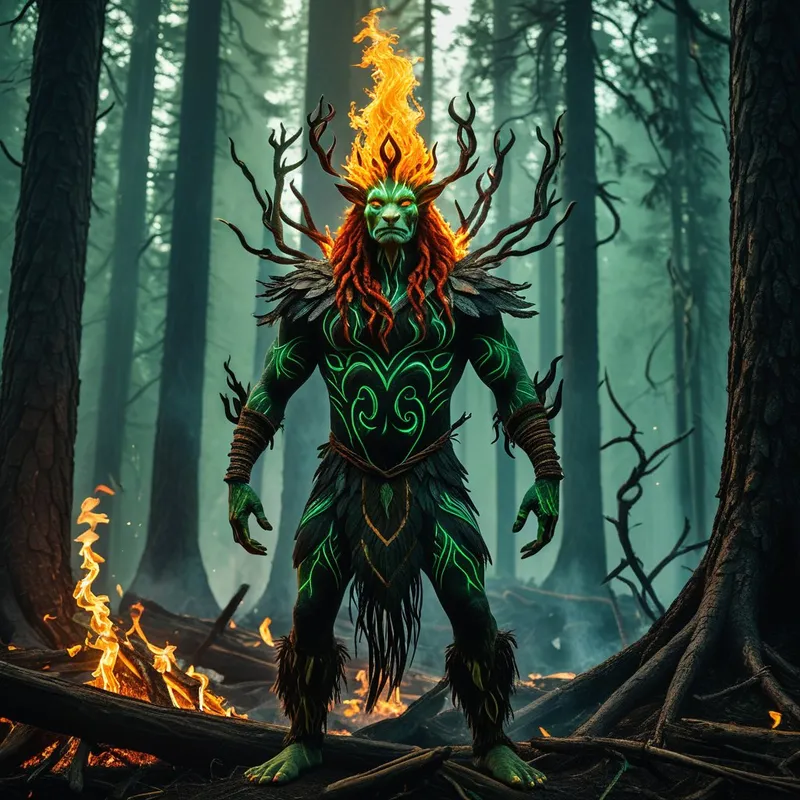
But in the heart of the inferno, a different truth stirred. The Keeper of the Deep Wood did not flee. This entity, old as stone and patient as shadow, stood within the flames. Its skin was like cracked bark, its hair the streaming smoke. It did not fight the fire; it opened its arms to it. For the Keeper remembered the covenant.
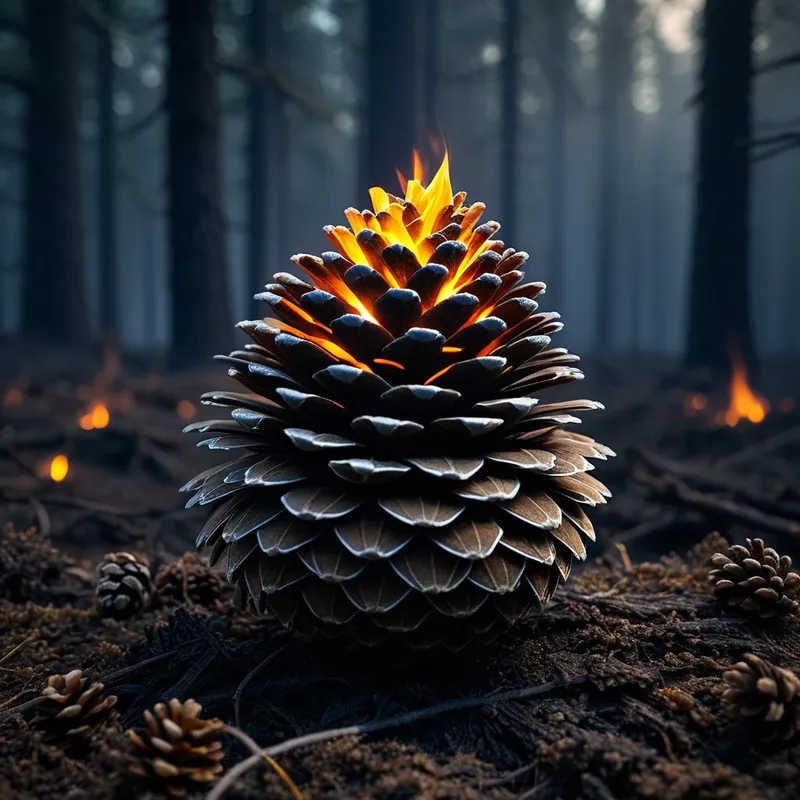
As the roaring beast passed, consuming the clutter of centuries, a miracle was performed in its wake. The intense heat worked upon the sealed Serotinous Vaults of certain trees. With a sound like a hundred tiny drums, they burst open, scattering a rain of precious seeds onto the newly bare, mineral-rich soil below. The fire’s ash became a blanket of potent nourishment.
And then, the Rumbling ceased. The beast of Fire, its work complete, sank back into the earth, sated. Rain came, a gentle, weeping rain that cooled the scorched land. Where there had been a monochrome of green and shadow, now there was a canvas of black and grey. But from that canvas, within days, a tender, vibrant green emerged. Not the deep, somber green of before, but a brilliant, hopeful green. Sunlight, long denied, flooded the forest floor. New trees, straight and strong, reached for the sky. Flowers unknown for generations painted the earth. The air hummed with new life. The forest was not dead. It had been sung awake.
Cultural Origins & Context
This is not a myth belonging to a single culture, but a ecological truth so fundamental it has been woven into the spiritual fabric of numerous peoples who live in fire-adapted landscapes. From the Indigenous nations of the North American ponderosa pine forests to the Aboriginal custodians of the Australian bush, from the tribes of the Mediterranean maquis to those of the African savanna, the story recurs. It was passed down not merely as a tale, but as a practical, sacred science.
Elders and fire-keepers were its custodians. They told it during ceremonies, pointing to the blackened scars on grandfather trees and the lush meadows that followed. Its societal function was multifaceted: it explained the terrifying yet necessary phenomenon of wildfire, it encoded the knowledge of when and how to use controlled cultural burning to protect the land, and it provided a cosmological framework for understanding cycles of death and rebirth that were observable in the natural world. The myth justified and sanctified the human role as a participant in this cycle, not merely a victim or an outsider.
Symbolic Architecture
At its core, this myth is a master symbol of the necessary creative destruction. The old, stagnant forest represents the psyche—or a life—that has become overgrown. It is successful on the surface but decaying within, choked by outdated beliefs, unresolved traumas (the "deadfall"), and patterns that no longer serve but are too familiar to clear away.
The fire does not destroy the forest; it destroys the forest's imprisonment. It is the ruthless, purifying agent of truth that burns away the inessential to reveal the essential ground of being.
The Keeper of the Deep Wood symbolizes the enduring Self, the core identity that can witness and contain the process of radical transformation without being annihilated by it. It is the part of us that knows, deep down, that a breakdown can be a breakthrough. The Serotinous Vaults are the latent potentials, the hidden seeds of new life, creativity, or insight that we carry within us but which remain sealed—protected—until a certain intensity of experience (crisis, loss, profound passion) "heats" us enough to crack us open and release them.
The Dreamer's Resonance
When this mythic pattern erupts in modern dreams, it often signals a profound somatic and psychological initiation. Dreaming of a controlled, purposeful fire in a natural setting may point to an active, conscious engagement with personal transformation. However, dreaming of a terrifying, out-of-control wildfire often reflects the dreamer's experience of being in the grip of an overwhelming emotional or life crisis—the "heat" feels destructive, not purifying.
The somatic experience is key. The dreamer may wake feeling the heat of shame, the ache of loss, or the adrenaline of panic. Psychologically, they are in the liminal space—the scorched earth between the death of the old and the birth of the new. This is a state of profound vulnerability, but also of immense potential. The dream is the psyche's way of portraying this terrifying yet sacred process, assuring the dreamer that even this inferno is part of the ecology of the soul. The appearance of green shoots in the dream, even amidst ashes, is a direct message from the unconscious: renewal is already in motion.
Alchemical Translation
The alchemical journey, or individuation, is perfectly modeled by this myth. The process begins with the nigredo—the blackening. This is the forest in its state of stagnant, heavy growth and the subsequent burning. It is the conscious descent into chaos, depression, or crisis, where everything one knew seems to be consumed.
The alchemist does not avoid the fire; they learn its nature. They become the Keeper within the flames, holding the tension between destruction and creation until the new substance is formed.
The fire itself is the calcinatio—the burning away of impurities by intense heat (suffering, conflict, fierce introspection). This is not a gentle process. It reduces the complex, overgrown persona to its basic, essential components: ash and bare earth. This is the stage of sacrifice, where what is no longer needed is offered up.
From this bare ground emerges the albedo—the whitening, represented by the first tender green shoots and the cleansing rain. This is the stage of insight, clarity, and new beginnings. The seeds released by the fire (the citrinitas, or yellowing, the dawning of the "solar" understanding) now germinate. Finally, the new, resilient, and more diverse forest represents the rubedo—the reddening, or the creation of the enduring, integrated Self. The cycle is complete, but not closed. The new forest will eventually grow dense again, and the wisdom of the myth is knowing that the fire is not an enemy, but a periodic, sacred guest in the eternal cycle of becoming. The modern individual's triumph is in moving from identifying as the burning tree to identifying as the entire, resilient ecosystem.
Associated Symbols
Explore related symbols from the CaleaDream lexicon: