
Fool's Cap Myth Meaning & Symbolism
A wandering fool's magical cap reveals the world's true nature, teaching that wisdom often wears the mask of folly.
The Tale of Fool's Cap
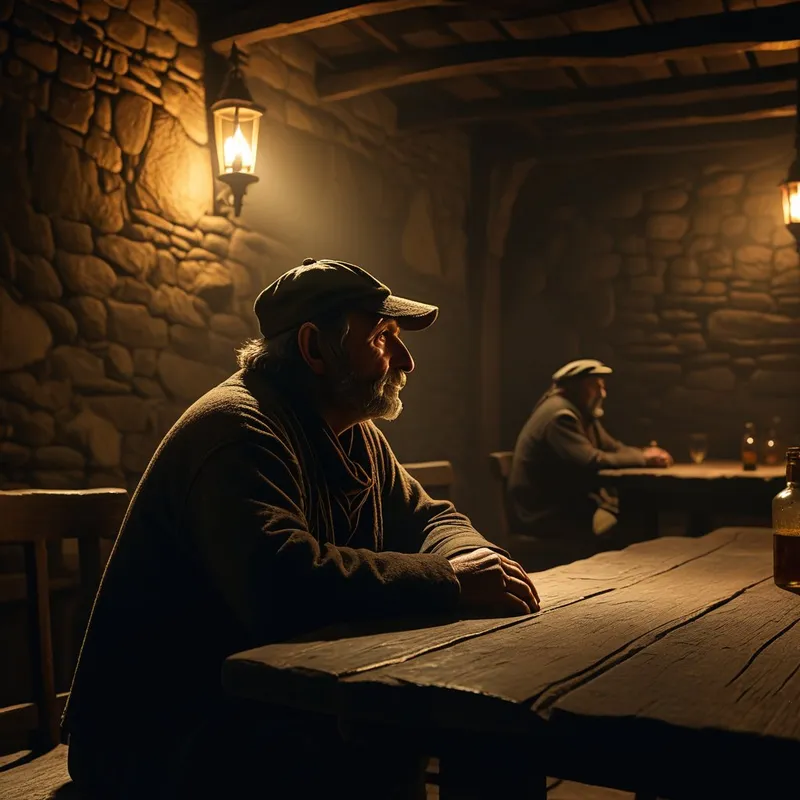
Listen, and let the hearth-fire smoke carry this tale to the corners of your mind. In a time when the roads were dust and the world was woven with older magics, there walked a figure known only as the Wanderer. He was not a king, nor a warrior, nor a merchant of note. His cloak was patched with the colors of forgotten banners, and on his head sat a cap—a ridiculous, floppy thing, too large, adorned with a single, silent bell and a feather from a bird no one could name.
He came to a village gripped by a silent blight. The crops grew, but tasted of ash. The children laughed, but their eyes were old. The elders spoke, but their words held no warmth. The people, in their despair, had turned their fear outward. They saw the Wanderer’s strange gait and heard his nonsensical songs about rivers that flowed uphill and stones that told stories. They named him Fool, and their scorn was a bitter tonic they drank daily.
One evening, as a cold fog slithered from the woods, a true darkness arrived. It was not a beast, but a Grey Silence, a presence that leached color from the fire and meaning from words. It settled in the village square, and the people found they could not speak at all; their voices were stolen, their thoughts turned to mud.
The Fool, untouched, or perhaps too simple to notice, wandered into the square. He tilted his ridiculous cap. The villagers, in their mute terror, watched as he did not flee. Instead, he began to dance—a clumsy, hopping jig. He sang his foolish song to the oppressive silence. The Grey Silence seemed to pulse, amused by this morsel of idiocy.
Then, the Fool stumbled. His oversized cap tumbled from his head and landed on the cobblestones. In that moment, the perspective shifted. Through the empty crown of the cap, the villagers saw not a fool, but the Grey Silence for what it truly was: a shriveled, fearful thing, a phantom fed only by their own certainty and scorn. And looking at the Wanderer standing bare-headed, they saw not folly, but a profound, unshakeable clarity in his eyes—a light that had been hidden beneath the cap’s brim.
The Wanderer smiled, a gentle, knowing thing. He did not reach for a weapon, but for his cap. As he placed it back upon his head, the illusion returned. He was the Fool once more. But the spell was broken. The Grey Silence, exposed and powerless against this unveiled perception, unraveled like mist in a sudden wind. Sound rushed back—the cry of a night bird, the sigh of the wind, the beating of their own hearts. The Wanderer gave a final, cheerful nod, turned on his heel, and continued his journey down the dusty road, his solitary bell now tinging softly in the clear air.
Cultural Origins & Context
The motif of the Fool's Cap is a true citizen of the world, appearing in fragments and echoes from European carnival traditions and Slavic folktales to the trickster narratives of Indigenous Americas and the parabolic teachings of Asian sages. It belongs to the oral tradition of the crossroads and the marketplace, told by travelers, minstrels, and grandmothers by the fire. Its tellers were often those on the margins—the ones who could observe the center from a distance.
Its societal function was multifaceted. For the oppressed, it was a fantasy of secret power and vindication. For the powerful, it was a cautionary tale about the blindness of pride and the wisdom that can reside in lowly places. At its core, it served as a cultural release valve, allowing a society to laugh at itself while secretly questioning the very foundations of its hierarchies and judgments. The myth affirmed that truth is not always solemn, that the sacred can be playful, and that the one who seems furthest from power may be closest to the fundamental realities of existence.
Symbolic Architecture
The cap itself is the central unifying symbol. It is both a mask and a lens, a container of identity and a tool of perception.
The cap does not hide the fool; it reveals the world as foolish, until the moment it falls, and reveals the fool as the only one who truly sees.
The Wanderer represents the Self in its unadorned state, choosing the guise of the Trickster to navigate a world asleep in its own convictions. His folly is a deliberate language, a code that can only be deciphered when one’s own conventional language fails. The villagers symbolize the collective ego, the persona, which is rigid, judgmental, and terrified of ambiguity. The Grey Silence is the psychological stagnation that sets in when this persona becomes absolute—the depression, meaninglessness, and psychic numbness that arise from a life lived only on the surface of things.
The cap’s fall is the critical moment of anagnorisis. It represents the involuntary collapse of our chosen identities and defenses. In that raw, uncapped moment, perception is cleansed. We see the inner poverty of our fears (the Grey Silence) and recognize the hidden sovereignty within (the Wanderer’s true gaze).

The Dreamer's Resonance
To dream of the Fool’s Cap is to dream at the precipice of a profound psychological shift. You may dream of finding a strange hat, of wearing one that feels alien yet familiar, or of it being forcibly removed. These are not casual symbols.
Somatically, this dream often accompanies a feeling of lightness or exposure around the crown of the head, a sense of being “uncapped.” Psychologically, it signals that the ego’s current strategy—its “cap” of the competent professional, the perfect partner, the cynical intellectual—has become a prison. The dream is the psyche’s enactment of the myth: it is forcing the cap to fall. The ensuing vulnerability is not a weakness, but the necessary precondition for insight. The “Grey Silence” in the modern dream may manifest as a suffocating job, a lifeless relationship, or a pervasive sense of ennui. The dream asserts that this stagnation is an internal condition, a construct maintained by your own allegiance to a limiting self-image. The dream-fool’s dance is the psyche’s irrational, instinctive move towards life, even when the conscious mind sees no logical path forward.
Alchemical Translation
The myth of the Fool’s Cap is a perfect map for the alchemical stage of nigredo and the beginning of albedo. The Wanderer’s journey into the scornful village is the descent of consciousness into its own shadowy, undervalued aspects—the foolish, the naive, the unsophisticated.
Individuation does not begin with putting on the crown of the king, but with willingly donning the cap of the fool. The first gold to be sought is the humility to be seen as nothing.
The “work” here is not an effortful striving, but a paradoxical allowing. It is the courage to entertain the foolish thought, the irrational impulse, the humiliating hobby. This is the dance before the Grey Silence. The cap’s eventual, accidental fall is the moment of psychic automatism, where the unconscious intervenes and shatters the conscious attitude. The integration occurs not when we permanently discard the cap, but when we consciously choose to wear it again, now knowing it is a cap. This is the transmutation. The individual no longer is a fool, but can play the fool when the situation demands—to challenge dogma, to introduce creativity, or to protect their own inner wisdom from a world that might otherwise try to crucify it or crown it too heavily. They become the Wanderer: sovereign, unattached, and moving freely through a world they perceive with unveiled eyes, all while wearing a bell that tingles with the secret joy of their own transformation.
Associated Symbols
Explore related symbols from the CaleaDream lexicon: