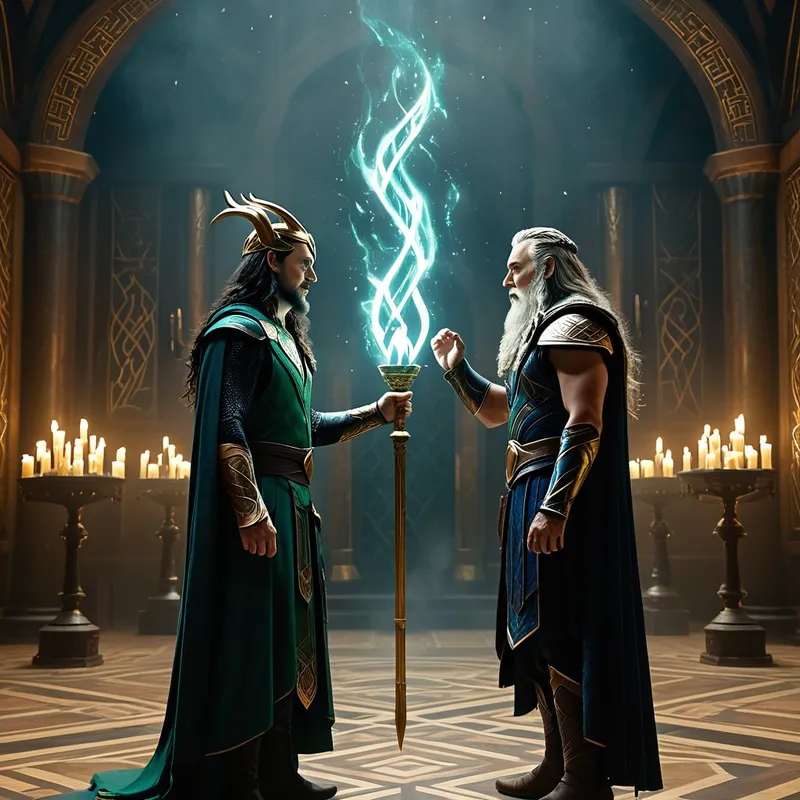
Flyting Myth Meaning & Symbolism
A mythic duel of words where insults become a sacred art, revealing hidden truths and forging identity in the crucible of confrontation.
The Tale of Flyting
Hear now the tale not of steel, but of the sharper blade. In the high hall of the gods, where the rafters groan with the weight of ages and the hearth-fire licks the shadows with a hungry tongue, a silence gathers. It is not a peaceful quiet, but the dense, humming stillness before the storm. The air is thick with the scent of pine resin, spilled ale, and the musk of wolf-pelts.
At the high seat, the Odin sits, his one eye a well of frozen sky, watching. The mead-horn passes from scarred hand to scarred hand, but the laughter is brittle tonight. For among them walks the flame-haired one, the weaver of knots, Loki. His smile is a crack in the world’s composure, and his eyes hold the mischievous glint of chaos itself.
It begins not with a shout, but with a sigh. A pointed word, disguised as a jest, about a spear-thrust that went awry. A retort, cloaked in a proverb, about wisdom bought too dearly. The circle of gods and goddesses tightens. This is the game they know, the sacred, terrible game: the flyting. The contest of insults, where verse is your armor and truth your only weapon.
Loki’s voice is like honeyed venom. He does not merely accuse; he unveils. He speaks of Thor’s fumbling in a giant’s glove, of the Asynjur and their whispered infidelities, of Heimdall’s lowly origins. Each line is a perfectly crafted spear, aimed not at the flesh, but at the story the god has built around themselves. The air grows cold. The fire sputters.
But the gods are not without their own poets. One by one, they rise. They give back his poison, refined in the forge of their own wounded pride. They recount Loki’s monstrous children, his slippery oaths, the essential, unstable fire at his core that can warm a hall or burn it to ashes. They do not call him evil; they name him necessary disruption. They do not call him liar; they name him uncomfortable truth.
The duel crescendos. It is no longer about shame, but about essence. The insults become incantations, stripping away titles and reputations until only the raw, quivering being remains. Loki, cornered by the chorus of his own unveiled nature, finally spits his last, most devastating truth—a secret so foundational it threatens the very order of Asgard. And in the shocking silence that follows, the resolution is not victory, but a terrible, crystalline clarity. The words hang in the smoke, undeniable. The feast is over. The world has been remade, not by a hammer, but by a tongue.

Cultural Origins & Context
This ritual of verbal combat, known as flyting (from the Old Norse flyta, meaning to provoke or quarrel), was far more than mere entertainment in the Norse world. It was a sanctioned, highly formalized social and legal mechanism. In the sagas and eddic poetry, like the infamous Lokasenna (Loki’s Flyting), we see it performed in the most sacred of spaces: the feasting hall. This was the heart of community, where status was affirmed, law was spoken, and honor was currency.
The flyting was presided over by the lord of the hall and required a deep knowledge of complex poetic meter (like fornyrðislag), kennings (metaphorical compound phrases), and the intricate web of kinship and deed that comprised a person’s social standing. To engage in flyting was to step onto a verbal battlefield where the stakes were public honor and social position. A skilled flyter could defend their status, humiliate a rival, or even settle a dispute without bloodshed by proving superior wit and verbal power—qualities deeply associated with Odinic wisdom. It was a theater of truth, however brutal, where the collective consciousness of the community could air its grievances and renegotiate its hierarchies through the sacred power of the spoken word.
Symbolic Architecture
At its core, the myth of flyting symbolizes the terrifying and necessary process of confrontation with the shadow—both personal and collective. The mead-hall represents the conscious ego, the ordered self, and society. Loki, the flyter, embodies the eruptive, unconscious shadow: all that is repressed, shameful, chaotic, and yet intrinsically true.
The insult in flyting is not a mere slur, but a symbolic knife that cuts away the persona, the mask we present to the world and to ourselves.
Each poetic barb is a projection made conscious. When Loki accuses the gods of cowardice or adultery, he is holding up a mirror to their hidden flaws. The gods’ retaliation is the ego’s defense mechanism, attempting to re-integrate this disruptive energy by naming its source. The flyting is a psychic drama where identity is not defended, but forged in the fire of exposure. The goal is not annihilation, but a brutal honesty that leads to a more complete, if more uncomfortable, state of being. The word, here, is a tool of alchemy, attempting to transmute base hypocrisy into golden, if painful, integrity.

The Dreamer's Resonance
When this mythic pattern stirs in the modern psyche, it often manifests in dreams of intense verbal arguments, public shaming, or being tongue-tied in a critical moment. You may dream of shouting truths that you dare not speak awake, or of being mercilessly criticized by a shadowy figure. Somatic sensations often accompany these dreams: a constricted throat, a burning in the chest, a feeling of being exposed and vulnerable.
This is the psyche initiating its own flyting. It signals a point of internal conflict where a repressed aspect of the self (your inner Loki) is demanding acknowledgment. The "insults" of the dream are the uncomfortable truths about yourself that your conscious persona has refused to admit—perhaps a hidden ambition, a denied weakness, or a stifled creative impulse. The psychological process is one of discrimination: the painful but necessary separation of the ego from its self-deceptions, forcing a confrontation with the authentic, complex, and often contradictory totality of the individual.

Alchemical Translation
The alchemical journey modeled by flyting is the Nigredo—the blackening, the putrefaction, the stage of confrontation and despair that is the essential first step toward wholeness. In our personal individuation process, we must engage in a sacred flyting with ourselves.
This means consciously inviting our inner critic, our shadow, our "Loki" to speak. We must create a safe, internal "hall" (through journaling, therapy, or active imagination) and allow the brutal, poetic truths to surface. We listen to the accusations: "You are a fraud," "You are cowardly," "You are selfish." The modern temptation is to silence this voice, to brand it merely negative. But the myth teaches us to answer it, to engage with it poetically, to refute it with other truths, and ultimately, to integrate its message.
The transmutation occurs not when the shouting stops, but when we realize the voice of the flyter is our own, and its harsh poetry contains the ore of our hidden gold.
By enduring this internal battle of words, we perform an alchemy on the psyche. The leaden weight of self-deception is exposed to the fire of truth. We do not emerge "better" in a simplistic sense, but more real. We gain the sagacious power of the sage, who sees the world, and himself, with unflinching clarity. The chaos of Loki is not expelled but given a seat at the table, its disruptive energy transformed into the catalytic force that prevents the soul from stagnating. We become, like the hall after the flyting, quieter, emptier, but immeasurably more aware of what—and who—truly resides within our walls.
Associated Symbols
Explore related symbols from the CaleaDream lexicon: