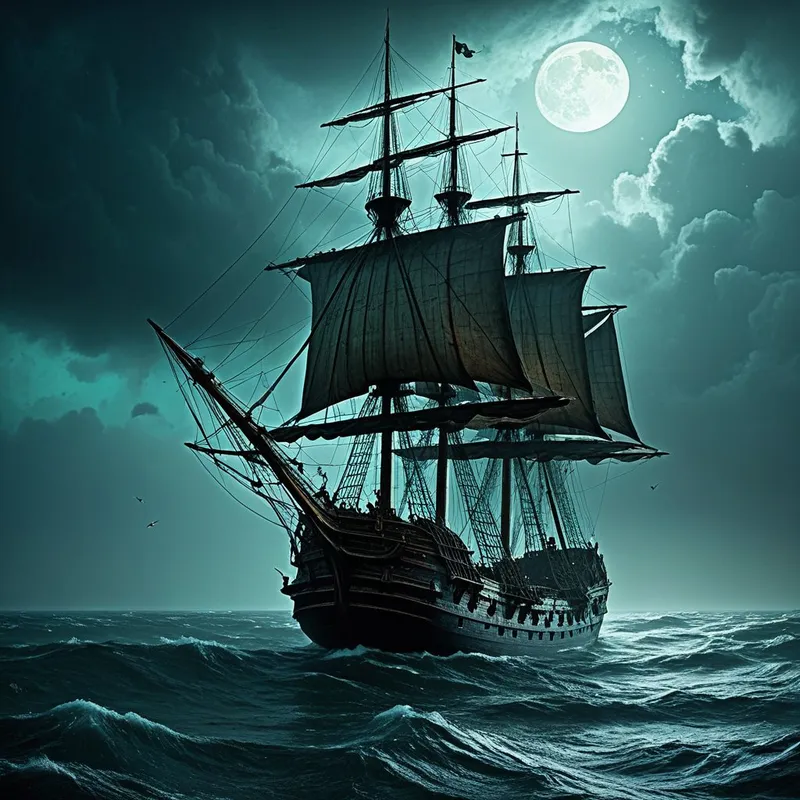
Flying Dutchman Myth Meaning & Symbolism
A ghost ship doomed to sail forever, its captain's hubris a curse, a spectral warning on the wind between damnation and a faint, impossible hope.
The Tale of the Flying Dutchman
Listen, and hear the wind’s oldest warning. It does not whisper; it howls a name across the centuries of salt and spray: De Vliegende Hollander. The Flying Dutchman.
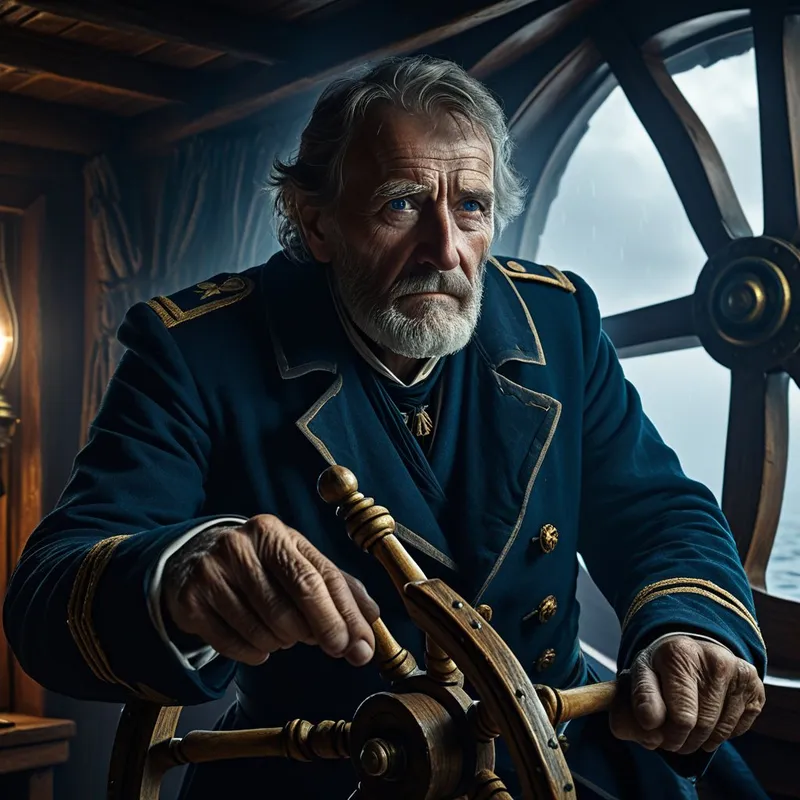
Our tale begins not in calm waters, but in the heart of a fury. The year is lost to time, but the ship is eternal: a mighty fluyt, her sails fat with the pride of an empire, her holds hungry for spice and fortune. And at her helm stands a man carved from the same stubborn oak as his vessel: Captain Hendrick van der Decken. His will is a compass that points only forward, his ambition a fire no ocean could quench.
He sought the Cape of Storms, that graveyard of ships we now call the Cape of Good Hope. The sky there did not promise fortune; it conspired. Clouds, black as a priest’s robe, swallowed the sun. Winds shrieked like the damned. Waves rose not as water, but as moving mountains intent on crushing his world to splinters. The crew, faces slick with rain and fear, begged him to turn back. "Captain! For God’s sake, reef the sails! Run before the wind!"
But van der Decken laughed, a sound swallowed by the gale. He cursed their cowardice. He cursed the sea. And then, as the mast groaned like a dying giant and the very timbers of his ship screamed, he committed the ultimate blasphemy. He raised a fist to the heavens, his voice cutting through the storm’s roar. "I will round this Cape," he swore, "if I must sail until the Day of Judgment!"
The universe answered. Not with a louder wind, but with a sudden, profound silence in the eye of the chaos. And then, a Figure stood upon the wave-tossed deck, though no boat had brought Him. He was calm, terrible, and His voice was the sound of deep water and old stars. He spoke of mercy, of rest, of turning back from this path of self-destruction.
Van der Decken, his soul already half-drowned in his own defiance, met this offer with a snarl. He challenged the divine messenger. He swore his oath again, eternal and irrevocable. In that moment, the die was cast. The Figure pronounced the doom, not in anger, but as a simple statement of cosmic law: "So be it. You shall sail on forever. You shall never know port, nor peace, nor the solace of the grave. A plague upon you and your ship."
And so it was. The storm abated, but not for him. His ship was lifted from the water of mere oceans into the spectral sea of eternity. The Dutchman became a ghost, a phantom of salt-bleached wood and sails that catch only the winds of purgatory. He and his crew are condemned to their endless task, forever on the verge of rounding that impossible Cape. To sight his ship, glowing with a sickly, phosphorescent light against the night, is to behold a moving monument to pride. Some say he is allowed to make port once every century, to seek a woman’s true love that might break the curse—a single, fragile thread of hope in a tapestry of despair. But the Cape always calls him back to his futile labor, a restless spirit sailing the border between worlds, a warning written in mist and moonlight for all who dare the deep.
Cultural Origins & Context
The myth of the Flying Dutchman is a child of the Dutch Golden Age, born from the collision of immense worldly success and profound mortal peril. This was an era when Dutch merchants and sailors, empowered by the mighty VOC, knit the globe together with trade routes, bringing unimaginable wealth from the Spice Islands. The sea was both the source of this fortune and its greatest reaper.
The tale is a quintessential piece of fo'c'sle lore, passed not in books but in the hushed tones of sailors in smoky taverns, or during the long night watches under strange southern stars. It functioned as a communal narrative tool. On one level, it was a supernatural explanation for the very real and terrifying optical illusions at sea—Fata Morgana—that could make a ship appear where none existed. On a deeper level, it served as a powerful moral and psychological anchor. In a profession ruled by the caprice of wind and wave, where a captain’s word was absolute law, the story of van der Decken was a stark parable about the limits of human authority. It preached a humility before God and nature that the Calvinist Dutch culture would have understood intimately. The captain’s sin was not mere ambition, but hubris—the defiance of natural and divine order for personal glory. The ghost ship thus became a floating sermon, a reminder that no amount of worldly power could save a soul from the consequences of its own cursed choices.
Symbolic Architecture
At its core, the Flying Dutchman is not a ghost story, but a profound map of a damned psyche. The ship itself is the persona—the outward vehicle of the ego—now frozen in a single, catastrophic moment of choice, forever displaying its grandeur and its ruin. The crew represents the fragmented aspects of the self, compelled into the service of a tyrannical directive.
The curse is not an external punishment, but the internal, eternalizing echo of a vow the ego makes to itself: "I will succeed on my terms, or I will be destroyed."
Captain van der Decken embodies the psychic complex of unbending will, the part of us that would rather be eternally right than momentarily surrendered. His oath at the Cape is the moment a stubborn thought, a grudge, or a fixation hardens into an identity. The Cape of Good Hope, ironically named, becomes the symbol of the longed-for goal that is always just beyond reach, the "if only" that structures a life of quiet desperation. The spectral voyage is the experience of being trapped in a behavioral or emotional loop, where one is busy sailing—working, striving, managing—but never actually arriving at any meaningful destination or rest.
The faint possibility of redemption through true love introduces the crucial element of the Other. It suggests that the self-made prison can only be unlocked from the outside, through a connection genuine enough to pierce the shell of obsession. It is the heart’s grace challenging the will’s tyranny.
The Dreamer's Resonance
When this myth stirs in the modern dreamer, it rarely appears as a full-rigged ghost ship. Instead, one may dream of being trapped in a vehicle—a car, a train, an elevator—that is moving endlessly toward a destination that never materializes. The dreamer is often at the controls, feeling a compulsive responsibility to keep going, coupled with a deep, somatic exhaustion. The landscape outside is monotonous, foggy, or stormy.
Psychologically, this is the somatic signature of an autonomous complex at the helm. The dreamer is identified with a "van der Decken" part of themselves: a driven executive, a perpetual caregiver, an artist obsessed with an unattainable ideal. The body in the dream feels the weight of this endless voyage—tight shoulders (carrying the burden), a dry mouth (the unsaid plea for help), or a feeling of chilled isolation. The dream is a report from the psychic frontier, stating, "The current course is unsustainable. You are sailing on a sea of your own stubbornness, and the land is an illusion." It marks a point where the ego’s project has become a prison, and the soul is begging for a mutiny.

Alchemical Translation
The alchemical journey mirrored in this myth is the arduous transition from the nigredo—the blackening, the state of despair and fixation—toward the albedo, which requires the dissolution of the very vessel of the old self.
The first and most radical step in transmuting this curse is not to sail better, but to willingly become shipwrecked.
The Dutchman's salvation does not lie in finally rounding the Cape through greater effort, but in the unthinkable act of letting go of the wheel. This is the alchemical solutio. For the modern individual, this translates to the conscious surrender of a controlling identity: the workaholic allowing a project to fail, the perfectionist embracing "good enough," the martyr ceasing to sacrifice. It is the death of the god-like captain-ego.
The mythical port he seeks every century symbolizes the rare, kairotic moment when the hardened heart is vulnerable enough to receive grace—often in the form of love, compassion, or a simple moment of genuine human connection that contradicts a lifetime of stubborn narrative. This love is the aqua permanens, the solvent that can melt the cursed oath. The integration of this myth is the realization that the true destination was never a geographical point, but a state of being: the peace found not in conquering the storm, but in laying down arms against life itself. The ship may never reach a earthly port, but in that surrender, the soul finds its anchorage.
Associated Symbols
Explore related symbols from the CaleaDream lexicon: