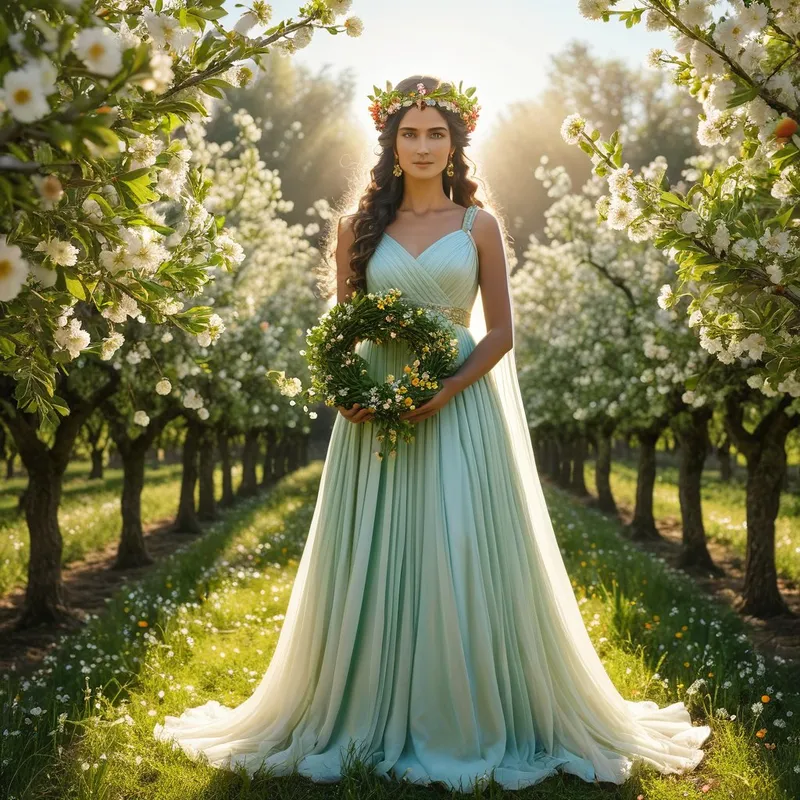
Flora Myth Meaning & Symbolism
The myth of Flora, a nymph transformed into the Roman goddess of flowering plants, reveals the alchemy of beauty, sovereignty, and cyclical rebirth.
The Tale of Flora
Listen, and let the scent of crushed blossoms carry you back. Before there was a name for spring, there was a nymph named Chloris. She wandered the wild meadows of a world still rough-hewn, where beauty was a fleeting, fragile thing, easily trampled. Her domain was the green shoot, the tender bud, the silent promise beneath the soil.
One day, as she danced through a field, the West Wind, Zephyrus, saw her. He was not a tempest, but the breath that stirs the first warm day after winter. Enchanted by her vitality, he pursued her. This was no violent abduction of mythic old, but a courtship of the elements. Chloris fled, not in terror of a monster, but from the overwhelming force of a destiny she could not yet comprehend—the transformation from maiden to mother, from part of the wild to its sovereign.
As she ran, her breath came in gasps that smelled of green sap. Zephyrus’s gentle, persistent breeze enveloped her. Where his breath touched her lips, words turned to petals. From her mouth spilled not a scream, but a cascade of roses. Her hair, streaming behind her, became a river of anemones and violets. Her skin, where the wind caressed it, softened into the velvet of poppy blooms. Her fleeing footsteps took root, and where she had stepped, the earth erupted in a riot of color and fragrance. She did not cease to be Chloris; she blossomed into something more. She became Flora.
Zephyrus, having wrought this miracle, took her as his wife. But this union was her coronation, not her captivity. He gifted her a realm of eternal spring, a garden where every plant that ever was or could be came to flower. And Flora, now goddess, did not merely preside. She learned the secret names of all seeds. She discovered the alchemy of coaxing color from the stem and scent from the dew. She became the architect of blossoms, the painter of meadows. When the world lay grey and dormant, it was Flora whom the great Jupiter consulted to restore its beauty, granting her dominion over all that flowers. Her festival, the Floralia, was not a somber rite, but a explosion of life—a carnival of petals, loose robes, and revelry, where the strict order of Rome temporarily dissolved into the joyful chaos of the blooming earth.
Cultural Origins & Context
The figure of Flora is a fascinating palimpsest of Italic and Greek influence. Her origins are likely ancient Italic, a native spirit of flowering and fertility worshipped by the Sabines and Oscans long before the rise of Rome. As Rome expanded and synthesized the cultures it encountered, Flora was seamlessly syncretized with the Greek Chloris, borrowing her poetic origin story from works like Ovid’s Fasti, a calendar of Roman festivals and myths.
Her primary societal function was anchored in the agricultural cycle. Romans were a practical people, and their gods had portfolios. Flora’s was unequivocal: the protection and promotion of flowering plants. This was not mere aesthetics; it was economics and survival. Successful flowering meant successful fruiting, which meant food, wine, and prosperity. Her priesthood, the flamen Floralis, and her major festival, the Floralia (April 28 – May 3), were vital civic acts to ensure a bountiful growing season.
Yet the Floralia reveals a deeper, more subversive layer. Marked by theatrical performances (often mimes and comedies), the wearing of brightly colored clothes (a break from the white toga), and the scattering of seeds and beans (symbolic of fertility), the festival temporarily inverted social norms. It was a licensed release, a symbolic return to a more primal, untamed state of nature, channeled through the goddess of blossoms. Flora governed not just the flower, but the fleeting, joyful, and sometimes risqué energy of spring’s awakening—a necessary psychological pressure valve for a rigidly ordered society.
Symbolic Architecture
Flora’s myth is a masterclass in non-violent transformation. She is not conquered; she is catalyzed. The central symbol is the blossom itself: the vulnerable, beautiful, ephemeral culmination of hidden growth. It represents the moment of manifestation, when internal potential becomes external reality.
The flower does not argue with the seed; it is the seed’s most eloquent speech.
Zephyrus symbolizes the necessary other, the external catalyst—be it love, inspiration, crisis, or insight—that precipitates transformation. He is not a destructive force but the animating breath that forces the bud to open. Their union represents the sacred marriage (hieros gamos) between the latent potential (the nymph) and the activating principle (the wind), a union that gives birth to a new, sovereign consciousness.
Flora’s sovereignty is key. She is given a realm and learns its secrets. This moves her from a passive object of desire to an active subject, a creator in her own right. She transitions from being an aspect of nature (nymph) to being the conscious, naming, cultivating spirit of nature (goddess). Her festival, the Floralia, symbolizes the temporary dissolution of persona—the rigid, social self—allowing for the expression of a more instinctual, colorful, and joyful layer of the psyche.
The Dreamer's Resonance
When the pattern of Flora’s myth stirs in the modern unconscious, it often signals a profound inner readiness to bloom. To dream of being surrounded by sudden, unexpected flowers, or of feeling petals forming on one’s own skin, is not mere fantasy. It is the somatic psyche announcing a culmination.
This is the dream of the individual who has endured a long, inward winter of preparation—a period of study, therapy, grief, or quiet gestation. The “Zephyrus” catalyst in the dream may appear as a new relationship, a career opportunity, a creative idea, or simply an overwhelming surge of feeling that feels both exhilarating and terrifying. The dreamer may experience this as pursuit, but the psychic truth is attraction: the soul is magnetically pulling toward it the very force needed to break its dormancy.
The psychological process is one of yielded transformation. Resistance is not met with greater force, but with a miraculous change in state. The ego, which fears dissolution, is invited not to die, but to transmute—to express its essence in a new, more beautiful, and more public form. The anxiety of “losing oneself” is reframed as the necessity of “becoming what one is.”
Alchemical Translation
In the alchemical vessel of the soul, Flora’s myth models the stage of albedo—the whitening, the flowering. After the blackening (nigredo) of dissolution and the greening (viriditas) of new growth comes the glorious and vulnerable moment of manifestation. The psychic transmutation here is from latent talent to embodied art, from inner knowing to outer expression, from private feeling to shared beauty.
Individuation is not about becoming perfect, but about becoming specific—unfolding the unique pattern of your own blossom in the world’s garden.
The modern individual engaged in this alchemy must first acknowledge their own “nymph” state: the potential that feels tender, hidden, and perhaps too fragile for the world. The encounter with the “Zephyrus” catalyst—often experienced as falling in love, a vocational call, or a crisis that demands authenticity—forces the issue. The choice is not whether to change, but how to change. Will one flee in fear, or allow the catalyzing breath to work its magic?
The triumph is Flora’s sovereignty. The final stage is not the bloom alone, but the conscious cultivation of the garden. It is taking the transformed self and learning its laws, tending its gifts, and ultimately, sharing its fruits. It is moving from being transformed by life to becoming a transformative force in life, a source of beauty and renewal for oneself and one’s community. The festival of the Floralia reminds us that this process, while profound, need not be solemn. It can be, and perhaps must be, infused with color, pleasure, and a joyful release of the spirit.
Associated Symbols
Explore related symbols from the CaleaDream lexicon: