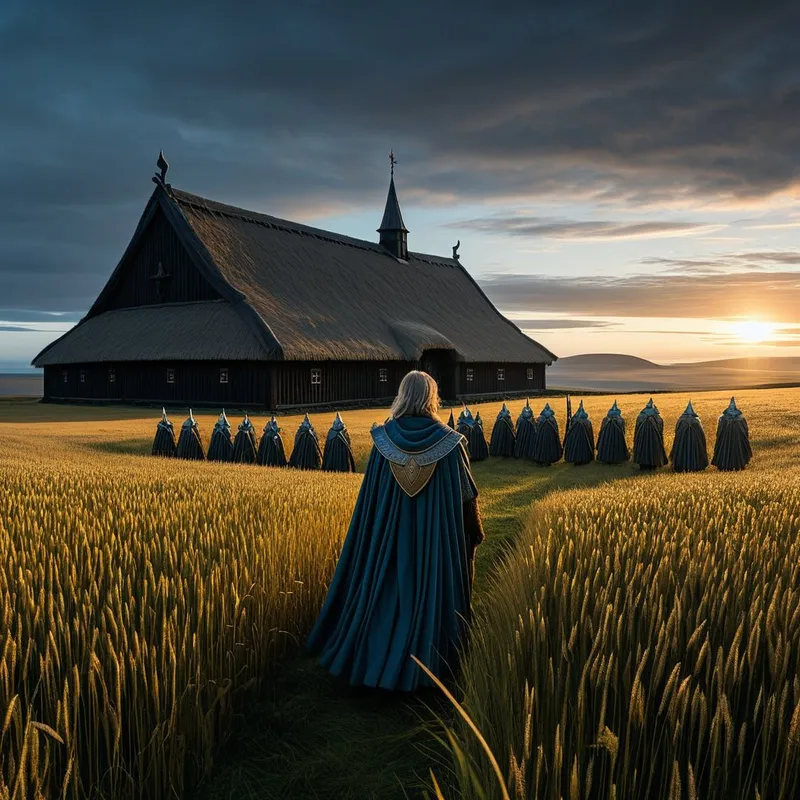
Fólkvangr Myth Meaning & Symbolism
The hall of Freyja, where half the battle-slain reside, a field of the people, a realm of love, war, and the deep feminine principle.
The Tale of Fólkvangr
Listen, and hear of the field where the banners are laid down, where the clamor of iron fades into a sigh of wind through long grass. It is not the only hall that awaits the brave departed, but it is the one sung of in whispers, a secret held close by the Valkyries. For every day, as the ravens fly and the wolves howl, the Choosers of the Slain ride forth from Asgard and Vanaheim alike.
Their queen is Freyja of the Vanir, she of the feathered cloak, she whose tears are gold and whose heart knows the depths of desire and the sharpness of loss. To her belongs the first choice. As swords clash and shields splinter on the mortal plane below, her gaze, fierce and sorrowful, falls upon the fallen. She does not seek only the mightiest king or the most famed berserker. She seeks the one who fought with a full heart, who loved their land with a fury, who held loyalty as a sacred bond even as the life-blood seeped into the soil.
And when she chooses, the world shifts. The fallen warrior, their spirit lifting from the broken husk, does not see only the stern faces of Odin’s messengers. They feel a softer pull, a resonant call that speaks not just of glory, but of homecoming. They are gathered, not to a roaring hall of endless mead and boastful tales alone, but to a vast, sun-dappled field—Sessrúmnir, “the room with many seats,” stands serene at its heart.
Here, in Fólkvangr, the “field of the people,” the air is sweet with the scent of meadow flowers and ripe grain. The eternal twilight is gentle, a balm to eyes strained by battle’s glare. The chosen ones—half of all those who fall with honor—are greeted not as mere recruits for a final war, but as guests. Their armor is removed, not discarded, but honored. Their wounds, though spirit-deep, are soothed by the profound peace of the place. They find rest, not in oblivion, but in a profound recognition. They are seen, in their entirety, by the goddess who embodies the terrible and beautiful cycle of all things: love, fertility, magic, war, and death. In her field, they are made whole, not just warriors, but people once more, awaiting what final destiny the roots of the Yggdrasil may hold.
Cultural Origins & Context
The primary source for Fólkvangr is the Grímnismál, a poem in the Poetic Edda. In it, the god Odin, disguised, describes the dwellings of the gods. The passage is stark and authoritative: “The ninth is Fólkvangr, where Freyja decrees / who shall sit in the hall; / half the slain she chooses each day, / and half Odin owns.” This simple statement is a tectonic piece of Norse cosmology.
It reveals a profound duality at the heart of the Norse conception of death and honor. The martial, sovereign, strategic principle (Odin, Valhalla) does not claim monopoly over the heroic dead. It shares sovereignty with the potent, magical, and fertile principle (Freyja, Fólkvangr). This reflects the historical and cultural synthesis between the warrior-focused Æsir and the nature-worshipping, fertility-focused Vanir. Freyja, a Vanir goddess integrated into the Æsir, becomes a bridge. Her claim to the slain legitimizes a different kind of valor and a different kind of afterlife—one potentially more connected to the cycles of the earth and the mysteries of seiðr than to the linear preparation for Ragnarök.
The myth was likely told and retold in halls, serving multiple functions. For the warrior, it offered a second, complementary path to posthumous honor, one that may have resonated with those whose bravery was rooted in defense of family and home (the “folk”) rather than pure conquest. For the society, it reinforced the essential, powerful role of the feminine divine, a sovereign counterbalance to Odin’s often ruthless machinations. It acknowledged that the forces which give life and the forces which take it are intimately, inseparably linked.
Symbolic Architecture
Fólkvangr is not merely an alternative destination; it is a profound symbolic statement about the architecture of the soul. It represents the field of the complete self, where disparate and often warring aspects of our nature can finally lay down their arms.
The field is where the warrior and the lover meet, where the will to power kneels before the need for peace, and is not diminished, but completed.
Freyja herself is the ultimate symbol of this integration. She is a goddess of love, beauty, and sensual pleasure, yet also a master of magic, a leader of the Valkyries, and a seeker of wisdom who weeps tears of gold. Her hall, Sessrúmnir, is a place of “many seats,” suggesting a capacity to hold multitudes, to host the entirety of one’s experiences. The slain who go to Fólkvangr are not chosen for a single facet of their being (martial prowess), but for the fullness of their lived passion. The field symbolizes the psyche’s capacity for integration—a space where our battles (our conflicts, our traumas, our fierce struggles) are not erased, but are allowed to rest within a wider, accepting landscape of being. It is the reconciliation of the persona of the hero with the deeper, often feminine, currents of the anima or the psyche.
The Dreamer's Resonance
When Fólkvangr appears in the modern dreamscape, it rarely comes as a literal Norse hall. It manifests as a feeling, an atmosphere, a symbolic landscape. To dream of a vast, peaceful field after a period of intense conflict or striving is to touch Fólkvangr. To dream of a powerful, magnetic feminine figure who offers solace not through pity, but through fierce acknowledgment, is to meet the Freyja principle.
The dreamer undergoing this pattern is likely at a point of profound exhaustion or completion after a long “battle.” This could be a career struggle, a creative endeavor, a period of caregiving, or an inner conflict. The psyche is signaling a deep need for sanctuary—not escape, but a sacred space for reconstitution. The somatic feeling is often one of release: a deep sigh, the unclenching of a jaw, the softening of a perpetually guarded posture. Psychologically, it is the process of moving from a state of identification with a single role (the fighter, the achiever, the protector) towards a state of simply being. The dream asks: Can you lay down your armor? Can you allow the part of you that fought so hard to be welcomed, seen, and rested by the other, often neglected, parts of your soul?
Alchemical Translation
The journey to Fólkvangr models a critical phase in the alchemical work of individuation: the coniunctio oppositorum (the conjunction of opposites). Our modern lives often force us into false dichotomies: strength vs. vulnerability, action vs. receptivity, thinking vs. feeling, masculine vs. feminine. We are conscripted into the service of one pole, often repressing the other. This internal civil war is draining and fragments the self.
The alchemical translation of Fólkvangr is the creation of an inner sanctum, a psychic “field,” where these opposites are not forced into a battle to the death, but are invited to coexist under the sovereign gaze of the integrated Self.
Freyja represents this sovereign Self. To undertake this transmutation, one must first grant “first choice” to this integrating principle. After any significant life-struggle (our personal battle), we must consciously choose to not let the warrior identity claim all the spoils of our energy and attention. We must allow the Freyja aspect—the part that feels, mourns, appreciates beauty, seeks connection, and knows magic—to select the experiences and lessons that need integration.
The process is one of sacred hospitality. We build our inner Sessrúmnir, a hall with many seats, and we invite our inner warrior to sit by the fire alongside our inner lover, our inner magician, our inner mourner. We do not judge their coexistence; we simply provide the peaceful field for it. This is not passivity, but the highest active sovereignty. It is the work of making the psyche a Fólkvangr—a “field of the people” that constitutes the whole self. In doing so, we prepare not for an external Ragnarök, but for a more holy war: the lifelong, creative tension of being fully, complexly, and authentically human.
Associated Symbols
Explore related symbols from the CaleaDream lexicon: