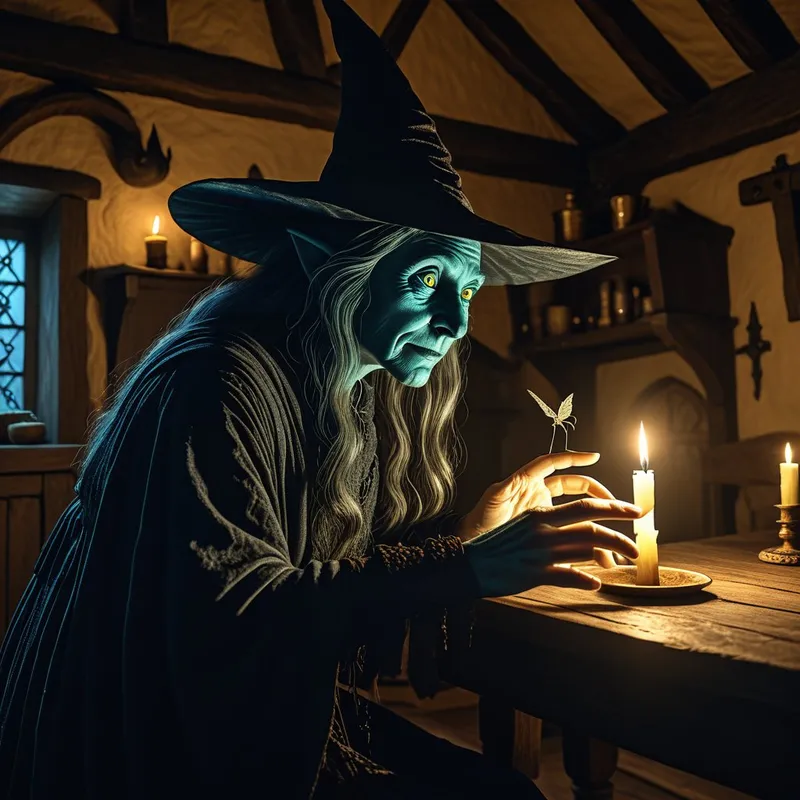
Flea as Familiar Myth Meaning & Symbolism
A tale of a cunning witch who binds a flea as her familiar, forging a pact of whispered secrets and parasitic power from the world's smallest creature.
The Tale of Flea as Familiar
Listen, and hear a tale not of dragons or knights, but of a power that dwells in the dust, in the crease of a bedsheet, in the quiet, itching dark. In a time when the forest pressed close to the village walls and the hearth-fire was a fragile sun against the endless night, there lived a woman named Elara. She dwelt not in the heart of the village, but in its shadow, in a cottage of leaning timber where the herbs grew wild and pungent.
The villagers spoke of her in hushed tones, when the wind moaned in the chimney. They called her a wisewoman, a cunning-woman, and sometimes, when fear was sharp on their tongues, a witch. Elara cared little for their names. Her work was in the roots and the runes, in the language of owls and the patterns of mold on stone. Yet, for all her knowing, she lacked a familiar. No cat graced her lap, no toad sat by her door. Her power was solitary, untethered, and it yearned for a mirror in the living world.
One bitter winter, when the world was locked in iron-hard frost, a desperation fell upon her. A sickness, swift and cruel, had taken the lord’s firstborn son. The lord, a man of iron faith and iron fist, declared it God’s judgment. But the boy’s mother, in the secret hour before dawn, came to Elara’s door, her eyes hollow with a grief beyond tears. She begged for a charm, a spell, anything to pull her child back from the threshold.
Elara knew the peril. To act was to paint a target upon her own brow. Yet, in the woman’s silent agony, she saw the reflection of her own solitude. She needed a ally, a vessel for a working of such delicate, invasive magic. She looked to her cat, but its spirit was too independent; to a mouse, but its heart beat too fast with fear. Then, her eye fell upon a tiny, dark speck moving with impossible spring across the parchment of her grimoire. A flea.
She did not crush it. Instead, she stilled her breath and extended a single thought, a thread of will finer than spider-silk. She spoke not with her voice, but with the voice of the blood the creature sought, the voice of the warm, secret dark. She offered a pact: not domination, but symbiosis. She would provide a world of warmth and endless, secret feasts—her own blood. In return, the flea would become her eyes and ears in places no human could go, a carrier of whispers into the very blood of the ailing boy.
The creature paused, a minuscule monument of perfected hunger. Then, in a leap that was a silent assent, it landed upon her wrist. She felt not a bite, but a pinprick of connection, cold and sharp as a star. With a sliver of bone needle and ink mixed with her own blood and crushed aconite, she inscribed a single, looping sigil upon its polished back. The air in the cottage tightened. The flea grew still, not with death, but with a terrible, focused awareness. Its simple existence was now woven with her intent.
That night, the flea, bearing a dust-grain of fever-breaking herbs bound by Elara’s will, journeyed. It traversed the castle stones, slipped past sleeping hounds, and found the boy’s fevered body. There, it performed its sacred, profane duty. It fed, and in feeding, delivered the charm directly into the river of his life. The fever broke by morning. The boy lived.
But the pact was sealed. The flea returned, not to the straw, but to the fold of Elara’s sleeve. It was her familiar. Its leaps were her curiosity; its persistent, hidden presence, her power. The villagers never knew what saved the child. They only knew the witch in the woods now had a companion no one could see, a whisper in the blood, a power that could enter any locked room, any guarded heart. And in their beds at night, feeling an itch they could not place, they wondered.
Cultural Origins & Context
The notion of the flea as a familiar spirit is a fascinating outlier in the rich tapestry of medieval European folk belief. While cats, toads, hares, and even insects like bees or beetles are documented as familiar spirits in trial records and folklore, the flea occupies a uniquely intimate and unsettling niche. These stories did not originate in grand epics or courtly romances, but in the oral tradition of the peasantry and the fearful accusations found in the records of the Inquisition.
Passed in whispers by the hearth and formalized in the coerced confessions of the accused, the "flea familiar" served a specific societal function. It embodied the ultimate subversion of order and the terror of invisible invasion. In a society defined by rigid hierarchies, clear boundaries (between human and animal, pure and impure, inside and outside), the flea was chaos incarnate. It respected no class, jumping from beggar to lord. It invaded the most private of spaces—the bed, the body itself. To imagine a witch commanding such a creature was to articulate a deep cultural anxiety: that the most humiliating, pervasive, and invisible nuisance could be weaponized, that the boundaries of the self were perpetually vulnerable.
This myth also reflects a pragmatic, if grim, folk understanding of contagion. Long before germ theory, the link between pests and illness was intuitively understood. A witch whose familiar was a flea was thus a master of miasma and sickness, able to inject blight directly into the bloodstream of a community or an individual enemy. The myth gave a face—a tiny, armored, leaping face—to the inexplicable spread of disease and misfortune.
Symbolic Architecture
Psychologically, the Flea as Familiar is a masterful symbol of the shadow made manifest as a companion. It represents all that we deem too small, too irritating, too parasitic, and too intimately connected to our own vitality to acknowledge.
The familiar is not the opposite of the self, but its neglected, hungry, and utterly persistent counterpart.
The flea’s nature is dual. It is a creature of phenomenal athleticism (able to jump hundreds of times its body length) reduced to a symbol of pestilence. Similarly, the aspects of ourselves we relegate to the shadow often contain immense, compressed energy—obsessions, fixations, "itches" we cannot scratch—that, if recognized, could grant unexpected mobility. The witch’s pact is not one of domination, but of conscious negotiation with this parasitic energy. She offers it a sanctioned place at her table (her own blood), transforming a random, draining annoyance into a focused tool of perception and influence.
The flea’s method of operation is also profoundly symbolic. It works not through grand gestures, but through stealthy, percutaneous entry. It delivers its payload—be it poison or cure—directly into the lifeblood. This mirrors how repressed shadow content influences us: not through obvious confrontation, but by "getting under our skin," influencing our moods, motivations, and health from within, often without our conscious awareness.
The Dreamer's Resonance
When the motif of the Flea as Familiar arises in modern dreams, it seldom appears as a literal, giant insect. Instead, it manifests as a somatic or situational pattern. The dreamer may experience a relentless, nagging irritation that has no clear source—a buzzing just out of sight, an itch that moves when scratched. They may dream of discovering a tiny, intricate, mechanical or alien object buried in their belongings or embedded in their skin, representing a compact or an invasive idea they have unconsciously "hosted."
Psychologically, this dream signals that an aspect of the dreamer’s own psychic energy has become split off and has taken on a parasitic, autonomous life. This could be a gnawing resentment (feeding on old wounds), a compulsive thought pattern (jumping from worry to worry), or a creative impulse so minor and irritating it is constantly swatted away. The dream is an announcement from the unconscious: you have a familiar. You have entered into a pact with a fragment of your own psyche, and it is feeding on you. The question posed is whether this relationship will remain a draining, hidden infestation, or if, like the witch, the dreamer can dare to recognize it, name it, and redirect its fierce, focused energy.

Alchemical Translation
The myth models the alchemical stage of Nigredo and the beginning of Albedo. The initial state is one of isolated, intellectual power (Elara’s solitary craft) that lacks embodied, instinctual connection. The "blackening" is the confrontation with the most despised, "lowest" aspect of nature—the parasite. This is the prima materia, the worthless starting point of the great work.
Transmutation begins not with gold, but with the recognition of the power in the dust.
The pact is the coniunctio oppositorum—the sacred marriage of opposites. The witch (consciousness, will) unites with the flea (the unconscious, instinctual, shadow energy). Her blood, her vital life force, is the solvent that facilitates this union. By willingly offering sustenance, she sanctifies the relationship, moving it from unconscious infestation to conscious collaboration.
The flea’s successful journey represents the Albedo. The redeemed shadow, now carrying the sigil of the Self (the witch’s mark), becomes an active agent of healing and insight. It can navigate spaces the conscious mind cannot—the hidden corridors of the psyche, the forgotten wounds, the repressed desires—and deliver the "medicine" of awareness directly into the core of a complex. For the modern individual, this translates to the arduous process of shadow-work: identifying that persistent, "parasitic" thought or feeling, not to exterminate it, but to understand what it feeds on. By consciously "feeding" it with attention and integrating its relentless energy, we transform a psychic drain into a specialized faculty—perhaps a keen eye for detail, a relentless drive, or the ability to access neglected, instinctual wisdom. The power was always there, leaping in the dark. The work is to make it familiar.
Associated Symbols
Explore related symbols from the CaleaDream lexicon: