Flamenco Myth Meaning & Symbolism
A myth of the soul's raw cry, born from the earth's sorrow and forged in fire, finding its voice in the crucible of human suffering and joy.
The Tale of Flamenco
Listen. Listen to the silence before the storm. It is not empty. It is the silence of a land holding its breath, of a people whose history is written in the dust of exile and the salt of tears. In this silence, the myth begins not with a word, but with a tremor.
In the deep south, where the sun bleaches bone and the wind carries whispers of forgotten tongues, the earth itself grew heavy with memory. It remembered the clash of empires, the sorrow of the displaced, the fire of those who worshipped in secret. This weight became a pressure, a molten core of unsung stories and unwept grief. And from this pressure, the land gave birth to her.
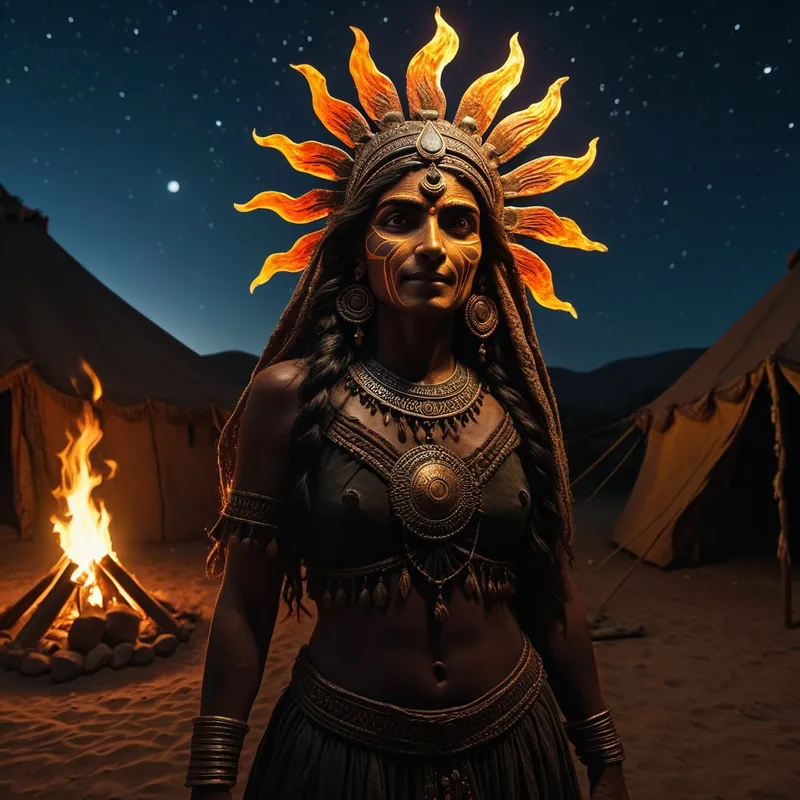
She was not born smiling. She was born in a gasp, a ragged inhalation of the world’s pain. They called her Duende. She was not a goddess of palaces, but of the crossroads, the tavern, the hidden clearing. Her skin was the color of parched earth, her hair a wild tangle of night, and her eyes held the flicker of a candle fighting the dark.
For centuries, she wandered, a restless spirit. She settled in the hearts of the Gitanos, whose own odyssey of survival mirrored her own. She slept in the sighs of the Moors, remembering Al-Andalus. She stirred in the weary bones of the peasants. She was the collective shadow, the thing too raw for daylight.
Then came the night of the forging. It happened in a juerga, a circle of firelight in a cave-dwelling. A man, his spirit crushed by toil, opened his mouth to curse his fate, but no words came. Instead, a sound emerged—a guttural, broken cry that tore at the air. It was a hook, and it hooked Duende’s heart.
She stepped into the circle. The man’s cry became a song, a cante jondo. It spoke of love like a prison, of death like a neighbor. As he sang, a woman rose. Her feet, calloused and strong, began to speak what the voice could not. They were not dancing to the rhythm; they were hammering it into the earth—a staccato prayer, a defiant map of survival. This was the zapateado.
A third figure, with hands like weathered maps, drew a guitar close. His fingers did not pluck strings; they strummed nerves. The toque was a conversation with the void, a search for a harmony in dissonance.
In that circle, Duende did not possess them; she became them. She was the crack in the voice, the sweat flying from the brow, the blister on the finger. The sorrow did not vanish. It was not cured. It was alchemized. It was poured into the crucible of rhythm and emerged as a terrible, beautiful power. The weeping turned to a shout of existence. The lament became a proclamation: I am here. I have suffered. I feel. Therefore, I am.
When the dawn threatened, the circle spent, Duende retreated. But she left her imprint in the husk of the night—in the hoarse throat, the trembling legs, the ringing silence that was now full. She had given them a language for the unspeakable. And they knew she would return, whenever truth needed a voice fiercer than words.
Cultural Origins & Context
Flamenco is not a myth from a single, sacred text, but a living mythology born from the historical crucible of Andalusia. Its "gods" are not Olympian figures but the archetypal experiences of marginalized communities: the Gitanos (Spanish Roma), the persecuted Moors and Jews after the Reconquista, and the impoverished Andalusian peasantry. For centuries, these groups existed on the periphery of Spanish society, their cultures suppressed, their voices silenced.
The myth was passed down not in scrolls, but in blood memory and communal ritual. Its temple was the private home, the hidden tavern, the family gathering—the juerga. Here, away from the judgmental eyes of the mainstream, the raw material of life—oppression, longing, joy, death—was forged into art. The singer (cantaor), dancer (bailaor), and guitarist (tocaor) were not mere performers; they were priests and priestesses of an embodied, cathartic rite. Their societal function was profound: to provide a vessel for collective grief and resilience, to affirm identity in the face of erasure, and to transform personal agony into communal, aesthetic power.
Symbolic Architecture
At its core, the myth of Flamenco is an archetypal drama of the repressed finding expression. It is the psyche's rebellion against silence.
The figure of Duende symbolizes not a external muse, but the daemon within—the accumulated, often painful, psychic energy of a person or a people. It is the shadow made audible, the personal and historical unconscious demanding to be heard. Duende is not about beauty; it is about authenticity, even when that authenticity is ugly, ragged, and raw.
The true song begins where politeness ends. It is the ego's decorum shattered by the soul's necessity.
The three arts—cante, baile, and toque—represent a tripartite model of psychic expression. The cante is the voice of emotion itself, the raw cry from the depths. The baile is the body's response, grounding that emotion in the physical, marking territory with the feet, mapping the conflict with the arms. The toque is the structuring principle, the mind's attempt to find pattern, rhythm, and dialogue in the chaos. Together, they enact a complete psychological event: feeling, embodying, and structuring the contents of the soul.

The Dreamer's Resonance
When this myth pattern activates in the modern dreamer, it signals a profound somatic and psychological pressure. It is the unconscious announcing that something can no longer be contained.
Dreams of being forced to sing a painful, wrenching song before an audience may point to a felt need to express a long-held sorrow or truth, often related to personal history or familial trauma. Dreams of dancing with furious, earth-pounding intensity suggest a psyche struggling to "ground" overwhelming emotional energy, to literally "stand its ground" against an internal or external force. The dream image of broken guitar strings or a silent scream embodies the frustration of expression blocked.
The somatic process here is one of compression seeking release. The body in the dream may feel heavy, hot, or taut before the "performance" begins. The psychological process is the confrontation with one's own Duende—the dark, passionate, and untamed aspect of the self that culture or the ego has demanded be silenced. To dream of Flamenco is to dream of the impending, necessary, and terrifying act of giving that shadow a voice.
Alchemical Translation
The Flamenco myth is a precise map for the alchemical process of individuation, specifically the nigredo and rubedo stages—the blackening and the reddening.
The nigredo is the initial, dark material: the leaden weight of suffering, shame, inherited trauma, or un-lived life. In the myth, this is the heavy silence, the wandering Duende, the unsung stories. The first step is not to transcend this darkness, but to consent to it, to gather it into the sacred circle of awareness (the juerga of the self).
The fire is not lit to destroy the pain, but to reveal that the pain itself is the fuel for the transformation.
The act of cante jondo is the mortificatio—the agonizing dissolution of the "polite" persona. The ego's defenses are broken by the sheer force of the authentic cry. The zapateado is the separatio and coagulatio—separating the raw energy from passive victimhood and coagulating it into a willful, embodied stance. The guitarist's search for harmony amidst dissonance is the coniunctio—the attempt to reconcile opposites, to find the Self in the conflict.
The final, red gold of the process is not happiness, but vitality and presence. It is the ecstatic exhaustion after the performance. The suffering is not gone; it has been transmuted from a passive state endured into an active power expressed. The individual becomes the vessel for a force greater than their personal story—they become an artist of their own existence. They have learned the soul's most defiant alchemy: to take the duende of their life, and with rhythm, fire, and voice, turn it into a testament that burns brighter for having passed through the darkness.
Associated Symbols
Explore related symbols from the CaleaDream lexicon: