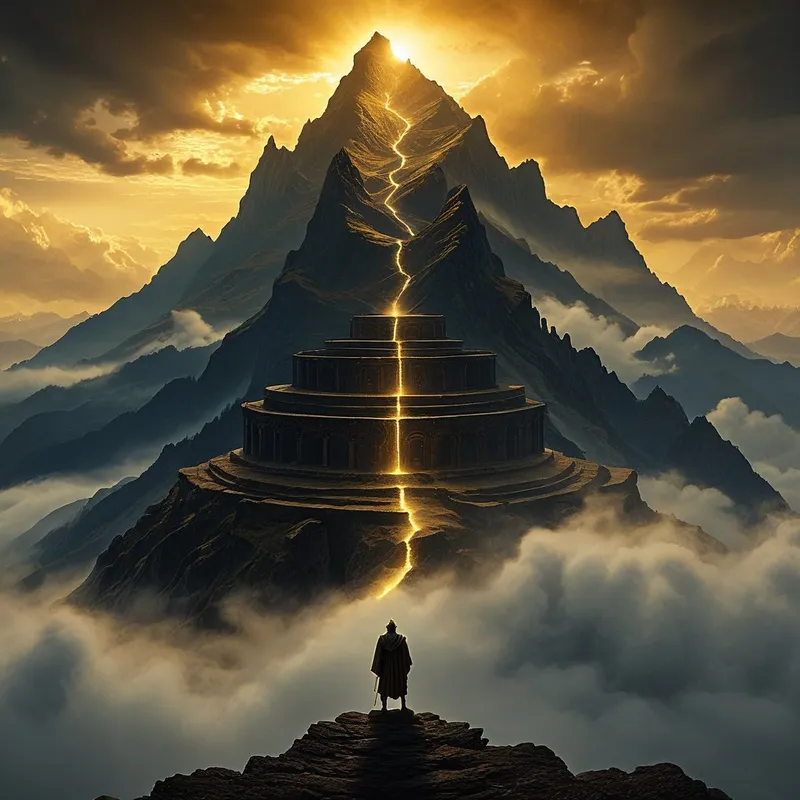
Five Ages of Man Myth Meaning & Symbolism
Hesiod's tale of humanity's descent through five metallic ages, from a golden paradise to our current age of toil, strife, and fragile hope.
The Tale of the Five Ages of Man
Listen. Before history was written on [papyrus](/myths/papyrus “Myth from Egyptian culture.”/) or stone, it was written in the memory of the gods. In the beginning, under the fresh rule of Zeus, the immortals fashioned the first race of mortals. This was the Golden Race. They lived in the time of [Kronos](/myths/kronos “Myth from Greek culture.”/), when [the earth](/myths/the-earth “Myth from Hindu culture.”/) itself gave freely. No plough bit the soil, for wheat sprang unbidden from the furrow. Rivers flowed with milk and nectar. These people knew no sorrow, no labor, no old age. Their bodies never ached; their spirits were light. When their time was done, they did not die as we know death. They simply fell into a gentle, dreamless sleep. And by the will of Zeus, they became benevolent spirits, cloaked in mist, wandering [the earth](/myths/the-earth “Myth from Hindu culture.”/) as guardians of mortal [justice](/myths/justice “Myth from Tarot culture.”/) and bestowers of wealth. Their age was an echo of paradise, a season that would never come again.
Then came the Silver Race, a generation lesser in both spirit and body. They remained children for a hundred years, coddled and foolish in their mothers’ halls. Their brief adulthood was marked by reckless pride and violence against one another. They refused due honor to the Olympians, neglecting the sacred altars. Their hearts were brittle. Zeus, in his wrath, swept them away, burying this race beneath the earth. Yet, for their brief moment of life, they are granted a lesser honor: to be known as the “Blessed Mortals” among [the underworld](/myths/the-underworld “Myth from Greek culture.”/)‘s gloom.
Next, the gods of bronze forged the third race from the ash-speckled meliai. They were terrible and strong, their hearts carved from flint, their armor and tools fashioned from dark bronze. Their passion was for the shriek of war and violence. They knew no bread, only the meat of beasts and the glory of conflict. Their strength consumed them, and they turned their bronze weapons upon each other until none were left. Nameless, they descended into the sunless house of [Hades](/myths/hades “Myth from Greek culture.”/), leaving no memory behind but the chill of their metal.
But then, a divergence—a flicker of light before the final descent. The fourth race was the Race of Heroes, a demigod breed nobler and more just. These were the men who fought at Troy and Thebes. Their age was one of colossal deeds and tragic fate. When death’s chaos took them, Zeus granted them a separate destiny. He settled them at the very edges of [the world](/myths/the-world “Myth from Tarot culture.”/), in the Isles of the Blessed. There, under a forever-kind sun, the heroes live a life free from care, where the earth bears honey-sweet fruit thrice a year. This age was a sigh, a poignant exception in the narrative of decline.
Now, we live in the fifth age: the Race of Iron. Our lot is ceaseless labor and grief by day, and wasting away by night. The gods have left us to our own devices, though they watch still. Our hearts are a tangle of good and evil. Father is pitted against son, guest against host, comrade against comrade. There is no respect for the suppliant, [the stranger](/myths/the-stranger “Myth from Biblical culture.”/), or the oath-keeper. Might is right. The Aidos and [Nemesis](/myths/nemesis “Myth from Greek culture.”/), the last divine spirits among us, will finally abandon the blood-soaked earth, trailing their white robes in sorrow as they return to Olympos. And then, we are told, will come the end: when children are born with grey temples, and no shred of goodness remains to hold back our final, self-wrought destruction.
Cultural Origins & Context
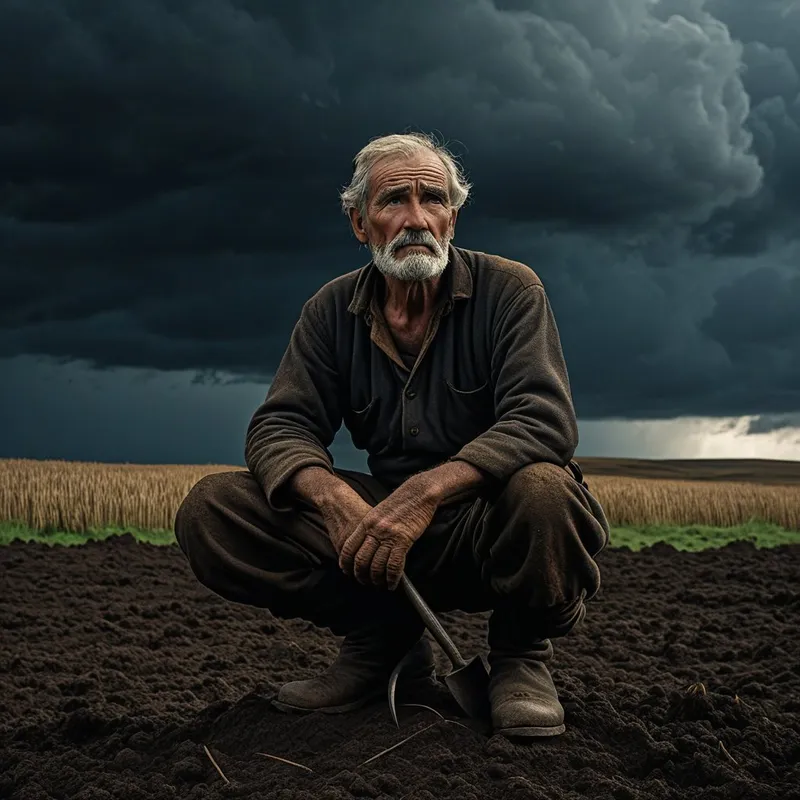
This somber chronicle comes to us from the poet Hesiod, in his didactic epic Works and Days. It is not a temple hymn, but a farmer’s almanac threaded with divine truth, told by a weary man to his wayward brother as a lesson in justice and the necessity of hard work. The myth functions as an aition—a story of origins—explaining why humanity’s lot is one of relentless toil, political strife, and moral ambiguity. It grounds the daily struggles of the 8th-century BCE Greek farmer in a grand, tragic cosmology.
Hesiod’s telling is deeply rooted in an agrarian, pre-philosophical worldview. It reflects a society intimately aware of natural cycles of fertility and blight, and one that saw a direct correlation between human morality and divine favor (or wrath). The myth served as a conservative social force, promoting eusebeia and justice by framing the current, difficult age as a consequence of ancestral failings. It was a story passed not for entertainment, but for warning and ethical orientation, a cosmic justification for the “why” of human suffering.
Symbolic Architecture
The Five Ages are not a literal [history](/symbols/history “Symbol: History in dreams often represents the dreamer’s past experiences, lessons learned, or unresolved issues that continue to influence their present.”/), but a profound psychic map of [consciousness](/symbols/consciousness “Symbol: Consciousness represents the state of awareness and perception, encompassing thoughts, feelings, and experiences.”/) devolving from unity into [fragmentation](/symbols/fragmentation “Symbol: The experience of breaking apart, losing cohesion, or being separated into pieces. Often represents disintegration of self, relationships, or reality.”/). The metals are not just markers of technology, but of spiritual [density](/symbols/density “Symbol: Represents the concentration of matter, energy, or meaning in a given space, often symbolizing complexity, weight, or substance.”/) and [connection](/symbols/connection “Symbol: Connection symbolizes relationships, communication, and bonds among individuals.”/).
[The Golden Age](/myths/the-golden-age “Myth from Greek culture.”/) represents the original, unconscious wholeness of the [psyche](/myths/psyche “Myth from Greek culture.”/)—a state of psychic [inflation](/symbols/inflation “Symbol: A dream symbol representing feelings of diminishing value, loss of control, or expansion beyond sustainable limits in one’s life or psyche.”/) where [the ego](/myths/the-ego “Myth from Jungian culture.”/) is entirely contained within [the Self](/myths/the-self “Myth from Jungian culture.”/), and there is no distinction between wish and fulfillment. It is the primal, paradisiacal [memory](/symbols/memory “Symbol: Memory symbolizes the past, lessons learned, and the narratives we construct about our identities.”/) that haunts all [human](/symbols/human “Symbol: The symbol of a human represents individuality, complexity of emotions, and social relationships.”/) mythology, the state before the “fall” into [awareness](/symbols/awareness “Symbol: Conscious perception of self, surroundings, or internal states. Often signifies awakening, insight, or heightened sensitivity.”/).
The descent through the ages is the story of the ego crystallizing out of the unconscious, gaining definition but losing its divine connection.
The Silver Age symbolizes a prolonged, helpless adolescence of the psyche. It is the stage of immature consciousness, refusing the responsibilities of relating to the inner gods (the archetypes) and the outer world. Its [punishment](/symbols/punishment “Symbol: A dream symbol representing consequences for actions, often tied to guilt, societal rules, or internal moral conflicts.”/) is to be buried, representing psychic content repressed into [the personal unconscious](/myths/the-personal-unconscious “Myth from Jungian Psychology culture.”/).
The brutal Bronze Age is the [emergence](/symbols/emergence “Symbol: A process of coming into being, rising from obscurity, or breaking through a barrier, often representing birth, transformation, or revelation.”/) of the crude, undifferentiated ego in its raw, martial power. It is pure libido directed [outward](/symbols/outward “Symbol: Movement or orientation away from the self or center; expansion, expression, or externalization of inner states into the world.”/) as aggression and conquest, a psyche that knows only the [shadow](/symbols/shadow “Symbol: The ‘shadow’ embodies the unconscious, repressed aspects of the self and often represents fears or hidden emotions.”/) principle of power, incapable of culture, art, or agriculture—the nourishing, civilizing forces.
The Heroic Age is the critical, fleeting [moment](/symbols/moment “Symbol: The symbol of a ‘moment’ embodies the significance of transient experiences that encapsulate emotional depth or pivotal transformations in life.”/) of potential [redemption](/symbols/redemption “Symbol: A theme in arts and music representing transformation from failure or sin to salvation, often through creative expression or cathartic performance.”/). It represents the ego’s conscious struggle with immense archetypal forces (the tasks, monsters, and wars of legend). This is the psyche attempting to integrate its colossal contents, to achieve something noble. Its reward—the Isles of the Blessed—is the [symbol](/symbols/symbol “Symbol: A symbol can represent an idea, concept, or belief, serving as a powerful tool for communication and understanding.”/) of content that has been successfully integrated, becoming a permanent, nourishing part of the [personality](/symbols/personality “Symbol: Personality in dreams often symbolizes the traits and characteristics of the dreamer, reflecting how they perceive themselves and how they believe they are perceived by others.”/)‘s inner [landscape](/symbols/landscape “Symbol: Landscapes in dreams are powerful symbols representing the dreamer’s emotional state, personal journey, and the broader context of life situations.”/).
Our Iron Age is the psyche of modern consciousness: complex, alienated, and burdened with the [knowledge](/symbols/knowledge “Symbol: Knowledge symbolizes learning, understanding, and wisdom, embodying the acquisition of information and enlightenment.”/) of good and evil. It is the ego acutely aware of its [separation](/symbols/separation “Symbol: A spiritual or mythic division between realms, states of being, or consciousness, often marking a transition or loss of connection.”/) from the Self (the gods have departed), left to navigate a world of inner conflict and moral [ambiguity](/symbols/ambiguity “Symbol: A state of uncertainty or multiple possible meanings, often found in abstract art and atonal music where clear interpretation is intentionally elusive.”/) using its own flawed, “iron” tools of reason and will.
The Dreamer’s Resonance
When this myth stirs in the modern unconscious, it often manifests not as a linear narrative, but as a somatic and emotional landscape. One may dream of finding a perfect, golden object in a field, only to watch it tarnish to silver, then corrode to a greenish bronze, and finally crumble into rust as they touch it—a direct expression of the grief of decay and lost innocence.
Alternatively, a dreamer might find themselves in a vast, multi-level parking garage or library (the tiered structure of the ages), desperately trying to ascend from a dark, cold basement (Iron) to a sunlit rooftop (Gold), but finding the stairs broken or the elevators leading only sideways. This captures the feeling of spiritual striving within a perceived structure of decline. The somatic experience is often one of profound weight, of being made of a dense, cold metal, or of a deep, nostalgic ache for a warmth and lightness just beyond memory’s reach. These dreams point to a psyche wrestling with its place in time, feeling the burden of history, personal and collective, and yearning for a lost connection to a more sacred order.
Alchemical Translation
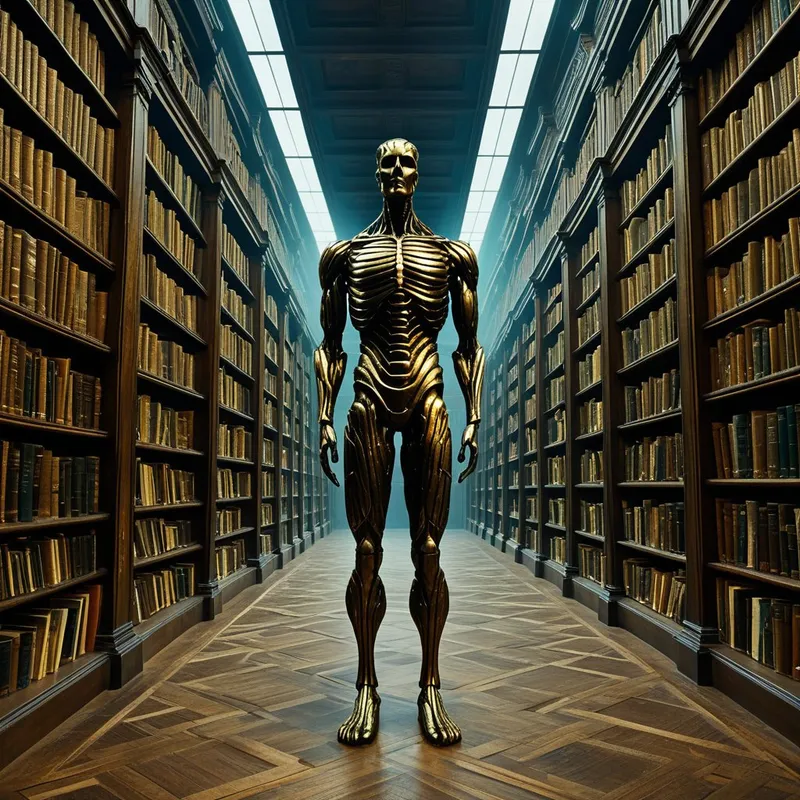
For the individual on the path of individuation, the Five Ages myth does not prescribe a return to a Golden unconsciousness. Rather, it models the necessary [nigredo](/myths/nigredo “Myth from Alchemical culture.”/)—the blackening, the descent—that must precede any true transformation. Our Iron Age consciousness, with all its strife and alienation, is the essential raw material, the [prima materia](/myths/prima-materia “Myth from Alchemical culture.”/) for the alchemical work.
The process begins with the honest recognition of our “iron” nature: our capacity for betrayal, our weariness, our moral compromises. This is the confrontation with [the shadow](/myths/the-shadow “Myth from Jungian culture.”/) in its most pervasive form. The myth warns that Aidos and Nemesis are preparing to leave—meaning the conscious connection to moral feeling and consequence is fading. The alchemical task is to internally detain these goddesses, to consciously rebuild the inner altar they have abandoned.
The goal is not to regain the Golden Age, but to perform the alchemy that transforms the base metal of our fragmented, iron consciousness into a philosopher’s stone of integrated awareness.
The Heroic Age provides the crucial clue. It is the proof that within the cycle of metallic degeneration, a vertical leap is possible. This is the ego’s heroic journey inward—not to conquer external foes, but to engage the inner wars, to undertake the labors of self-confrontation and integration. The successful elements of this struggle earn a place in the personal “Isles of the Blessed,” becoming permanent, vivifying complexes within the psyche.
Thus, the alchemical translation of Hesiod’s pessimism is ultimately one of profound hope. The entire arc—from Gold to Iron—is seen not as a historical fact, but as a necessary descent of spirit into matter, of wholeness into fragmentation, so that consciousness itself can be born. Our current age of iron is [the crucible](/myths/the-crucible “Myth from Alchemical culture.”/). The heat of our suffering, the friction of our conflicts, and the catalyst of conscious reflection are the forces that can, if we work with them, begin a transmutation. We cannot go back to paradise, but by bearing the full weight of our iron nature, we may forge something entirely new: a consciousness that has integrated the memory of gold, the failure of silver, the power of bronze, the nobility of the hero, and the weary wisdom of iron. In doing so, we become not a sixth age, but the conscious stewards of all five.
Associated Symbols
Explore related symbols from the CaleaDream lexicon: