Fisher King Myth Meaning & Symbolism
A wounded king's land lies barren until a hero asks the sacred question, revealing the deep link between sovereign trauma and the world's vitality.
The Tale of the Fisher King
Listen, and hear the tale of the land that wept. In the heart of Logres, where the rivers once ran with silver and the forests whispered with life, there stood the castle of Corbenic. Its lord was the Fisher King, a man both blessed and cursed. He was the guardian of the most sacred of relics—the Holy Grail itself. But a shadow had fallen.
In his youth, driven by a fiery passion, the king had pursued a mysterious fire-breathing knight into a deep forest. There, in a moment of piercing violence, a Dolorous Stroke found its mark. A burning spear, or some say a sword, was thrust through his thighs, leaving a wound that would not close. It was a wound that festered not with poison, but with a deeper malaise—a wound of the spirit.
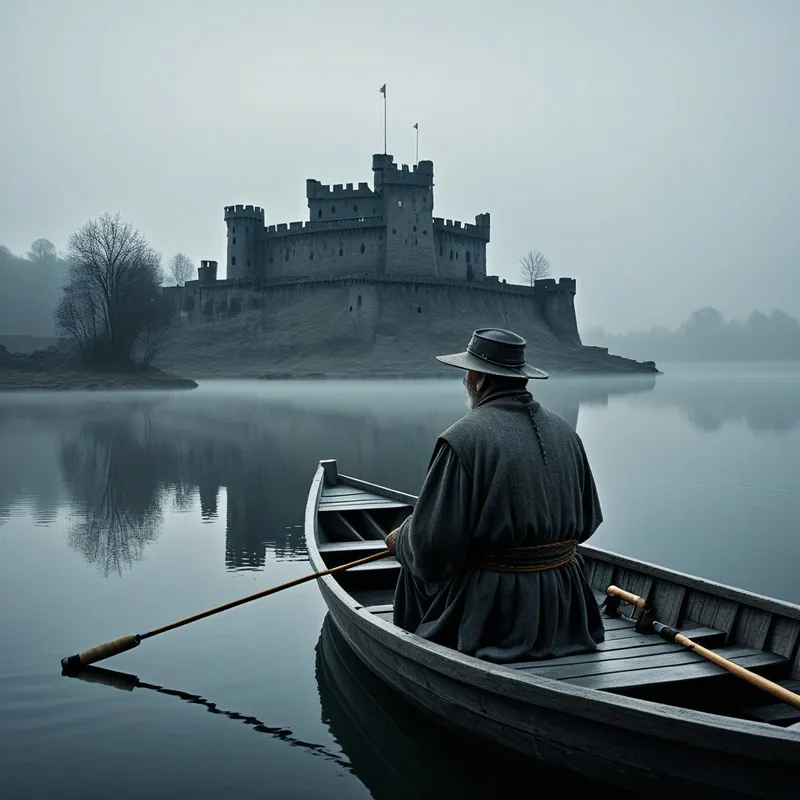
From that day, the king could no longer ride, no longer rule as a warrior. He could only fish, sitting in a small boat on the quiet waters near his castle, a passive sovereign in a world growing still. And as he languished, so too did his realm. The curse of the king became the curse of the land. The seasons ceased their turn. Spring forgot to come. The fields lay fallow and hard as stone. The rivers sank into their beds. The very air grew thin and sorrowful. The castle of Corbenic became an island of silent suffering in a sea of desolation, a Wasteland.
Into this blighted realm came the chosen ones, the knights of the Round Table, questing for the Grail to heal the land. The greatest of them, the pure Sir Galahad, or in older tellings, the earnest Sir Perceval, would find their way through the mist to the water's edge. There, the Fisher King would beckon, and lead the knight to his hall.
In that dim, echoing hall, a solemn procession would pass before the knight and the wounded king upon his couch. A squire carried a bleeding spear that dripped into a vessel. Maidens bore candles and a silver platter. And finally, a maiden carried the Grail itself, radiating a light that filled the hall with the scent of spices and the promise of paradise. It contained a single mass wafer, the sustenance of all life. The knight, overwhelmed by awe and courtly restraint, would watch in silence. He saw the king's agony. He felt the weight of the unasked question pressing on his heart: Whom does the Grail serve?
But fear, or mere politeness, would seal his lips. The moment would pass. The procession would vanish. And upon waking, the knight would find the castle empty, the gates shut, and the Wasteland stretching before him once more, now deepened by his failure. The curse held.
Until one knight, guided by compassion over protocol, finally let the question burst forth from his soul: "Good sir, what ails you?" Or, in the most sacred formulation: "Whom does the Grail serve?"
At that utterance, the spell shattered. The king let out a cry that was both agony and release. The wound was finally seen, finally acknowledged. And in that seeing, it began to heal. As color returned to the king's cheeks, a sound like distant thunder rolled through the castle. It was the sound of rain, after a century of drought, falling upon the parched earth. The Wasteland bloomed. The rivers ran. The Fisher King rose, his sovereignty restored, for the Grail served he who had the courage to ask the healing question.

Cultural Origins & Context
The myth of the Fisher King is not a single story, but a haunting melody woven through the later tapestry of the Arthurian cycle. Its deepest roots likely tap into pre-Christian Celtic sovereignty myths, where the health of the king (rí) was intrinsically tied to the fertility of the land (tír). A maimed or unjust king meant a blighted kingdom.
The tale crystallized in the 12th and 13th centuries, most profoundly in Chrétien de Troyes' unfinished Perceval, or the Story of the Grail and later in the Queste del Saint Graal. These were not folk tales told around fires, but sophisticated literary works composed for courtly audiences, blending chivalric romance with burgeoning Christian mysticism. The storytellers were poets like Chrétien and Wolfram von Eschenbach, who transformed older motifs into a spiritual allegory for the age. Its societal function was dual: it was a thrilling adventure of knightly questing, and a profound mirror held up to a culture grappling with the relationship between spiritual purity, personal responsibility, and communal well-being. The failure of the knights reflected a fear of spiritual inadequacy in a world perceived to be in decline.
Symbolic Architecture
At its core, the myth is a masterful depiction of the psyche in a state of traumatic arrest. The Fisher King is the archetypal Ruler within us, the function of consciousness that is meant to steward our inner kingdom.
The wound that will not heal is the memory the psyche cannot integrate; the barren land is the life that cannot be lived while the king lies bleeding.
The thigh wound is profoundly symbolic. It is a wound to the seat of generative power and vitality, a psychic castration that halts forward movement and creative life-force. The king is reduced to fishing—a passive, contemplative, waiting state—because active striving is impossible. The Wasteland is the externalized reality of this inner stagnation: depression, creative block, relational deserts, a sense of meaninglessness. The castle Corbenic, filled with haunting silence and spectral rituals, is the fortress of a complex, a sealed-off chamber of pain where the same traumatic scene repeats endlessly.
The Grail represents the transcendent function, the ultimate source of healing and wholeness that is paradoxically present within the wounded castle but inaccessible. It is the Self, the core of psychic totality. The failure of the knights is the failure of the conscious ego. They see the mystery but approach it only with awe or intellectual curiosity, not with engaged, compassionate inquiry. They lack the one thing needed: the heartfelt question.

The Dreamer's Resonance
When this myth stirs in the modern dreamer, it signals a profound encounter with a core wound that has dictated the landscape of one's life. To dream of a barren, empty landscape—a dried-up career, a ghost-town relationship, a repetitive, joyless routine—is to dream the Wasteland. The somatic feeling is one of heaviness, paralysis, and airless confinement.
Dreaming of a wounded or passive authority figure—a silent parent, an incapacitated boss, a king in chains—points directly to the Fisher King complex. The dreamer may find themselves in a decaying, labyrinthine building (the castle), witnessing a strange, poignant ritual they do not understand. The psychological process underway is the approach of consciousness to this long-buried injury. The dream is the Grail procession itself, presenting the symbols of the wound (the spear) and the healing (the Grail) before the dreamer's sleeping self. The anxiety of the dream is the pressure of the unasked question. The dream recurs because the psyche is demanding engagement, not just observation. It is a call to move from passive suffering to active inquiry.

Alchemical Translation
The myth models the alchemical process of solve et coagula—dissolve and coagulate—for psychic transmutation. The first stage is the nigredo, the blackening: the acknowledgment of the Wasteland, the admission of the wound and the life it has drained. This is the dissolution of the old, brittle identity built around the injury.
The knight's journey to the castle is the arduous work of introspection, following the thread of one's pain back to its source. The hall of the castle is the vas, the sealed vessel of the opus, where the confrontation occurs.
The sacred question is the alchemical solvent that dissolves the seal of trauma, allowing the lapis of the Self to be glimpsed.
Asking "What ails you?" or "Whom does the Grail serve?" is the pivotal moment of albedo, the whitening. It represents a shift from ego-centricity ("What can I get from this?") to a genuine interest in the Other—in this case, the wounded, rejected part of one's own psyche. It is an act of compassionate witness that breaks the narcissistic spell of isolated suffering. This question is the operation that allows the opposing forces—the bleeding wound and the healing Grail—to conjoin.
The healing of the king and the greening of the land (viriditas) symbolize the rubedo, the reddening, and the final coagulation. Vitality returns. The transcendent function (the Grail) becomes active, serving a renewed and humble sovereignty. The individuated Self does not rule from a place of untouchable power, but from a wisdom forged in wounding and restoration. The Fisher King rises, not as a conquering hero, but as a healed steward, and his first act is to let the rains fall. The inner kingdom is restored to fertile, dynamic life.
Associated Symbols
Explore related symbols from the CaleaDream lexicon: