First Zodiac Animal Myth Meaning & Symbolism
A celestial race decreed by the Jade Emperor determines the order of the zodiac, where cunning and pragmatism triumph over brute strength and speed.
The Tale of the First Zodiac Animal
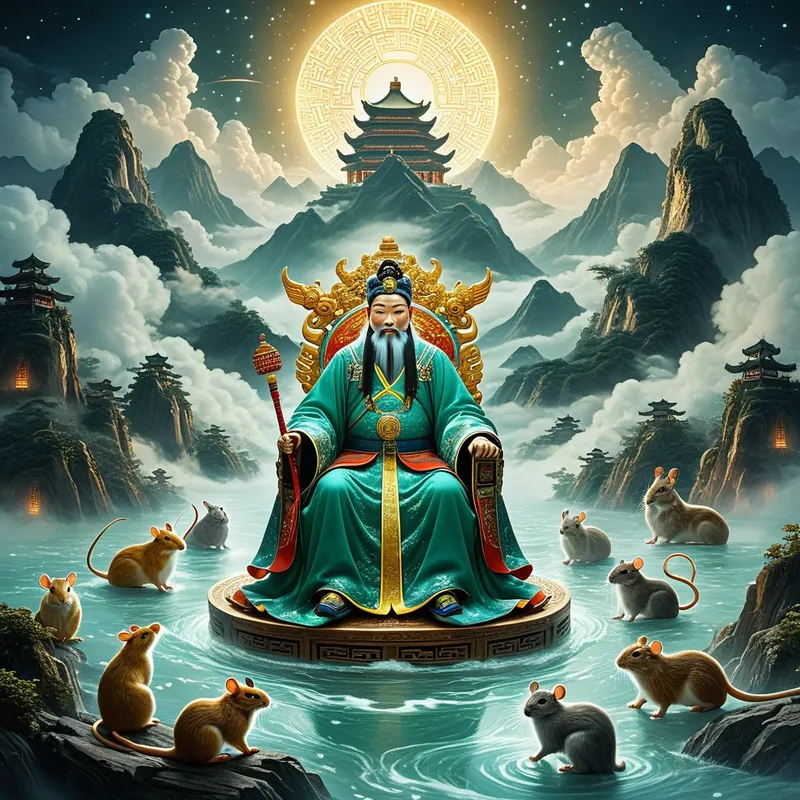
In the time before time was measured, when the sky was a seamless cloak of dark silk and the earth a sleeping giant, the Jade Emperor gazed upon his realm. A profound loneliness touched his celestial heart. The cycles of the moon were beautiful, the march of the seasons orderly, yet there was no rhythm to mark the passage of years for mortal kind. No story for the people to tell their children by the fire. He desired a clock of flesh and spirit, a cycle of twelve.
So he sent forth his decree, carried on the breath of the east wind and the ripple of every stream: a Great Race was to be held. All creatures of the land were invited to a grand banquet at his heavenly palace. The first twelve to arrive, to cross the final raging river and present themselves at the vermilion gates, would have their names etched into the very fabric of time. They would become the guardians of the years, their natures forever defining the souls born under their watch.
The land stirred with ambition. The mighty Ox, knowing his strength was unmatched, began his journey at a steady, ground-shaking pace. The Dragon, confident in his ability to fly, prepared for a majestic aerial crossing. The sleek Horse pawed the earth, muscles coiled. And in the hidden places, small eyes glittered with a different kind of intelligence.
One such creature was the Rat. He heard the decree and felt a burning desire, not for the banquet’s feast, but for the glory of first. He saw the ox, a mountain of patient muscle, leaving at midnight to ensure a timely arrival. A plan, sharp and clear, formed in the rat’s mind. As the ox lumbered through the silent, dew-heavy grass, the rat, with silent grace, scrambled up a tall stalk and leaped onto the ox’s broad back. The ox, focused on his path, did not notice the tiny passenger.
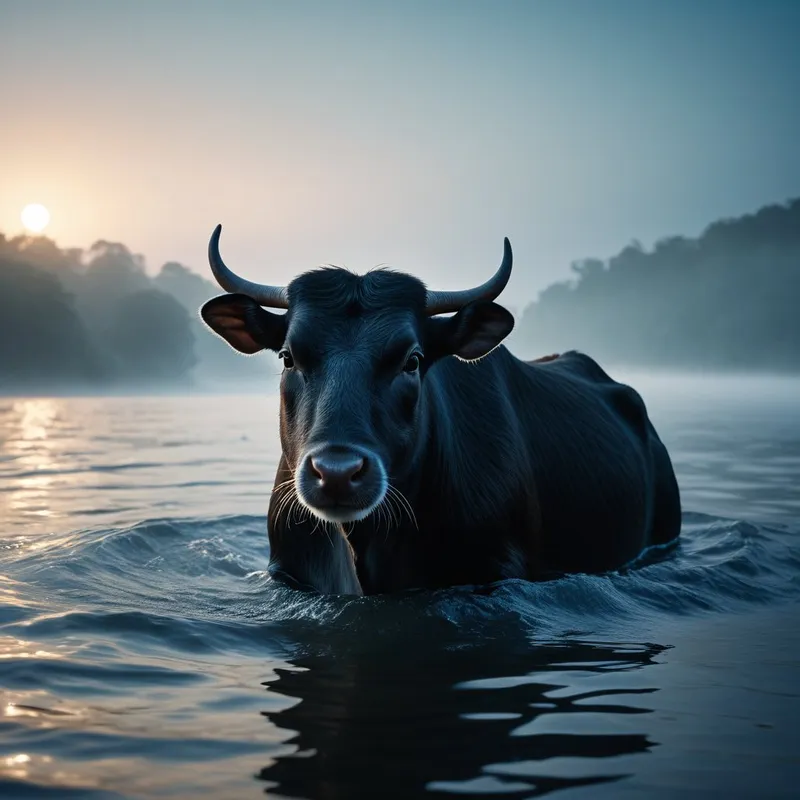
For hours they traveled, the ox swimming with powerful, unyielding strokes across the wide, cold river that barred the way to the heavens. As the far bank drew near, and the celestial gates gleamed in the first light of dawn, the rat saw his moment. With a final burst of energy, he sprang from the ox’s head. His tiny legs carried him the last few paces. He crossed the finish line a mere whisker ahead of the loyal, bewildered ox.
Thus, the Rat became the First, the opener of the cycle. The Ox, ever noble, followed as the Second. One by one, the others arrived—the Dragon delayed by bringing rain to a parched village, the Horse startled by the Snake coiled at its hoof. And so the order was set, not by strength alone, but by a tapestry of nature, chance, and cleverness, sealed by the Jade Emperor’s nod.
Cultural Origins & Context
This myth, in its many variations, is a cornerstone of Chinese folk tradition, passed down not in formal scriptures but through the intimate, living channels of oral storytelling. Grandparents narrated it to children on warm nights, village elders recounted it during lunar New Year celebrations, and it was immortalized in woodblock prints and folk operas. Its primary function was etiological—to explain the seemingly arbitrary order of the Shengxiao, or Chinese zodiac. But its deeper purpose was pedagogical and social.
Embedded within an agrarian society that valued both hard work (the ox) and social harmony (the established order), the tale served as a complex mirror. It validated the cunning and resourcefulness necessary for survival, traits as crucial as brute strength in the struggle of life. It was a story told with a knowing smile, acknowledging that the world’s rules sometimes reward the quick-witted over the simply powerful, and that cosmic order often arises from a mix of intention and unexpected alliance. It placed the humble, often-despised rat at the pinnacle, a subversive reminder that significance can come from the most unexpected quarters.
Symbolic Architecture
The myth’s power lies in its elegant symbolic architecture. The Jade Emperor represents the ordering principle of consciousness, the Self that seeks to structure the chaos of time and potential into a meaningful, repeating pattern. The Race is the journey of life and the struggle for identity within a collective system.
The First is not always the Strongest, but the one who understands the terrain of the moment.
The Rat symbolizes raw, undifferentiated ambition, survival intelligence, and pragmatic cunning. It is the psychic force that seeks advantage, recognition, and the primal satisfaction of being first—of securing resources, attention, and a place in the sun. It is not malicious, but ruthlessly opportunistic, a necessary component of the psyche often repressed in favor of more "virtuous" traits.
The Ox represents diligence, endurance, steadfastness, and unconscious strength. It is the capacity for slow, reliable labor, the part of us that carries burdens without complaint. The rat’s ride on the ox’s back is a profound image of symbiosis. It illustrates how raw ambition (rat) must often hitch a ride on the vehicle of patient, enduring strength (ox) to achieve its goals. One without the other is incomplete; ambition without endurance is fleeting, endurance without ambition is directionless.
The River is the threshold, the final barrier between the mundane and the celestial, the unconscious and consciousness. To cross it is to achieve recognition and a place in the defined order of things.
The Dreamer's Resonance
When this myth pattern surfaces in modern dreams, it often signals a crucial moment of strategic self-assertion or a renegotiation of one’s position within a system (a family, a career, a social hierarchy). Dreaming of being the rat might indicate the dreamer is leveraging an unseen advantage, or feeling a "cunning" but morally ambiguous ambition rising. There may be a somatic sense of clinging, of being a passenger on a larger force.
Dreaming of being the ox can speak to feelings of being used, of carrying a burden for another’s gain, or conversely, of accessing immense, patient strength. The dreamer may feel their fundamental diligence is being overlooked. The river itself, especially if turbulent, can symbolize an emotional or psychic transition that requires both a steady vehicle (ox) and a clever strategy (rat) to navigate. The dream is asking: What part of you is the clever strategist seeking recognition? What part is the enduring beast of burden? Are they working together, or is one exploiting the other?

Alchemical Translation
The individuation process modeled here is the integration of the Shadow trickster with the virtue of diligent labor. To become whole, the modern individual must not reject the rat-like qualities of self-interest, shrewdness, and the desire to be first. These are primal survival energies. Nor should they devalue the ox-like qualities of patience and perseverance.
The alchemical goal is not to crown the rat or the ox, but to honor the pact that got them across the river.
The psychic transmutation occurs when we consciously allow our clever, ambitious impulses (the rat) to inform and direct our capacity for hard work (the ox), and when our diligent nature agrees to carry those ambitions forward. It is the moment we stop seeing our cunning as shameful and our labor as mindless, and instead forge them into a conscious strategy. We must cross our own river—the barrier to self-realization—not by pure force or trickery alone, but by a synthesized effort. To claim the "first" place in our own psychic pantheon is to acknowledge and wisely direct the totality of our nature, from the most base and strategic to the most solid and enduring, thereby earning our true place in the celestial order of the Self.
Associated Symbols
Explore related symbols from the CaleaDream lexicon: