Fire Elemental Myth Meaning & Symbolism
A tale of a primal fire spirit, its binding by a saint, and the eternal dance between humanity's creative spirit and its destructive passions.
The Tale of the Fire Elemental
Hear now a tale not of knights and dragons, but of a spirit older than stone, a being born in the first forge of the world. In the deep, untamed woods where the old gods still whispered through the leaves, there dwelled a power. It was not a beast, nor a demon of scripture, but a Fire Elemental.
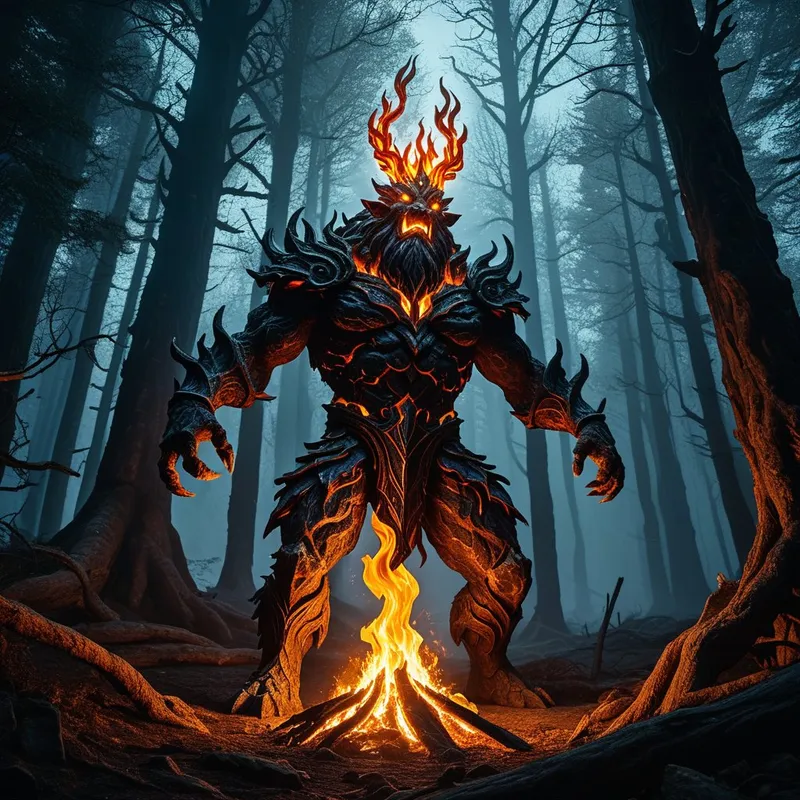
Men called it Ignis, or Salamander, names that hissed and sparked on the tongue. It did not walk; it consumed. Its body was a writhing column of flame, its bones were glowing embers, and its voice was the crackle of a forest ablaze. It was the spirit of the wildfire that cleansed the earth, the forge-fire that shaped the plowshare and the sword, and the hearth-fire that held the night at bay. But left to its wild nature, it knew only one song: the song of transformation through utter reduction to ash.
The village at the forest's edge knew this song well. Their thatch would blacken and curl without cause. Their winter stores would smolder from within. Children whispered of a man made of fire who danced at the edge of their dreams. The people lived in fear of the spark, for they knew the elemental was capricious—a giver of warmth and a bringer of desolation, two faces of the same fierce coin.
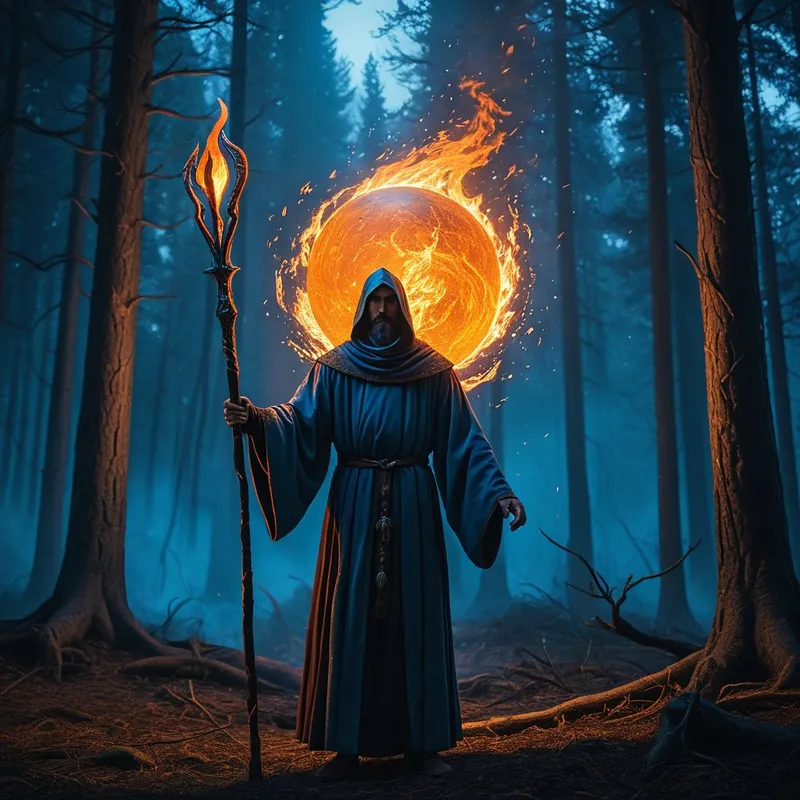
Into this tension came the anchorite, Brother Ansgar. He was a man of silence and soil, but his faith was not a quiet thing; it was a tempered blade. Hearing the people's terror, he did not take up a sword of steel. Instead, he took up his staff of oak, bound with simple iron, and walked into the heart of the wood as the sun bled out behind the hills.
He found the elemental in a granite bowl where a stream had run dry. It was not attacking, but being—a roaring, swirling vortex of heat and light, painting the surrounding stones with shimmering ghosts of itself. The air tasted of lightning and pine resin. Ansgar felt his brow bead with sweat that sizzled away.
"Spirit of the Flame," he called, his voice steady against the roar. "I come not to destroy you, for you cannot be destroyed. I come to speak."
The elemental turned, a face of living conflagration focusing on him. It did not speak in words, but in a wave of heat and a vision that seared Ansgar's mind: the glorious, necessary burn of the sun, the forging of continents in planetary fire, the sacred spark of life itself. And then, the other vision: the charred forest, the blackened field, the screaming child.
"You are all of these," Ansgar said, understanding. "You are creation and you are wrath. You are the tool and the wielder is absent."
The elemental roared, expanding, feeling the challenge. It lunged, not as a beast, but as a force—a wave of incineration meant to erase the impertinent speck before it. Ansgar planted his staff. He did not pray for water or for rain. He prayed for vessel. He prayed for the strength to hold a mirror to the flame, to show it its own form.
The iron bands on his staff began to glow, not with heat, but with a cool, blue-silver light. The light did not fight the fire; it outlined it, contained it, defined its raging chaos into a shape. The elemental shrieked, a sound of tearing metal, as it felt its boundless energy pressed into a form it did not choose—a form akin to a man, but wrought of contained, brilliant flame.
For three days and nights, the struggle held. Ansgar did not move, his will a ring of iron around the spirit's heart. The elemental raged, tested, and finally, exhausted its infinite fury against an unyielding purpose. It did not surrender; it recognized. It saw in Ansgar's unwavering focus a will as primal as its own—the will to give form to power.
On the dawn of the fourth day, a pact was struck, not in words, but in the silent language of archetypes. The elemental's form settled, no longer a wild inferno, but a towering, majestic figure of disciplined fire. Ansgar, his staff now forever warm to the touch, spoke the terms: the spirit would withdraw its capricious wrath from the homes of men. In return, it would be honored. The village smith would dedicate his first spark of the day to it. The hearth-fire would be spoken to with respect. Its wildness would have a place—the deep forest glade, the heart of the forge.
The Fire Elemental bowed its head of living flame, a gesture of acknowledgment to a worthy master. It turned and walked into the forest, its light now a guided beacon, not a random blaze. And in the village, they learned to live with the flame, not in fear of it, for they had been shown that the fiercest power requires the strongest vessel.
Cultural Origins & Context
The myth of the Fire Elemental, as told here, is a tapestry woven from several threads of medieval European thought. It does not belong to a single, canonical text like a saint's life, but emerges from the fertile ground between Christian theology, lingering pagan animism, and the practical cosmology of artisans.
Its primary carriers were likely the monks who compiled bestiaries and lapidaries, and the guild masters of smiths and alchemists. In the medieval mind, the world was not inert matter but a living corpus, filled with spirits and influences. The four classical elements—Earth, Water, Air, and Fire—were not just substances but intelligent principles. The Fire Elemental, or Salamander, was believed to be the being that gave fire its properties. This was not mere superstition; it was a functional cosmology that explained why fire behaved as it did—why it sought fuel, gave light, and could be both vital and lethal.
The societal function of this myth was multifaceted. For the common folk, it explained the terrifying randomness of house fires and crop blights, attributing them to a spirit that could be appeased through respect and ritual, thus offering a sense of agency. For the Church, tales of saints like Ansgar binding elementals served a crucial purpose: they demonstrated the supremacy of Christian divine order (represented by the saint's faith and will) over the untamed, potentially demonic forces of the old natural world. The elemental is not destroyed, but converted—its power integrated into a new, sanctified hierarchy.
Most profoundly, the myth was kept alive by artisans of fire: blacksmiths, glassblowers, and alchemists. To them, the Fire Elemental was a real spiritual colleague. The smith who could master his forge-fire was, in a sense, in communion with this spirit, channeling its transformative power to turn raw ore into a refined tool. The myth thus served as a narrative container for the sacred responsibility of wielding transformative power.
Symbolic Architecture
At its core, the myth of the Fire Elemental is a profound drama about the nature of raw psychic energy—the libido, the life force, the drive—and its relationship to consciousness.
The Fire Elemental itself symbolizes the pure, undifferentiated libido or the Shadow in its potent, energetic form. It is creativity, passion, vitality, and spiritual fervor. Yet, in its untamed state, it is also rage, lust, obsession, and the capacity for total psychological self-immolation. It is not evil; it is amoral, a force of pure process.
Fire does not ask if it warms the hearth or burns the house; it only asks for fuel and expresses its nature.
Brother Ansgar represents the emerging force of conscious ego and disciplined will. His staff, bound with iron, symbolizes the vessel—the structures of consciousness, morality, ritual, and focused attention necessary to contain and direct raw energy. The iron is significant; it is a metal born of fire (smelted) yet strong enough to shape it (the tool). It represents the ego forged in the fires of experience.
The binding is not a negation but a relationship. The ego does not kill the instinctual fire; to do so is to become lifeless. Instead, it enters into a pact. It acknowledges the power, respects its necessity, but insists on a form that allows for coexistence with the rest of the psychic "village"—other drives, relationships, and responsibilities. The dedicated spark in the smithy and the respected hearth-fire symbolize the sacred channels through which this potent energy is allowed conscious, creative expression.
The Dreamer's Resonance
When this myth stirs in the modern unconscious, it often manifests in dreams of fire. But these are not simple nightmares. To dream of a wild, untamed fire chasing you speaks of a feeling of being overwhelmed by passions, anger, or a creative impulse that feels too hot to handle. The dream ego is in the role of the terrified villager.
Conversely, to dream of controlling a great fire—containing it in a furnace, or calmly walking through flames—suggests the "Ansgar" process is underway. The dreamer is successfully integrating a powerful new energy or facing a "fiery" shadow aspect without being consumed by it.
Somatically, this process can feel like a rising heat in the body—flushing, agitation, a restless energy that seeks an outlet. Psychologically, it is the phase where a new idea, a long-suppressed anger, or a surge of life force demands recognition. The dream of the Fire Elemental asks the dreamer: Where in your life is there a raw, potent energy that is either running wild and causing destruction, or is so feared it is suppressed, leaving you cold? What is the "iron staff" in you—the discipline, the focus, the conscious principle—that can meet this fire and give it a form?
Alchemical Translation
In the alchemical journey of individuation, the myth of the Fire Elemental maps directly onto the critical stage of calcinatio. This is the fiery ordeal, the burning away of the dross of the old personality to reveal the essential core.
The individual begins identified with the "village"—a state where inner fire is projected outward as external danger (a bad temper, a threatening boss, a volatile situation) or is so banked that life feels devoid of passion. The call to adventure is the eruption of the elemental: a crisis, a burning desire, a furious truth that can no longer be contained.
The alchemist's fire is not for comfort; it is for the ruthless separation of the essential from the trivial.
The hero's journey is the "Ansgar" phase—the conscious descent into the woods of the unconscious to confront this power. The iron staff is the development of a conscious attitude strong enough to withstand the heat of self-confrontation. This is not repression, but the courageous act of seeing one's own shadowy passions and drives fully, without flinching.
The binding and the pact represent the successful integration. The wild libido is not eliminated; it is redeemed. Its energy is now available to the conscious personality. The creative spark is focused into artistic work. Righteous anger becomes the fuel for setting boundaries. Sexual passion deepens into committed intimacy. The elemental becomes an ally, its power fueling the forge where the raw material of the psyche is shaped into the unique, authentic Self.
The myth concludes not with the death of the fire, but with its sacred placement. The integrated individual learns to honor their inner flame, giving it appropriate and potent outlets, while respecting its power to destroy if left unattended. They become, in essence, both the saint and the salamander, the vessel and the verve, master of the inner forge where the base metal of experience is transmuted into the gold of meaning.
Associated Symbols
Explore related symbols from the CaleaDream lexicon: