Field Guardians Myth Meaning & Symbolism
An ancient tale of spirits who guard the fertile land, embodying the sacred pact between sacrifice, stewardship, and the soul's deepest calling.
The Tale of Field Guardians
Listen. The wind does not just blow across the plain; it carries a whisper older than the first plow. Before the first stone was laid for the first house, when people were few and the earth was vast and wild, there was a knowing. The land gave, but it also asked. It was in the time of the Great Hunger that the pact was forged, not in words, but in blood, sweat, and seed.
There was a village, its name lost to the turning years, nestled in a valley of incredible fertility. The soil was dark and sweet, the rains timely, and the sun a gentle gold. For generations, they lived in abundance, their granaries overflowing. They grew proud. They took without thought, planted without prayer, harvested without thanks. The land, they believed, was a servant.
Then, the silence came. The rains turned shy. The sun grew harsh. The seeds they cast into the earth either refused to sprout or yielded stalks thin and grey, their heads empty of grain. A blight, dry and whispering, crept from the field's heart. Famine perched on the rooftops, a carrion bird with endless patience. The elders consulted old signs; the people offered their finest trinkets to the soil. The earth remained mute and barren.
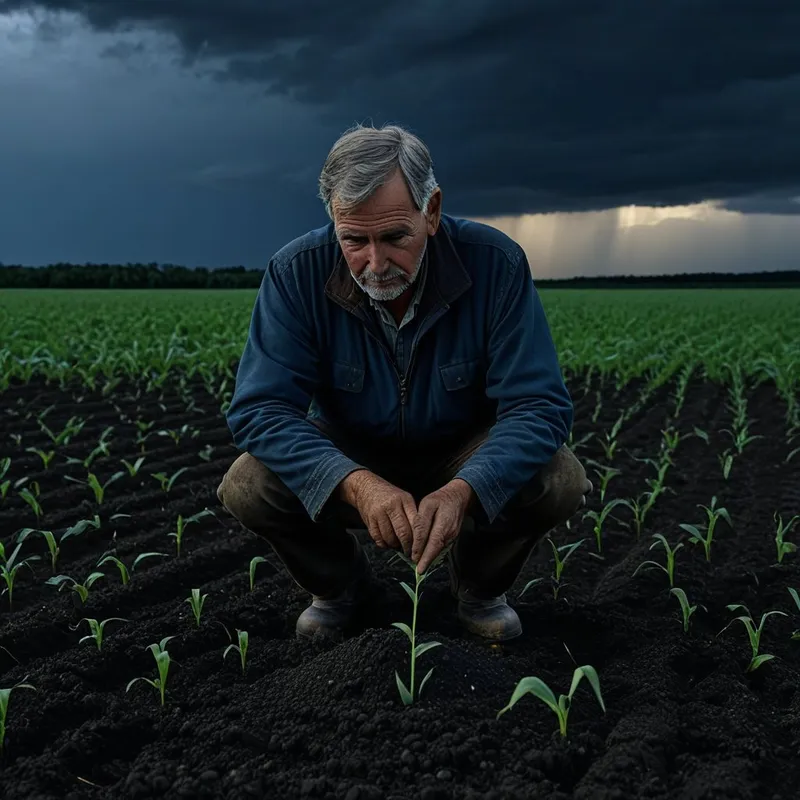
In despair, an old farmer named Kaelen walked to the center of the dying field as the sun bled into the horizon. He carried no offering of gold or wine. Instead, he carried the last viable seed from his ancestral stock, and a heart heavy with understanding. He did not ask for life for himself or his family. He knelt, the dry earth cracking beneath his knees, and he spoke to the land not as a master, but as a child who had erred.
“I have taken your bounty as a right,” he whispered, his voice rough with dust and regret. “I have forgotten the gift. I offer no wealth, for that is not what you are. I offer this, the last of what you gave me, back to you. Not for me. For the field itself. Let it live, even if we do not.”
With a tear that cut a clean path through the grime on his cheek, he planted the single seed. He poured onto it the last of his water, then sat in vigil as night fell. He expected nothing but to bear witness to the end.
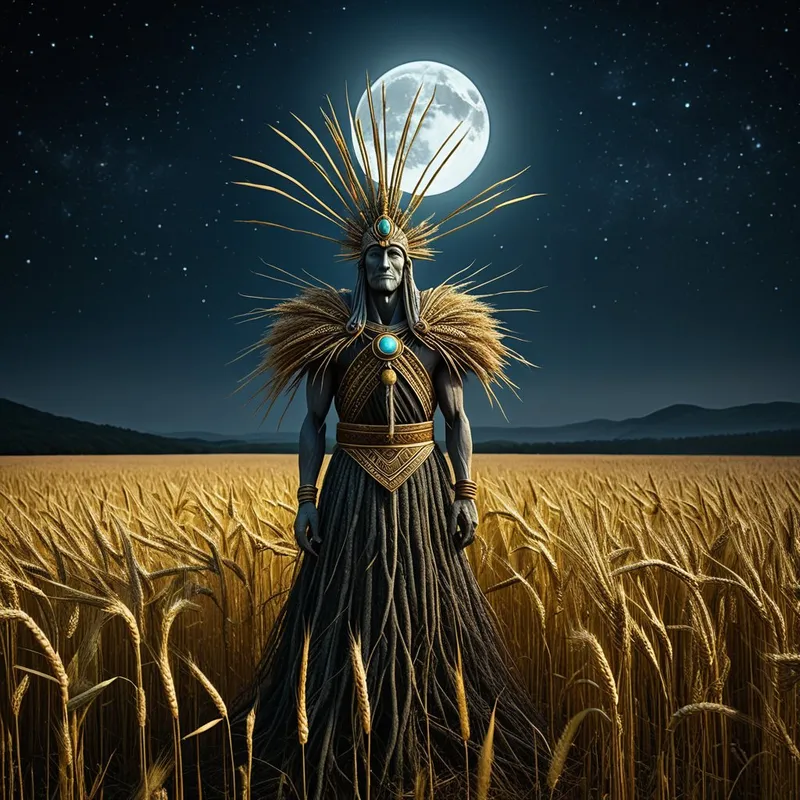
But in the deepest watch of the night, when the stars pressed close, a change stirred. Where his tear had fallen, a soft, silver-green light emanated from the soil. It spread in delicate filaments, like roots of luminescence, tracing the grid of furrows. From these lines of light, forms began to coalesce—tall, slender, and silent. They were figures of living earth and woven stalk, with eyes like deep pools of still water reflecting starlight. They were the Field Guardians.
They did not speak to Kaelen in words. A knowing settled into his bones. They were not new; they had always been, the latent spirit of the place, asleep in the soil, waiting for the call that was not a demand, but a sacred reciprocity. Their form was the land’s answer to a true sacrifice—not of a thing, but of the arrogance that separated the people from the ground that sustained them. As the first light of dawn touched the valley, the Guardians faded from sight, but their presence remained, a solemn vibration in the air. And where Kaelen had planted his seed, a single, impossibly strong green shoot had broken the crust of the earth, reaching for the sun.
Cultural Origins & Context
The myth of the Field Guardians is a cornerstone agrarian narrative found across countless pre-industrial cultures, from the river basins of Eurasia to the highland valleys of the Americas. It belongs not to a single "World Folklore" but to a global pattern born from the universal human transition from foraging to cultivation. This story was not the property of priests or kings, but of the farming folk themselves. It was told at hearthsides after harvest, during the long nights of winter planting, and to children as they learned to drop seeds into furrows.
Its primary societal function was pedagogical and ecological. It encoded a vital survival principle: sustainable agriculture is a covenant, not a conquest. The myth taught that fertility was a relational, spiritual condition as much as a chemical one. It established the ethical framework for stewardship, prescribing rituals of offering (the first fruits, libations) not as empty superstition, but as performative acts of remembrance—re-enacting Kaelen’s sacrifice of pride and his offering of the last seed. The story served as a cultural check against the hubris of over-exploitation, personifying the consequences of ecological disregard in the tangible, terrifying form of the blight and the famine.
Symbolic Architecture
At its core, the myth maps the psyche’s relationship to the source of its own nourishment and creativity. The fertile field is not merely farmland; it is the inner landscape, the soul’s potential. The villagers’ arrogance represents the conscious ego’s belief in its total autonomy, its assumption that it can extract from the unconscious (instinct, emotion, inspiration) without gratitude or relationship, leading to psychic barrenness—creativity block, depression, a life devoid of meaning.
The Guardian does not appear to the one who seeks to control the field, but to the one who is willing to become its servant.
Kaelen’s journey is one of profound humiliation and ego-death. His offering of the "last seed" is the ultimate symbolic act: it is the surrender of his final claim to control, his last hope for personal salvation, handed back to the source. This is not despair, but the birth of a higher responsibility. The tear is the water of genuine feeling, the emotional truth that finally irrigates the parched relationship between ego and Self.
The Field Guardians themselves symbolize the archetypal law of reciprocity. They are the awakened daimons of the place, the psychic structures that organize and protect vitality when the ego aligns itself with its deeper purpose. They are not external rescuers; they are the externalized form of the field’s own inherent intelligence, which activates only when met with the correct attitude: stewardship, not ownership.
The Dreamer's Resonance
When this myth stirs in the modern dreamscape, it rarely appears as ancient farmers. Instead, one might dream of being tasked with protecting a neglected garden, a room of dying plants, or a mysterious, overgrown parcel of land. There is often a profound somatic weight—a feeling of urgent responsibility mixed with helplessness. The "blight" may manifest as a grey fog, a sucking mud, or a silent, spreading decay.
Such dreams signal a critical phase in what psychologists might call introversion. The dream ego is being confronted with a part of its own inner life—a talent, a relationship, a creative pursuit, a core value—that it has been exploiting or neglecting. The field is that psychic territory. The feeling of duty is the Self’s call to assume the role of Guardian. The dream is an invitation to the "Kaelen moment": to kneel before what has been taken for granted, to offer not a grandiose fix, but a simple, heartfelt act of attention and sacrifice of old, arrogant attitudes. The anxiety in the dream is the friction of this necessary humbling.
Alchemical Translation
The alchemical process mirrored here is nigredo transforming into albedo. The blight and famine are the nigredo—the dark night of the soul, where all previous modes of operation (the village’s arrogance) fail utterly, leading to a state of putrefaction and despair. This is a necessary death.
Kaelen’s vigil represents the mortificatio, the killing of the old, entitled ego. His sacrifice of the last seed is the pivotal act of coniunctio—not a marriage of male and female, but of human consciousness (the seed of intention) with the anima mundi, the world soul (the receptive earth). This union is not for personal gain, but for the sake of the "field" itself—the wholeness of the psyche.
Individuation is not about claiming the field as one’s kingdom, but about answering the call to become its Guardian.
The emergence of the Guardians is the albedo, the dawning of a new, spiritualized consciousness. They represent the birth of a conscious ethic of care from within the psyche itself. For the modern individual, the myth models the path from being an extractive consumer of one’s own life force to becoming a steward of it. The triumph is not a bounty harvested for the ego, but the permanent establishment of an inner attitude—the Guardian—who stands watch, ensuring that one’s relationship with the sources of one’s own life, creativity, and relationships remains sacred, reciprocal, and humble. The green shoot at dawn is the first evidence of a life now rooted in this new and ancient law.
Associated Symbols
Explore related symbols from the CaleaDream lexicon: