
Ferns Myth Meaning & Symbolism
A tale of a hidden flower of fire, guarded by spirits, whose finding grants vision but demands a profound sacrifice of the seeker's former self.
The Tale of Ferns
Listen, and let the mist of the old world gather. In the time before time was counted, in the deep heart of the Nemeton, there existed a secret known only to the earth itself and the spirits that walk between the roots. It was the secret of the Fern Flower.
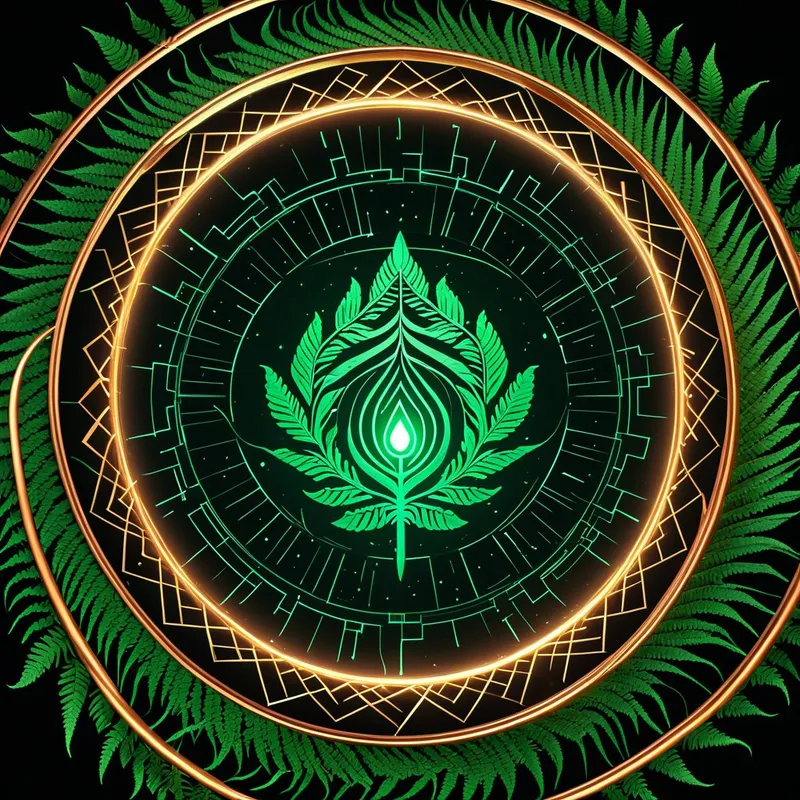
The woods then were not just trees, but a breathing entity. The Genius Loci of the forest was a being of immense, silent patience, woven from bark and shadow, its eyes like pools of still water reflecting the stars. It guarded the oldest, dampest hollows where the sun dared only to dapple. And in the deepest of these hollows, on the night when the sun stood longest in the sky—Alban Hefin—a miracle occurred. Not a bloom of petal and scent, but a flower of pure, condensed light. A single fern frond would kindle from within, glowing with a gold-green fire, a tiny star fallen to the forest floor.
But this light was not a gift; it was a test. To find it, a seeker had to enter the woods at dusk, drawn by a yearning they could not name. They had to walk without looking back, feeling the path with their feet more than their eyes, as the world of solid forms dissolved into whispers and shifting shadows. The forest would resist. Branches became grasping arms, the calls of night birds turned to mocking laughter, and the very air grew thick with the weight of forgotten fears. The seeker’s own doubt was the first and fiercest guardian.
If the heart remained true—not pure, for no human heart is purely so, but true in its longing—the seeker would stumble into a circle of profound silence. There, in a cradle of moss and stone, the fern would be waiting. Its light was cool and ancient, illuminating nothing but itself. To see it was to know the hidden veins of the world, the paths of underground streams, the true names of the stars, and the silent language of the stones. It was the knowledge of how things are woven together.
But the moment the seeker reached to possess it, to pluck the flower of fire, the final guardian acted. The Genius Loci would manifest, not in wrath, but in solemn inevitability. Its voice was the rustle of a million leaves. The price for the knowledge was the memory of the path. The seeker would take the light into their mind, but the way back to their old life, the simple identity of who they were before they knew, would be forever erased from the world. They would emerge at dawn, forever changed, bearing a wisdom they could never fully explain, strangers to the shore they once called home.

Cultural Origins & Context
The myth of the Fern Flower is a powerful strand of folklore found across many European traditions, with particularly potent roots in Celtic and later Slavic lands. In the Celtic world, it was not a formal myth recorded in epics like the Mabinogion, but a living, breathing piece of dinnseanchas—the lore of place. It belonged to the people, told by hearths and in fields, a secret passed in whispers.
Its tellers were the folk, not the Druids, though it resonates with Druidic reverence for the hidden knowledge of the natural world. The myth functioned as a societal metaphor for the dangers and rewards of seeking esoteric wisdom. It reinforced the idea that true knowledge—of herbs, of stars, of fate—was not academic, but experiential and transformative, guarded by the spirit of the land itself. It also served as a cautionary tale about the solstice, a liminal time when the veil was thin, and not all that glittered was benevolent. The fern, a plant that reproduces via invisible spores (a mystery to the ancients), was the perfect vessel for a myth about hidden, sudden, and inexplicable revelation.
Symbolic Architecture
The fern itself is the central symbol of latent potential. It grows in darkness, unfurling from a tight spiral (triskelion), a perfect image of development from a hidden core. It represents knowledge that is not in the bright sun of consciousness, but in the damp, fertile shadow of the unconscious.
The true seeker does not walk toward light, but into the deepening dark where the only illumination is the one they are destined to kindle within.
The Flower of Fire is the luminous moment of insight, the aha that reconfigures one’s entire understanding. It is not intellectual but gnostic—a knowing that sears. The arduous, disorienting journey symbolizes the necessary descent into the psyche, where one’s familiar landmarks (prejudices, identities, ego defenses) must dissolve. The final sacrifice—the loss of the path back—is the most profound symbol. It represents the irreversible nature of true psychological transformation. Once you have seen the hidden wiring of reality, you cannot "unsee" it. The old, naive self is gone; integration into the community as you once were is impossible. You are left with wisdom, but also with a fundamental solitude.
The Dreamer's Resonance
When this myth stirs in the modern dreamer, it often manifests as dreams of searching in dense, unfamiliar woods or labyrinthine buildings. The dreamer might be looking for a specific, glowing object or a hidden room. There is a palpable sense of urgency mixed with dread.
Somatically, this can correlate with feelings of constriction in the chest (the tight fern frond) followed by moments of expansive insight or anxiety (the unfurling, the confrontation). Psychologically, this dream pattern signals a crucial stage in the process of individuation: the ego’s conscious engagement with the treasures of the unconscious. The dreamer is on the verge of assimilating a powerful complex or archetypal knowledge that their conscious mind has resisted. The "guardians" in the dream—often threatening figures or obstacles—are personifications of internal resistance: fear, shame, or the attachment to an outgrown identity. The dream is the psyche’s way of rehearsing the ordeal necessary to claim one’s own inner authority and hidden insight.

Alchemical Translation
The myth of the fern is a perfect allegory for the alchemical Magnum Opus, particularly the stage of Nigredo. The seeker’s journey into the dark wood is the Nigredo—the dissolution of the known self in the murky waters of the unconscious. Confusion, fear, and the loss of direction are necessary; the ego must be humbled.
The finding of the glowing fern is the Albedo, the lunar illumination that follows the black night. It is the emergence of a new, purer understanding from the decay of the old. However, Celtic wisdom adds a crucial, often overlooked step: the sacrifice.
Transmutation is not complete with illumination alone; it is sealed by the willing surrender of the map that led you out of who you used to be.
The spirit’s demand—the erased path—is the Rubedo. This is the integration, where the illuminated knowledge is paid for with the totality of one’s being. You don't get to keep the new gold and the old lead. For the modern individual, this translates to a life change that is all-encompassing. Perhaps a spiritual awakening that ends a career, a trauma processed that alters all relationships, or a creative insight that demands a new, solitary path. The myth assures us that this painful irreversibility is not a punishment, but the hallmark of genuine, alchemical change. The seeker emerges not just wiser, but fundamentally remade, carrying the inner fire of the fern flower as their sole, and sufficient, guide.
Associated Symbols
Explore related symbols from the CaleaDream lexicon: