Ferment Myth Meaning & Symbolism
A myth of divine putrefaction where the sacred vessel shatters, releasing a chaotic ferment that is the essential, terrifying prelude to all true creation.
The Tale of Ferment
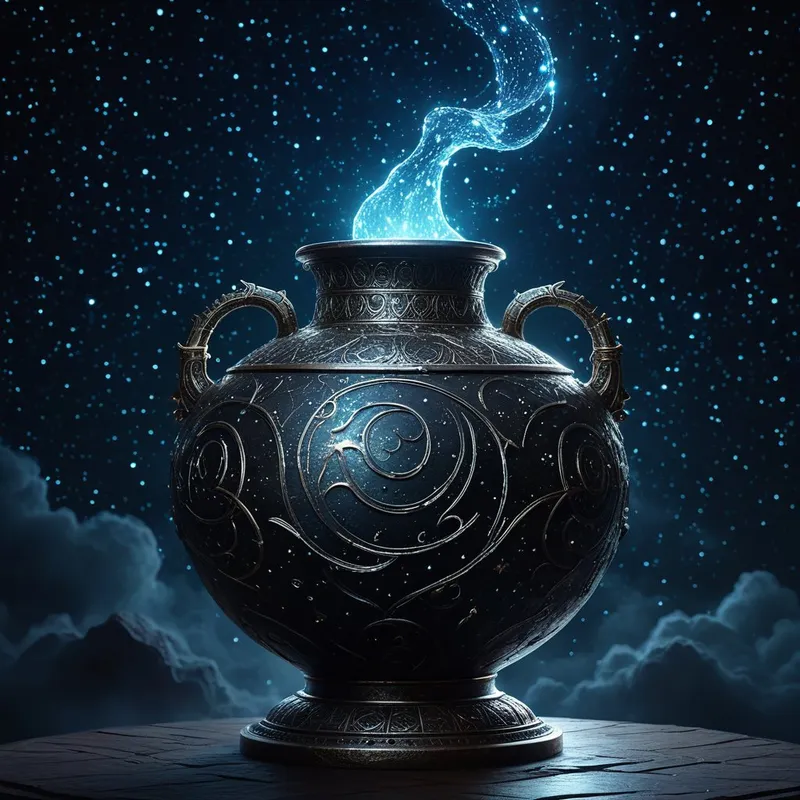
Listen. In the time before the first metal was drawn from stone, when the world was a crucible of potential, there existed the Vas Hermeticum. It was not a thing of this earth, but a principle given form—a perfect, silent sphere of obsidian and electrum, suspended in the chamber of the First Alchemist. Within it rested the Prima Materia, a sleeping, silver sludge, the seed of all that could be.
The First Alchemist tended the vessel with a devotion that knew no doubt. They applied the gentle heat of attention, the steady flame of will. For an age, the sphere remained silent, a closed womb. Then, a sound began: a low, wet grumbling, a subterranean digestion. The silver sludge darkened, clouding like a dying eye. A stench seeped through the imperceptible seams of the vessel—not of rot, but of a profound, essential unmaking: the smell of damp soil, of rust, of forgotten cellars and the deep sea’s breath.
The Alchemist recoiled. This was not the radiant transformation promised. This was putrefaction. Corruption. The sacred substance was spoiling. Desperate, they increased the heat, seeking to burn the decay away. But the grumbling within grew to a roar. The sphere trembled. Cracks, fine as spider-silk, etched across its perfect surface, glowing with a sickly, phosphorescent green.
And then, it burst.
Not with an explosion of light, but with a great, sighing rupture. From the shattered vessel poured the Ferment. It was a living, seething tide of contradictions: bubbling acids and cloying syrups, vapors that whispered madness and gases that sang of genesis. It was the color of a bruise in twilight. It flowed across the chamber floor, dissolving stone, spawning strange, temporary fungi that glowed and died in breaths. It contained everything—the screaming chaos of birth, the silent pull of decay, the furious dance of elements breaking their bonds.
The Alchemist fell to their knees, not in prayer, but in utter dissolution. Their ordered world, their perfect vessel, their clear intent—all were consumed by the chaotic, creative vomit of the Ferment. They watched as the tide receded, as the chamber was left scarred and stinking. And in the very center, where the vessel had been, rested a single, dark, granular mass. It was ugly, humble, and utterly new. It was the Caput Mortuum, the Head of the Raven. The first work was complete. The Ferment had done its terrible, necessary work.

Cultural Origins & Context
The myth of Ferment is not a story told to children or sung in public squares. It was a secret narrative, passed in whispers between adepts in the torch-lit undercrofts of medieval laboratories and Renaissance workshops. It belonged to the "oral tradition of the furnace," a counter-narrative to the clean, linear diagrams of the published alchemical texts. Its tellers were those who had, through long and frustrating practice, encountered the visceral, messy reality of the work: the failed experiments, the inexplicable colors, the foul odors, the moments when the matter in the flask seemed to rebel against all theory.
Its societal function was initiatory and psychological. It served as a warning and a comfort. A warning that the path to the Lapis Philosophorum did not bypass the swamp of the soul’s own decomposition. And a comfort, in that it normalized the experience of profound inner chaos, framing it not as a personal failure, but as a divinely mandated, mythic phase—the Nigredo. It was a myth that gave meaning to despair, alchemizing the practitioner’s personal crisis into a participation in a primordial, cosmic process.
Symbolic Architecture
At its core, the Ferment symbolizes the active, chaotic phase of decomposition that must precede recombination. It is not mere death or stillness, but a frenzied, fecund breaking apart. Psychologically, it represents the eruption of the unconscious when the conscious ego’s structures—the "vessel" of our identity, beliefs, and persona—can no longer contain the pressure of unlived life or unresolved trauma.
The vessel must shatter. The ordered self must submit to the chaotic ferment of all it has denied, for only in that seething soup can the elements of a new consciousness be freed.
The Vas Hermeticum is the fragile, constructed self, the persona we believe is solid and sealed. The Prima Materia within is the raw, unconscious content of the psyche. The First Alchemist is the directing, but naive, conscious will. The Ferment itself is the autonomous, transformative power of the psyche—the Shadow, in its most dynamic and overwhelming form, erupting not as a single repressed trait, but as a tidal wave of disintegrated complexity. The resulting Caput Mortuum is the humbled ego, stripped of its illusions, now a fertile "black earth" ready for the sowing of new meaning.

The Dreamer's Resonance
When this myth stirs in the modern dreamer, it announces a somatic and psychological process of profound inner fermentation. Dreams become landscapes of visceral, unsettling transformation. One may dream of flooded basements with swirling, murky water; of houses crumbling from the inside out, filled with strange molds; of vomiting endless, colorful, but disturbing substances; or of being caught in a riotous, chaotic crowd of shadowy figures that are all aspects of oneself.
Somatically, this can parallel experiences of illness, digestive turmoil, intense fatigue, or a feeling of being "poisoned" or "toxic." Psychologically, it is the feeling of a nervous breakdown, a depressive collapse, or an identity crisis where all former certainties dissolve into a confusing, emotional morass. The dreamer is not dying; they are fermenting. The process feels like rotting because our cultural framework has no positive container for this essential chaos. The myth provides that container, suggesting this is not an end, but the violent, necessary beginning of a reconstitution.

Alchemical Translation
For the modern individual seeking wholeness or individuation, the myth of Ferment models the non-negotiable first step of psychic transmutation: the descent into and submission to chaos. Our culture valorizes the "hero’s journey" as one of action and conquest, but alchemy posits a prior, more passive, and more terrifying journey—the Nekyia into the bubbling cauldron of the self.
The modern "alchemical work" often begins when our best-laid plans, our career identities, our relational paradigms, suddenly crack and are flooded by a ferment of anxiety, rage, grief, or meaninglessness. The instinct is to repair the vessel—to "get back to normal," to suppress the chaos. The myth instructs us to do the opposite: to allow the shattering. To let the ferment flow.
The goal is not to stop the fermentation, but to learn to stand, knee-deep in the seething mess of one’s own psyche, and witness it without fleeing. This witnessing is the first form of the new vessel.
This process transmutes the lead of neurotic suffering into the gold of self-knowledge. The chaotic emotional and psychic material (the Ferment) is not the enemy; it is the prima materia of the new self. By enduring it, by allowing the old, rigid structures of personality to be broken down, the individual creates the psychic space where new, more authentic configurations can eventually coalesce from the chaos. The triumph in the myth is not controlling the Ferment, but surviving it—and finding, in its wake, the humble, fertile blackness from which everything new must grow. The Ferment teaches that before we can become creators, we must consent to be compost.
Associated Symbols
Explore related symbols from the CaleaDream lexicon: