Fenrir's Chains Myth Meaning & Symbolism
A prophecy of doom, a wolf of immense power, and the cunning chains that bind him—a myth of inevitable fate, broken trust, and the shadow we cannot outrun.
The Tale of Fenrir's Chains
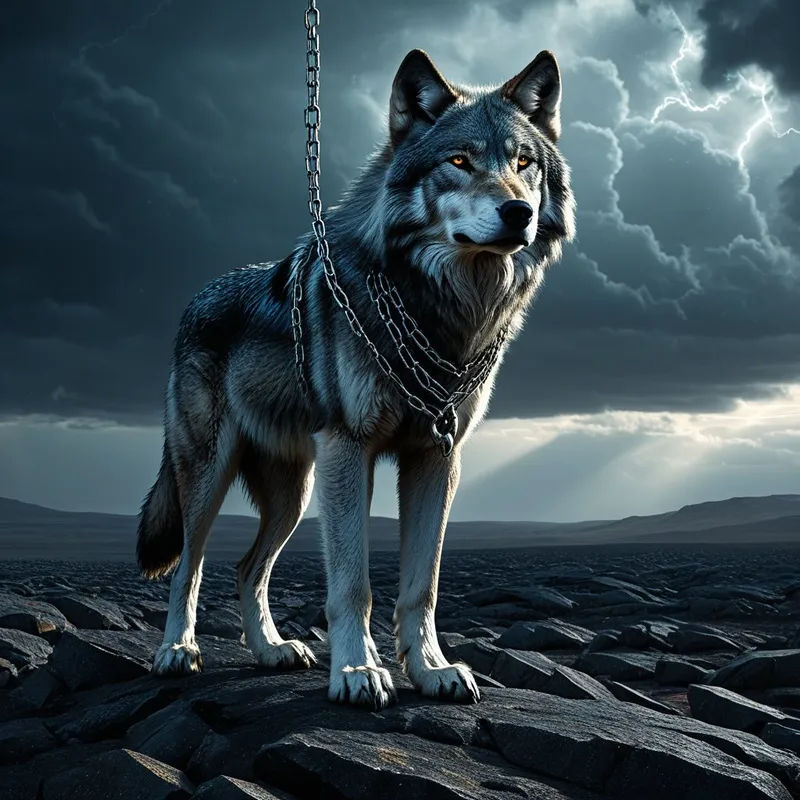
Listen, and hear the tale of the binding, a story told in the whisper of cold winds and the creak of ancient wood. In the dawn of the world, when the Æsir were young and Yggdrasil’s roots drank deep from the wells of fate, a shadow was born. From the union of the trickster Loki and the giantess Angrboða came three children, and the greatest of them was a wolf named Fenrir.
He was no ordinary beast. He grew with the speed of a looming storm, from a playful pup to a creature whose shoulders brushed the clouds. His eyes held the cold light of distant stars, and his jaws, it was said, could span the gap between heaven and earth. A whisper began among the gods, a dread prophecy spoken by the Norns at the foot of the World Tree: this wolf would be their doom. He would devour the sun, swallow the All-Father, and drown the worlds in blood at Ragnarök.
Fear, cold and sharp, settled in the golden halls of Asgard. The gods, in their wisdom—or was it their folly?—decided the wolf must be restrained. Twice they tried. They brought forth a great chain called Lædingr, and with false cheer, challenged Fenrir to test his strength. The wolf looked at the heavy links, then at the faces of the gods, and with a shrug that shook the earth, he shattered it. Next came Drómi, twice as strong. Again, the challenge, the wary gaze, and with a roar that echoed in the roots of Yggdrasil, Fenrir burst its bonds, sending shards of iron flying like hail.
Now, true terror gripped the Æsir. They knew no forge in the nine worlds could craft a fetter strong enough. So they turned to cunning. They sought out the dvergr in their sunless forges and commissioned a binding not of strength, but of impossibility. From six impossible things—the sound of a cat’s footfall, the beard of a woman, the roots of a mountain, the sinews of a bear, the breath of a fish, and the spittle of a bird—the dark elves spun a ribbon. It was named Gleipnir, smooth as silk, light as a breath, and stronger than any iron.
They brought Fenrir to the lonely isle of Lyngvi, in the middle of the lake Ámsvartnir. They showed him the slender ribbon. Fenrir’s nostrils flared. He sensed the magic woven into its essence. “This ribbon may be made with cunning,” his voice rumbled like stones grinding deep in the earth. “I will not be bound by it, unless one of you places a hand in my mouth as a pledge of good faith.”
A silence fell, colder than the winds of Niflheim. The gods looked at one another, their bravery faltering. Then one stepped forward. Týr, the one-handed god of oath and courage, who had always fed and treated the great wolf fairly. Without a word, he placed his right hand between Fenrir’s jaws.
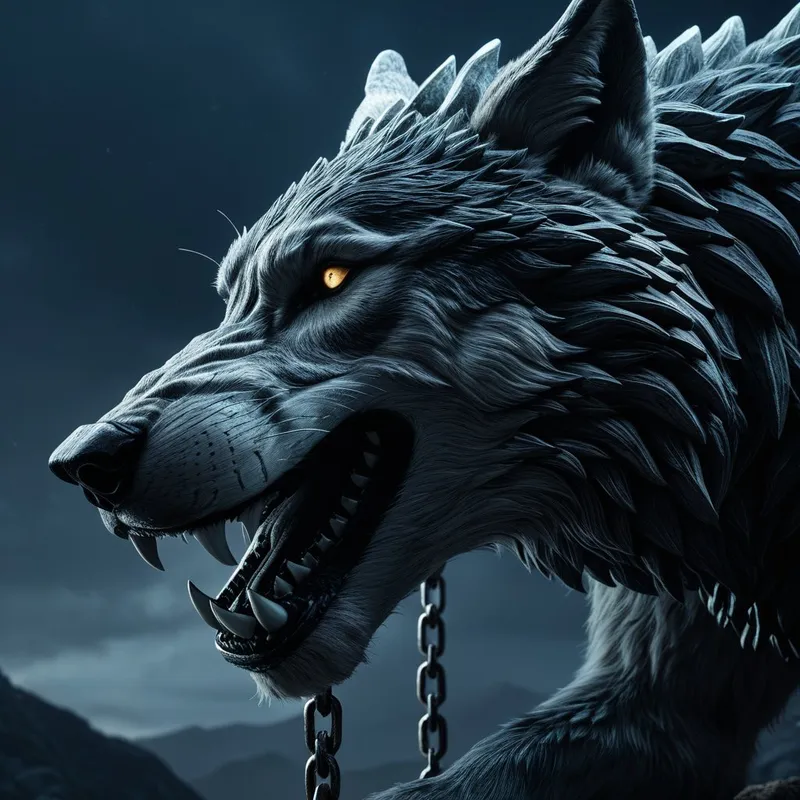
The wolf allowed himself to be bound. The moment Gleipnir was fastened, Fenrir strained against it. The softer he struggled, the tighter the band grew, biting into his flesh, fusing with his destiny. Realizing he was truly trapped, Fenrir snapped his jaws in rage and sorrow. And Týr’s hand, the pledge, was severed. The god did not cry out, but his blood stained the grey rocks of Lyngvi, the price of the gods’ security. As Fenrir howled a curse that would last until the end of days, the gods thrust a sword into his mouth, its hilt lodged in his lower jaw, its point piercing the roof. His terrible drool, now a river of despair named Ván, began to flow. There he lies, bound, until the chains of the world break.
Cultural Origins & Context
This myth reaches us from the twilight of the Viking Age, preserved primarily in the 13th-century Prose Edda of Snorri Sturluson and the older, poetic fragments of the Poetic Edda. It was not a children’s fable but a foundational narrative for a culture intimately acquainted with harsh necessity, fate (ørlög), and the complex ethics of survival. Skalds would have recited this tale in smoky longhouses, its themes resonating with a people for whom betrayal for the greater good, the binding of dangerous forces (be they human, natural, or supernatural), and the acceptance of grim prophecy were not abstract concepts, but lived realities. The myth functioned as a theodicy—an explanation for the presence of suffering and betrayal in the divine order—and as a societal mirror. It asked: What must a community sacrifice, and what honor must it compromise, to ensure its continued existence? The binding of Fenrir was a necessary, yet stainingly tragic, act of cosmic governance.
Symbolic Architecture
At its heart, the binding of Fenrir is a supreme allegory for the psyche’s attempt to manage its own uncontrollable, destructive potential—the Shadow, in Jungian terms. Fenrir is not mere evil; he is raw, amoral power, the inevitable consequence of chaos (Loki) unleashed in the world. The prophecy of Ragnarök ensures he is not an external enemy, but a destined part of the cosmic cycle. The gods’ fear is our own fear of the untamed aspects of ourselves: our rage, our hunger, our capacity for utter devastation.
The chain is not placed on the monster from without; it is forged from the collective fears and cunning of the conscious mind.
The first two chains, Lædingr and Drómi, represent crude, forceful attempts at repression. They are the willpower we apply to bottle up our anger, the rigid rules we impose to control our desires. They always fail, often making the repressed force stronger and more explosive. Gleipnir, however, is different. Crafted from “impossible” or intangible things, it symbolizes the subtler, more insidious binds of the psyche: the internalized narratives, the neurotic patterns, the unconscious agreements we make that hold our wildness in check. It is the guilt that stifles passion, the anxiety that paralyzes action, the “reasonable” voice that chains the rebel soul.
Týr’s sacrifice is the myth’s moral core. It represents the necessary cost of this binding. To integrate or even safely contain our shadow, we must offer up something of real value—a piece of our innocence, a cherished self-image, the simple comfort of seeing ourselves as purely good. Týr loses his hand, his instrument of action and pledge. We lose a part of our naive wholeness. The sword in Fenrir’s mouth, forcing the river Ván (Hope), is a poignant detail. It suggests that the bound monster’s torment itself becomes a source of something new, a flowing, corrosive hope born of unbearable tension.
The Dreamer's Resonance
When this myth stirs in the modern dreamer, it often manifests as dreams of constriction, betrayal, or being monstrous. To dream of being bound by thin, unbreakable threads or silken cords points directly to the Gleipnir in one’s life—the subtle, self-imposed limitations born of family expectations, societal conditioning, or a deeply ingrained fear of one’s own power. Dreams of being the wolf, raging against invisible restraints, signal a Shadow aspect fighting for recognition, straining at the bonds of repression.
Dreams featuring a profound betrayal, especially by a trusted figure (the Týr archetype), may reflect the psyche’s processing of the moment we realized our own innocence or trust was the price paid for “security” or social acceptance. The somatic experience is one of tightness in the jaw, throat, or chest—the very places where Fenrir is bound and gagged. This is the body remembering where it has swallowed its roars and choked back its truth.
Alchemical Translation
The individuation process modeled here is not one of slaying the monster, but of relating to it. The first alchemical step is recognizing the prophecy—acknowledging that within us lies a Fenrir, a destructive potential that is part of our totality and connected to our ultimate destiny (our personal Ragnarök, or crisis of transformation). We cannot outrun it.
The second is examining our chains. Are we using crude, forceful repression (Lædingr), or are we bound by the almost invisible, magical fetters of neurosis and internalized dogma (Gleipnir)? The work involves tracing the threads of our Gleipnir back to their origins: the “sound of a cat’s footfall” (the fears we never faced), the “beard of a woman” (inverted or unnatural constraints).
The ultimate alchemy is not in forging a better chain, but in developing the courage to approach the bound wolf and hear its grievance.
This is where Týr’s courage becomes the model. The final translation is the conscious, willing sacrifice. We must offer the “hand” of our old identity—the part of us that needs to see itself as perfectly in control, purely good, or forever safe—into the jaws of our truth. This is a terrifying risk, the equivalent of losing a hand. It feels like a betrayal of the self by the self. But it is the only pledge that allows for a new relationship with our bound power. The goal is not to set Fenrir loose indiscriminately, but to sit at the edge of the river Ván, to understand the source of its flow, and to await, with conscious readiness, the twilight hour when all bindings must be tested, and destiny met with open eyes.
Associated Symbols
Explore related symbols from the CaleaDream lexicon: