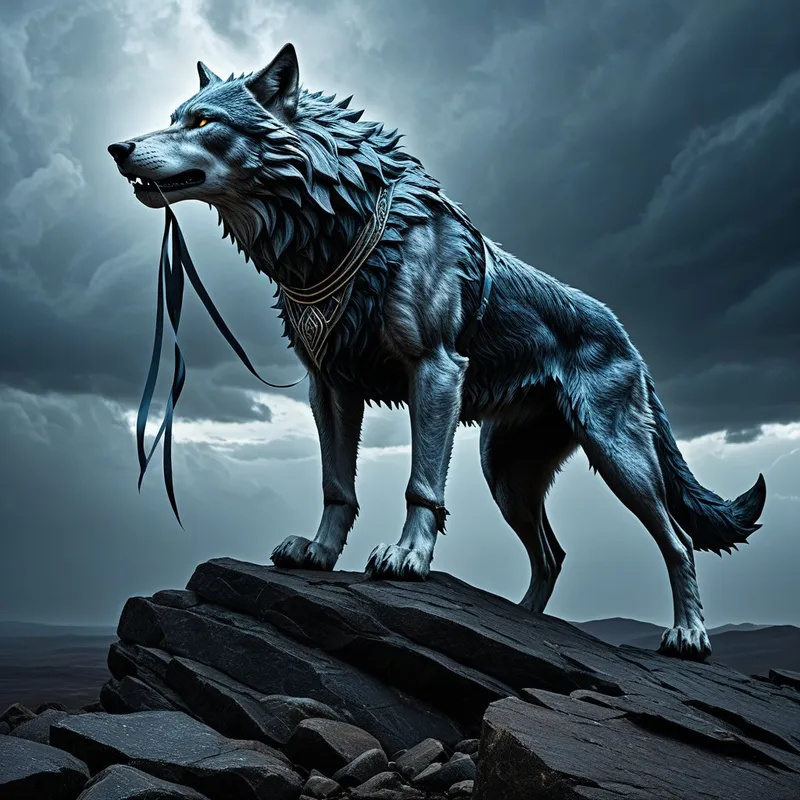
Fenrir's Binding Myth Meaning & Symbolism
A prophecy of destruction leads the gods to bind the great wolf Fenrir through trickery, a fateful act of fear that seals their own doom.
The Tale of Fenrir's Binding
Hear now of the doom that was woven, not in the stars, but in the hearts of the gods themselves. In the golden courts of Asgard, where mead flowed and boasts were made, a chill had taken root. It grew from a whisper, a seeress’s cold utterance that spoke of three children born of the trickster Loki and the giantess Angrboða. One was a serpent whose coils would encircle the world. One was a goddess who would rule the underworld. And the third… the third was a wolf.
His name was Fenrir, and he grew not as a pup grows, but as a storm gathers. He grew in the shadow of the gods’ fear. They brought him to Asgard, thinking to tame what they feared to destroy. But his eyes held the cold light of ørlög, and his jaws could crush mountains. The gods saw their own end in his gullet.
So they conceived a test, a game of strength. “Great Fenrir,” they said, their voices honeyed with false pride, “let us see if even the mighty chains of the dwarves can hold you.” They brought forth Leyding, a fetter of thick iron. Fenrir looked upon it, snorted, and with a single surge of muscle, shattered it like glass. The gods smiled too brightly.
They commissioned a second, Dromi, twice as strong. Again the wolf allowed them to bind him. Again he strained, and again the metal screamed and burst apart. The silence that followed was heavier than any chain. In that silence, their fear became a living thing.
They turned to the dark forges of the dwarves, masters of impossible craft. And from the dwarves they received Gleipnir. It was a ribbon, slender as a silken cord, fashioned from six impossible things: the sound of a cat’s footfall, the beard of a woman, the roots of a mountain, the sinews of a bear, the breath of a fish, and the spittle of a bird. It was not a thing of substance, but a thing of negation, of magic made law.
They brought Fenrir to the isolated island of <abbr title="The island of the "soundless" where Fenrir was bound">Lyngvi, in the middle of the lake Ámsvartnir. They showed him the ribbon. Fenrir, whose wisdom was as great as his strength, felt the deceit woven into its fibers. “This may look a slender band,” he growled, the sound like grinding stones, “but I sense great fame will come to him who forges such a fetter. I will not be bound by it, unless one of you places a hand in my mouth as a pledge of good faith.”
The gods looked at one another. Their courage, so loud in the hall, was silent now. Then one stepped forward. Tyr, whose word was his bond. Without a word, he placed his right hand, his sword-hand, between the wolf’s jaws.
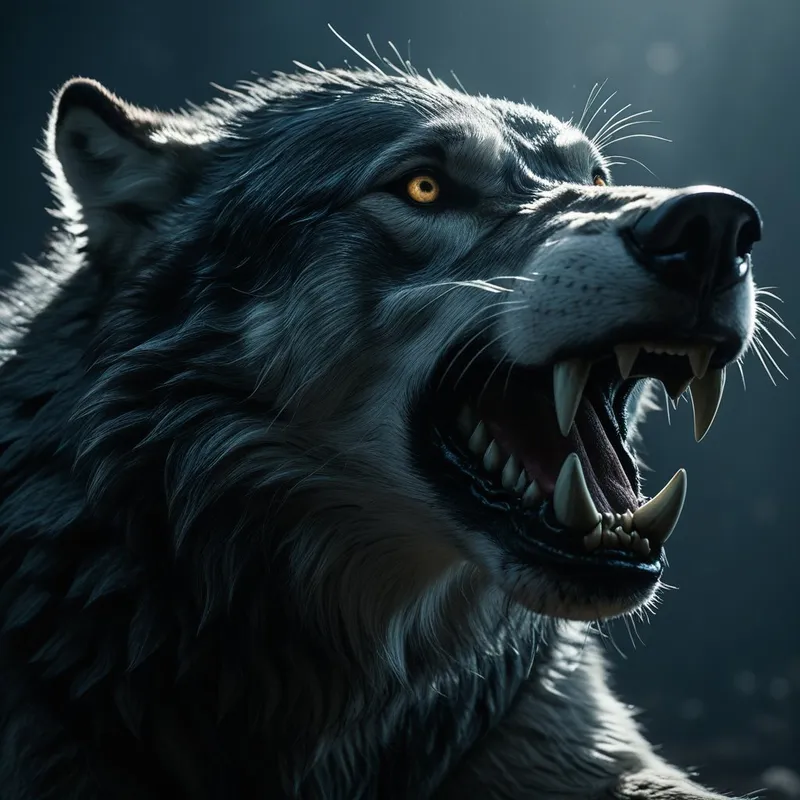
The binding began. The more Fenrir struggled, the tighter the ethereal band grew. He roared, and the world shook. He bit down in his fury, and Tyr’s hand was severed at the wrist. The gods laughed then, a sound of relief and triumph, all but Tyr, who stood in silent sacrifice. They took a great sword and thrust it through Fenrir’s jaws, propping them open so his terrible howls became a river of drool, <abbr title="The river "Expectation" formed from Fenrir's drool">Ván, a river of waiting rage. And there they left him, bound by a thread of magic, until the day the bonds of the world would break.
Cultural Origins & Context
This myth, like all Norse mythology, was not scripture but story, living in the oral tradition of the Viking Age and earlier Germanic peoples. It was preserved in two primary 13th-century Icelandic texts: the Poetic Edda, a collection of older poems, and the Prose Edda of Snorri Sturluson, who systematized the lore. These were written down centuries after the Christianization of Scandinavia, meaning the tales are refracted through both time and a new religious lens, yet their pagan bones remain stark and clear.
The myth of Fenrir’s Binding was not a children’s fable. It was a foundational narrative about the nature of the cosmos and the gods themselves. It was told in halls where the concepts of honor, oath-breaking, and fate were immediate and vital. The story functioned as a theological explanation for the inherent instability of the divine order. The Æsir were not omnipotent, benevolent rulers; they were flawed, fearful beings engaged in a desperate holding action against chaotic forces they themselves had engendered through their own actions (like Loki’s progeny). The binding was a necessary, yet morally ambiguous and ultimately self-defeating, act of preservation. It taught that even the gods are subject to ørlög, and that the attempt to cheat destiny often forges the very chains of that destiny.
Symbolic Architecture
At its core, the binding of Fenrir is a myth of containment. It represents the psyche’s attempt to manage a force of pure, amoral, destructive potential that it has itself created and nurtured.
Fenrir is not evil in a simplistic sense; he is the embodiment of ravenous, unchecked instinct, the shadow of the gods’ own ambition and violence. He is the consequence of Loki’s chaotic essence—the untamed, creative-destructive potential that the gods harness but fear. The prophecy of Ragnarök, where Fenrir breaks free and kills Odin, is the ultimate return of the repressed.
The gods do not conquer their shadow; they betray and imprison it. And in doing so, they guarantee its apocalyptic return.
The binding tools are profoundly symbolic. The heavy chains Leyding and Dromi represent brute force, law, and overt control—methods that fail against a power born of the unconscious. Gleipnir, however, is different. It is a binding of subtlety, of paradox, made from “impossible” things. It represents the power of taboo, social contract, psychological manipulation, and “civilized” deceit to restrain what raw strength cannot. Tyr’s sacrifice is the crucial price. The god of law and oath must violate his own nature (by participating in a bad-faith oath) and pay with his hand—his capacity for action and pledge. This signifies that the act of repressing the shadow always costs a part of the Self its integrity and agency.

The Dreamer's Resonance
When this myth stirs in the modern dreamer, it speaks of a profound internal conflict around containment and rebellion. To dream of being Fenrir is to feel a potent, intelligent, but feared power within oneself being tricked, betrayed, or stifled by the “gods” of one’s own psyche: the internalized parents, societal rules, or the super-ego. The dream may manifest as being trapped by a deceptively flimsy yet unbreakable constraint—a job, a relationship, a self-concept—that feels like a betrayal of one’s true nature. There is often rage, a howling frustration that feels both immense and silenced.
Conversely, to dream of being one of the binding gods is to experience the anxiety of the conscious ego trying to manage an eruption from the unconscious that feels world-ending. The dreamer may be crafting elaborate, subtle schemes (Gleipnir) to control an addiction, a temper, a forbidden desire, or a creative impulse they deem too dangerous. The somatic experience is one of tense vigilance, a fear of something breaking loose, often accompanied by a gnawing guilt (the price, Tyr’s hand) for the dishonesty of the repression.

Alchemical Translation
For the modern individual on the path of individuation, Fenrir’s Binding is not a model to follow, but a profound warning of what not to do. The alchemical goal is not to bind the wolf, but to integrate him.
The myth depicts the pre-individuated state: the conscious ego (the gods), fearing the dissolution of its kingdom, violently segregates the shadow (Fenrir). This creates a psychic civil war, with the ego spending immense energy to maintain the prison, and the shadow growing in potency and malice in the darkness. The prophecy of Ragnarök is the inevitable psychic crisis—the depression, explosion, or neurosis—that occurs when the repressed content breaks free.
The alchemical work begins not with a chain, but with an offering. One must approach the bound wolf, not with treachery, but with the courage of Tyr—not to lose a hand, but to offer something of the Self as a genuine pledge of engagement.
This means consciously engaging with one’s rage, one’s wildness, one’s “monstrous” appetites and instincts, not to act them out blindly, but to acknowledge their power and intelligence. The goal is to take the wolf off the island of isolation (Lyngvi) and bring him into some form of conscious relationship. This is the “freeing of Fenrir” that does not lead to destruction, but to empowerment. The raw, destructive force is transmuted into vital life energy, fierce protection, and unshakeable instinctual grounding. The individual who has integrated their Fenrir no longer fears their own depth; they have made an ally of the wolf, and in doing so, have averted their personal Ragnarök. The binding ribbon Gleipnir then transforms from a fetter into a sacred cord, a symbol of the conscious, respectful covenant between the ego and the immense power of the instinctual Self.
Associated Symbols
Explore related symbols from the CaleaDream lexicon: