Feng Huo Lun Myth Meaning & Symbolism
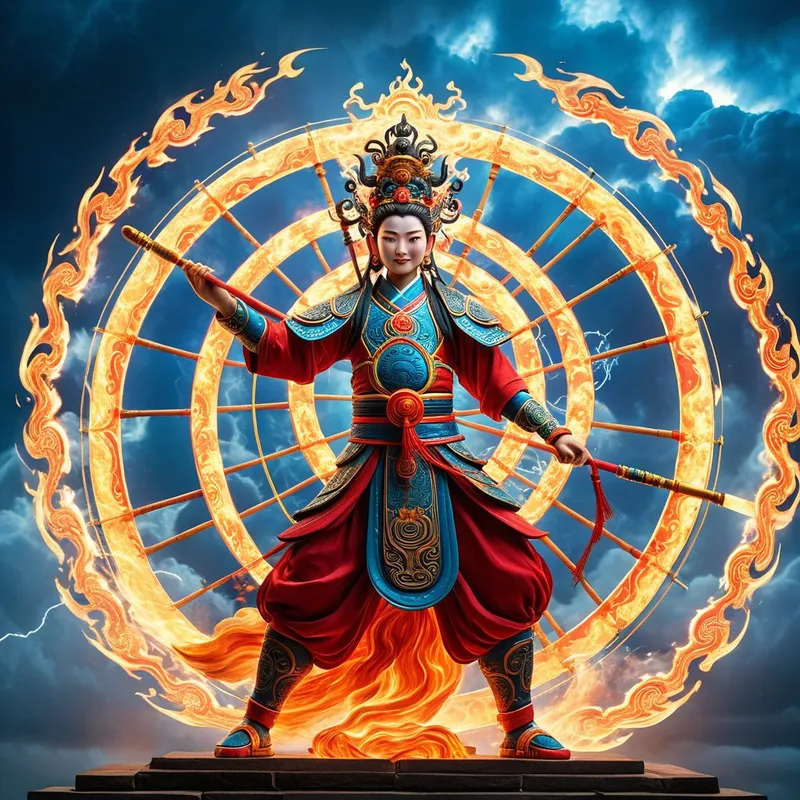
A myth of celestial artifice, where a divine wheel of wind and fire grants transcendence, symbolizing the mastery of opposing forces within the self.
The Tale of Feng Huo Lun
In the age when the [Jade Emperor](/myths/jade-emperor “Myth from Chinese culture.”/)’s court shone with immortal light and the boundaries between heaven, earth, and sea were still being drawn, a storm was born not from clouds, but from a heart. This is the tale of Nezha, the Third [Lotus](/myths/lotus “Myth from Hindu culture.”/) Prince, and the artifact that became his soul’s signature: the Feng Huo Lun.
He was a child of paradox, born from a celestial [pearl](/myths/pearl “Myth from Chinese culture.”/) into the household of General Li Jing, a ball of cosmic fury wrapped in mortal flesh. From his first breath, he carried the weight of heaven’s mandate and the fire of rebellion. His youth was a series of divine transgressions: slaying [the dragon](/myths/the-dragon “Myth from Chinese culture.”/) prince of the East Sea, challenging the Old Dragon King himself, and ultimately, in an act of filial piety and devastating defiance, returning his own flesh and bone to his parents to sever their mortal [karma](/myths/karma “Myth from Hindu culture.”/).
But a spirit forged in such fire cannot be extinguished. From the sacred lotus flowers of Guanyin, his form was reconstituted—stronger, purer, yet still burning with that essential, unquenchable flame. It was then that his true master, the profound and enigmatic Taiyi Zhenren, presented him with the tools of his destiny. Among them was not a weapon of simple destruction, but a key to transcendence.
The master unveiled the wheels. They were not of metal or wood, but of captured essence. One wheel churned with the untamed spirit of the celestial winds, the very breaths that stir the stars and carry prayers to the heavens. The other blazed with primordial fire, the cleansing, transformative force that dwells in the heart of suns and volcanoes. Separately, they were elements of chaos. But under Taiyi Zhenren’s art, they were bound into a perfect, rotating unity.
With a thought, Nezha willed them to life. The Feng Huo Lun ignited beneath his feet. Fire did not consume [the wind](/myths/the-wind “Myth from Various culture.”/); wind did not scatter the fire. Instead, they spun in a glorious, roaring synergy. He rose, not merely flying, but traversing. The ground fell away, not as something beneath him, but as a state he had outgrown. He became a streak of light and hurricane, moving with impossible speed across the skies, over mountains, and across the seas. The wheels were his mobility, his sovereignty, his declaration that he was bound no longer by the laws of earth or the dictates of stagnant order. They carried him into his great battles, against [the stone monkey](/myths/the-stone-monkey “Myth from Chinese culture.”/) [Sun Wukong](/myths/sun-wukong “Myth from Chinese culture.”/), against legions of demons, always as the embodiment of dynamic, righteous fury—a protector whose power was his freedom to be anywhere, to confront any threat, in the blink of an eye.
Cultural Origins & Context
The myth of Nezha and his Feng Huo Lun is woven deeply into the fabric of Chinese folk religion and classical literature. While Nezha’s origins may reach back to Vedic influences via Buddhism, his story was profoundly Sinicized and popularized through two monumental works: the Ming dynasty novel Fengshen Yanyi and, later, [Journey to the West](/myths/journey-to-the-west “Myth from Chinese culture.”/). These texts, recited by storytellers and performed in operas, cemented his place in the popular imagination.
He is not a remote, austere god, but a divine child, a relatable figure of immense power and adolescent impulsivity who matures into a guardian. His myth served multiple societal functions. For the common people, he was a powerful intercessor—a protector against floods and evil spirits, whose swift wheels meant he could come to aid with celestial speed. For the religious and philosophical traditions, his story illustrated profound Daoist and Buddhist principles: the transmutation of base elements (fire and wind) into spiritual tools, the importance of a master (Taiyi Zhenren) in guiding raw potential, and the ultimate journey from rebellious individuality to enlightened service within a cosmic order.
Symbolic Architecture
At its core, the Feng Huo Lun is an alchemical [emblem](/symbols/emblem “Symbol: A symbolic design representing identity, authority, or ideals, often used in heraldry, logos, or artistic expression.”/) of synthesized opposites. Wind (Feng) represents the mind, intellect, [spirit](/symbols/spirit “Symbol: Spirit symbolizes the essence of life, vitality, and the spiritual journey of the individual.”/), and [movement](/symbols/movement “Symbol: Movement symbolizes change, progress, and the dynamics of personal growth, reflecting an individual’s desire or need to transform their circumstances.”/)—the invisible force that directs and spreads. Fire (Huo) represents [passion](/symbols/passion “Symbol: Intense emotional or physical desire, often linked to love, creativity, or purpose. Represents life force and deep engagement.”/), will, vitality, and transformative [energy](/symbols/energy “Symbol: Energy symbolizes vitality, motivation, and the drive that fuels actions and ambitions.”/)—the visible force that consumes and renews. Unintegrated, these are the sources of [human](/symbols/human “Symbol: The symbol of a human represents individuality, complexity of emotions, and social relationships.”/) turmoil: a restless, scattered mind (wind) and a destructive, unchecked anger or desire (fire).
The artifact is not the suppression of an element, but the sacred marriage of opposites, creating a third, transcendent force: directed motion.
The wheel itself is the [symbol](/symbols/symbol “Symbol: A symbol can represent an idea, concept, or belief, serving as a powerful tool for communication and understanding.”/) of this [synthesis](/symbols/synthesis “Symbol: The process of combining separate elements into a unified whole, representing integration, resolution, and the completion of a personal journey.”/). A wheel turns, it moves, it is a [mechanism](/symbols/mechanism “Symbol: Represents the body’s internal systems, emotional regulation, or psychological processes working together like a machine.”/) for travel and change. It requires both the fiery drive to initiate [motion](/symbols/motion “Symbol: Represents change, progress, or the flow of life energy. Often signifies transition, personal growth, or the passage of time.”/) and the windy intelligence to guide its [direction](/symbols/direction “Symbol: Direction in dreams often relates to life choices, guidance, and the path one is following, emphasizing the importance of navigation in personal journeys.”/). Nezha’s mastery of the wheels signifies the [moment](/symbols/moment “Symbol: The symbol of a ‘moment’ embodies the significance of transient experiences that encapsulate emotional depth or pivotal transformations in life.”/) [the ego](/myths/the-ego “Myth from Jungian culture.”/), often torn between thought and [emotion](/symbols/emotion “Symbol: Emotion symbolizes our inner feelings and responses to experiences, often guiding our actions and choices.”/), integrates these forces under the [guidance](/symbols/guidance “Symbol: The act of receiving or seeking direction, advice, or leadership in a dream, often representing a need for clarity, support, or a higher purpose on one’s life path.”/) of the greater Self (represented by the master, Taiyi Zhenren). He no longer has a fiery temper; he commands [sacred fire](/myths/sacred-fire “Myth from Various culture.”/). He is no longer blown about by whims; he rides the celestial wind. The Feng Huo Lun thus becomes the ultimate [symbol](/symbols/symbol “Symbol: A symbol can represent an idea, concept, or belief, serving as a powerful tool for communication and understanding.”/) of psychic mobility—the [ability](/symbols/ability “Symbol: In dreams, ‘ability’ often denotes a recognition of skills or potential that one possesses, whether acknowledged or suppressed.”/) to consciously move through inner and outer worlds with agency, speed, and [purpose](/symbols/purpose “Symbol: Purpose signifies direction, meaning, and intention in life, often reflecting personal ambitions and core values.”/).
The Dreamer’s Resonance
When the pattern of the Feng Huo Lun spins into modern dreams, it often signals a critical phase of psychic integration. The dreamer may not see the wheels literally, but feel their signature: a sensation of incredible, almost terrifying speed; dreams of flying with newfound control; or confronting a situation with a surprising fusion of passionate conviction and clear-minded strategy.
Somatically, this can correlate with a release of stagnant energy—a feeling of “getting unstuck.” Psychologically, it marks the struggle to harmonize a deep inner conflict. One may feel torn between a “fiery” impulse (a career change, a creative pursuit, a necessary confrontation) and a “windy” anxiety (overthinking, fear of consequences, mental paralysis). The emergence of the Feng Huo Lun archetype in the dream suggests the unconscious is forging the tool for resolution. It is the promise that these opposing forces can be harnessed, not to cancel each other out, but to propel the dreamer forward into a new level of personal agency and life trajectory.
Alchemical Translation
The myth models the individuation process as one of celestial artifice. We begin as Nezha did: with raw, undifferentiated, and often chaotic potential. Our fire and wind rage internally, causing suffering and conflict. The first step is the “dismemberment”—the painful but necessary deconstruction of the old, conditioned self (Nezha returning his flesh). This is followed by a period of reconstitution from a more authentic, symbolic source ([the lotus](/myths/the-lotus “Myth from Hindu culture.”/)).
Individuation is the process of becoming the artificer of your own soul, forging scattered elements into a vehicle for consciousness.
Then comes the alchemical work, guided by the inner Taiyi Zhenren—the inner sage or guiding principle of [the Self](/myths/the-self “Myth from Jungian culture.”/). This master shows us how to take our elemental passions (fire) and our intellectual or spiritual aspirations (wind) and consciously bind them into a functional unity. This is not calm neutrality, but dynamic, purposeful synergy.
The triumphant result is the Feng Huo Lun of the integrated [psyche](/myths/psyche “Myth from Greek culture.”/). It is the ability to move through life with intention and power. Your passion fuels your journey, and your awareness steers it. You gain what Nezha gained: sovereignty over your own inner realm and the capacity to traverse great distances in your personal development with breathtaking speed. The wheel spins, and you are no longer a victim of your inner weather; you are the rider who commands the storm, using its very force to ascend.
Associated Symbols
Explore related symbols from the CaleaDream lexicon: