Feng Bo Myth Meaning & Symbolism
The myth of Feng Bo, the volatile Wind God, explores humanity's relationship with the untamable forces of nature and the psyche.
The Tale of Feng Bo
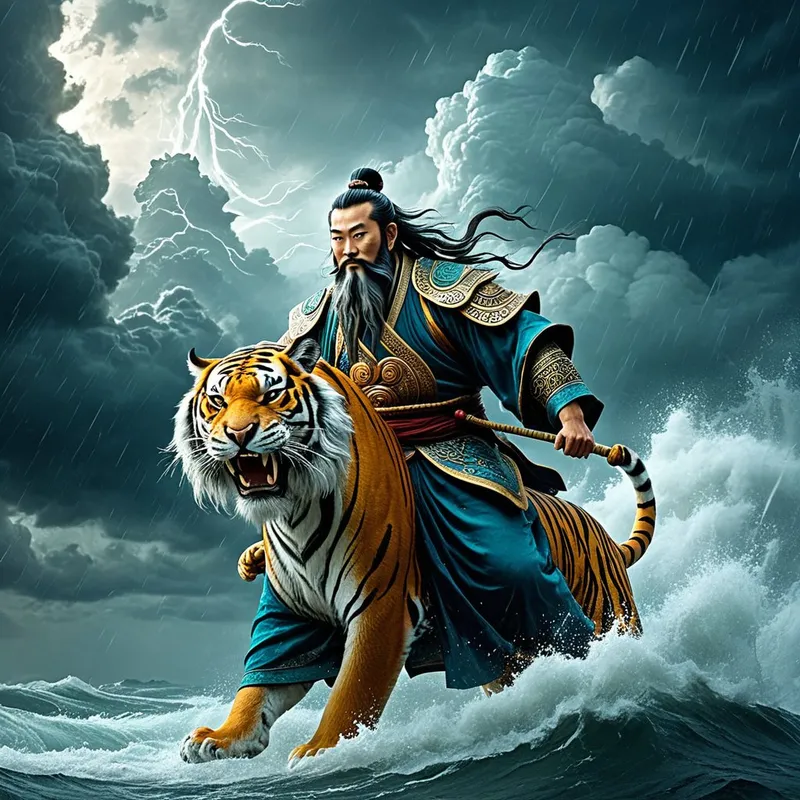
Listen, and hear the tale of the breath that moves between heaven and earth, the sigh of the world that is neither gentle nor cruel, but simply is. In the time when the world was still soft clay, when the hundun had only just begun to settle, there walked a being of pure impulse. His name was Feng Bo, and he was the wind itself given form—a giant with a beard of tangled cloud and eyes that flashed with distant lightning. He carried a great sack upon his back, and within it, he kept all the winds of the world: the zephyr that kisses the peach blossom, the gale that bends the ancient pine, and the typhoon that drinks the sea and spits it upon the land.
Feng Bo answered to no one. He roamed the wild edges of the cosmos, his laughter the roar of a storm front, his anger the shriek of a tornado. When he loosened the cord of his sack, chaos followed. Crops were flattened, rivers changed course, and the people huddled in fear, their prayers lost in the tumult. He was a necessary force, for without his breath, the air would grow stagnant and die, yet he knew no measure, no boundary. He was the untamed spirit of the yuanqi, raw and unchecked.
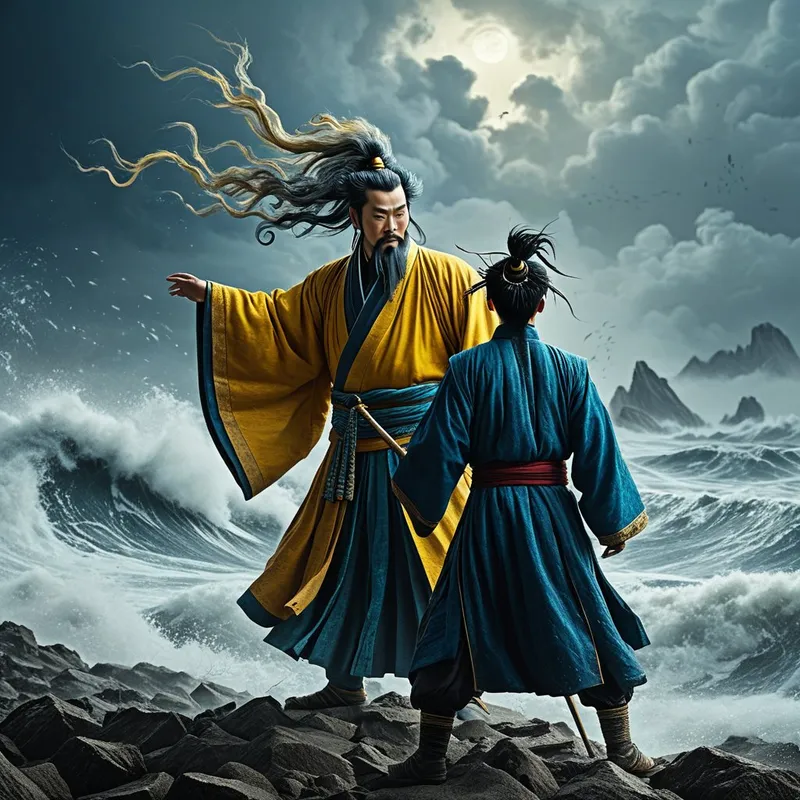
Then came the Yellow Emperor, Huang Di, he who brought order to the eight directions. He saw the suffering of the people and the disruption to the celestial and earthly orders. The Emperor did not seek to destroy Feng Bo, for he understood that to kill the wind is to kill the world. Instead, he sought to civilize the chaos. With the wisdom of the stars and the mandate of heaven, Huang Di confronted the wild god.
Their meeting was not upon a battlefield of swords, but in the liminal space where order meets impulse. "Your power is vast, Earl of Wind," spoke the Emperor, his voice calm as still water. "But power without duty is a flood that drowns the very land it waters. I give you a duty: serve the celestial court. Bring the rains in their season, drive the clouds to their appointed places. Be the breath of the world, not its fever."
Feng Bo, whose will had never been bridled, raged. He opened his sack wide, unleashing a fury meant to scatter the Emperor's order to the four winds. But Huang Di stood firm, embodying the unwavering Dao of the ruler. He did not fight the wind; he shaped it. He offered Feng Bo a place within the great celestial bureaucracy, a title, a function—a name with responsibility. The storm of rebellion met the mountain of sovereign intent. And slowly, the wild winds began to circle, not in destruction, but in a vast, cosmic pattern. The chaos was not eliminated; it was integrated. Feng Bo, the untamed force, became the Feng Bo, the Minister of Wind. His sack remained, but its opening was now governed by celestial decree.
Cultural Origins & Context
The figure of Feng Bo emerges from the deep, animistic strata of early Chinese thought, where natural forces were perceived as conscious, willful entities—shen or spirits. He is not a god of a later, highly systematized pantheon, but a relic of a time when the world was alive with individual volition. His stories are fragments, passed down through texts like the Shan Hai Jing and later woven into the narratives surrounding the Yellow Emperor, the great civilizing culture hero.
This myth functioned as an etiological narrative, explaining the often-violent weather patterns of the North China Plain. More profoundly, it served a crucial societal function: it modeled the central Chinese philosophical preoccupation with bringing benevolent order (zhi) out of productive chaos (luan). Feng Bo’s taming is not a conquest but an enrollment. It reflects the early imperial ideology where the ruler’s virtue (de) could harmonize even the most rebellious elements of nature and society into a functional, hierarchical whole. He was a reminder that the wild, necessary forces of the world could be respected and incorporated, but never fully owned or controlled.
Symbolic Architecture
At its core, the myth of Feng Bo is a profound drama of psychic integration. Feng Bo symbolizes the raw, undifferentiated libido or life force—the storm of unconscious impulses, creativity, anger, and primal energy that exists within every individual. He is pure potential and pure danger.
The untamed wind is the psyche before consciousness; it is all force and no direction.
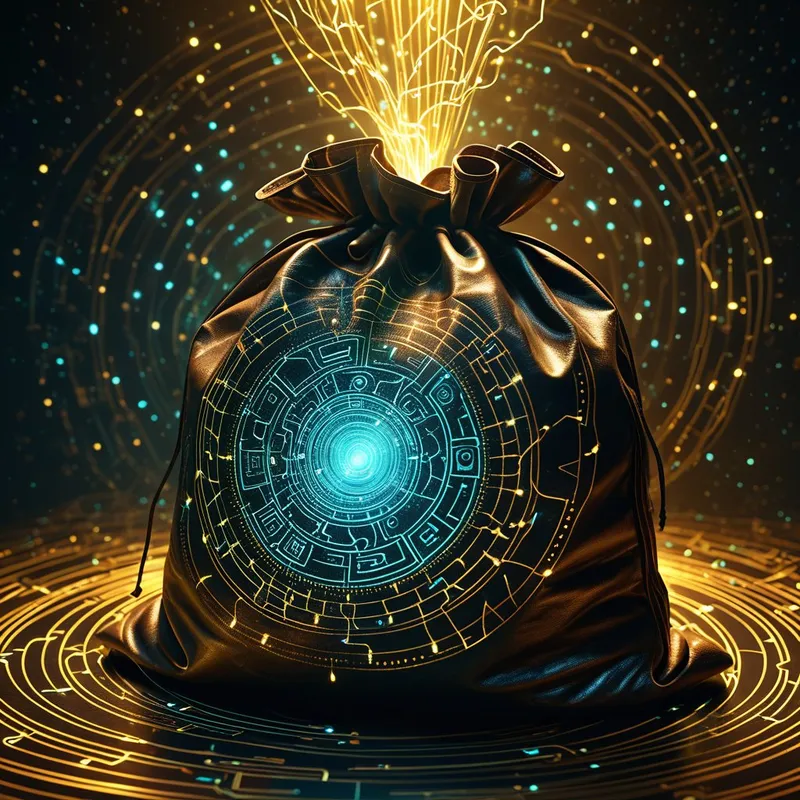
His great sack is a potent symbol of the unconscious itself, containing all possibilities, from gentle inspiration to destructive frenzy. The Yellow Emperor represents the emerging principle of consciousness, the ego or the self that seeks to structure, understand, and direct this innate energy. The conflict is not good versus evil, but between two necessary poles of existence: chaotic potential and conscious order.
The resolution—Feng Bo becoming a minister—is the act of individuation in mythic form. The wild instinct is not repressed or killed; it is given a role, a channel. The energy of the storm is redirected to fertilize the fields (the psyche) rather than lay them waste. This mirrors the psychological process of integrating shadow elements, where raw anger can become assertive action, and unfocused passion can become dedicated creativity.
The Dreamer's Resonance
When the archetype of Feng Bo stirs in the modern dreamer, it often manifests as dreams of being in uncontrollable storms, of powerful winds tearing at the structures of one’s life, or of trying desperately to hold closed a bag or door from which a gale is escaping. Somatic sensations might include anxiety, a feeling of being emotionally "blown about," or a restless, agitated energy with no clear outlet.
This dream pattern signals a critical phase in the dreamer’s psychological process. The conscious ego (the Yellow Emperor) is being challenged by a surge of unconscious material—repressed emotions, a creative impulse, or a necessary rebellion against an overly rigid life structure. The psyche is announcing that a force within has been too long contained and is now demanding recognition and a place at the table of the self. The chaos in the dream is not a threat to be eliminated, but a message to be understood: a part of the self is fighting for its existence and its right to contribute to the whole.

Alchemical Translation
The alchemical journey modeled by Feng Bo’s myth is the transmutation of prima materia—the chaotic, base substance of the soul—into a functional element of the integrated self. For the modern individual, this is the work of shadow integration.
The first stage is Confession, or recognition: acknowledging the "Feng Bo" within—the tempers, the wild desires, the non-conformist urges we have tried to sack away. The second is the Confrontation: allowing this energy to surface, to feel its full force without immediately judging or suppressing it, much as the Yellow Emperor faced the storm without fleeing. The critical third stage is the Consecration: the alchemical translation itself.
To consecrate the storm is to ask it, "What purpose does this mighty wind serve? What dormant seed needs this gale to scatter it? What stagnant pond needs this agitation to become clear?"
This is where raw anxiety is translated into vigilant awareness, where unfocused rage is forged into the strength to set boundaries, where chaotic creativity is given the vessel of a disciplined practice. The individual does not become "tame," but like the minister-god, they learn to wield their own elemental power with intention and responsibility. The sack is never emptied; the wind never stops blowing. But one learns to open it not in blind fury, but with the wisdom of the seasons, directing its power to nurture the inner world and, by extension, the world one inhabits. The rebel is not destroyed; the rebel is given a cause worthy of its passion.
Associated Symbols
Explore related symbols from the CaleaDream lexicon: