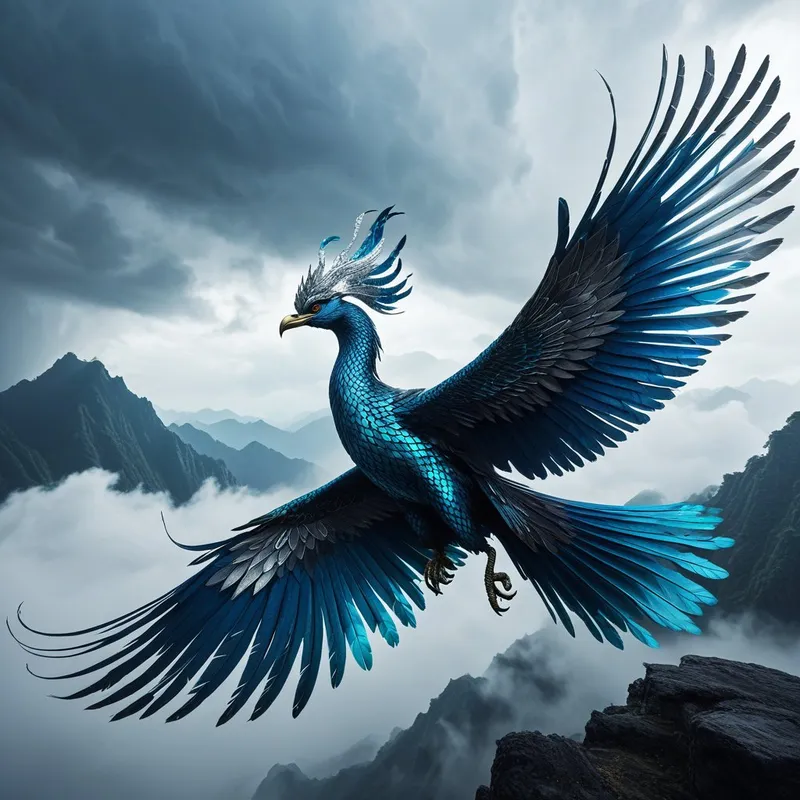
Feng Myth Meaning & Symbolism
A myth of the cosmic Wind Bird, whose flight births storms and whose rest brings peace, embodying the psyche's primal dance between chaos and order.
The Tale of Feng
In the time before time, when the world was a canvas of mist and potential, the heavens held their breath. There was no east wind to coax the blossoms, no west wind to carry the seeds, no north wind to sharpen the frost, no south wind to bless the rains. There was only a profound and pregnant stillness. Then, from the womb of the primordial void, it stirred.
It was not born; it awakened. Its name was Feng, and it was the first movement in a motionless universe. Its form was that of a bird, yet it was woven from the very fabric of the air—a creature of iridescent blue and storm-grey feathers that shimmered like rain on a dragon’s scale. Its eyes were whirlpools of ancient sky, and its wings, when folded, held the silence of the abyss between stars.
For eons, Feng slept, coiled around the axis of the world, a latent promise. But a promise must be kept. On a day that was not a day, a tremor passed through the fabric of things. The Feng opened one eye. With that single glance, the air grew taut. It stretched its wings—a slow, cosmic unfurling—and the first sigh of wind whispered across the silent plains. It was a tender sound, a mother’s breath on an infant’s brow.
But Feng was not made for tenderness alone. It was the embodiment of qi in its most untamed form. With a second beat of its wings, the sigh became a moan. Clouds, virgin white, were torn into tatters of grey and black. With a third beat, the moan became a roar. The great bird launched itself into the vault of heaven, and its flight was chaos given direction. It carved tempests from the calm, hurling rain against the mountains, bending the forests to its will, and churning the seas into froth. This was the birthing scream of the world’s weather—a necessary, violent creativity.
The newly formed earth trembled. Rivers overflowed, and the first humans huddled in caves, hearing in the wind’s howl the voice of a capricious god. They named the storms after it, and they feared it. For years that felt like centuries, Feng rode the gales, a sovereign of splendid fury. Yet, in the heart of the storm, a loneliness grew—a memory of the primordial stillness. Its wild flight began to slow. Exhaustion, or perhaps a dawning purpose, weighted its wings.
Seeking the axis it once knew, Feng descended. It found a peak that pierced the clouds, a spire of rock that touched the lower heavens. There, a great pine, twisted and strong, offered a perch. The Wind Bird folded its storm-weary wings. As it settled, the roaring gales softened to breezes. The lashing rain gentled to mist. The world, which had known only the fury of creation, now tasted its first calm. Feng did not die; it entered a watchful repose. Its breath became the zephyr that carries pollen, the gust that fills a sail, the gentle wind that cools a fevered brow. It learned to rest, so that the world might live.

Cultural Origins & Context
The myth of Feng is not a single, codified narrative from a text like the Shan Hai Jing, but a composite being woven from ancient animist beliefs, later Daoist natural philosophy, and regional folklore. Its roots are in the earliest Chinese observations of and reverence for the wind (feng 风)—an invisible, powerful, and utterly essential force. In oracle bone inscriptions from the Shang dynasty, wind was already deified, with rituals performed to appease the "Wind Earl" or to pray for favorable winds.
Feng, as the avian personification, likely emerged from this deification, blending with the imagery of powerful birds like the Fenghuang and the simurgh of broader Eurasian myth. It was a story told not by court historians, but by farmers, sailors, and shamans—those whose lives were intimately tied to the wind's whim. It served a crucial societal function: to explain the terrifying yet vital duality of nature. The myth provided a cosmology where chaos (the storm) and order (the calm) were not opposing forces, but two phases of a single, sacred entity's being. It taught that the destructive gale and the life-giving breeze came from the same source, fostering a worldview of respectful acceptance rather than mere fear.
Symbolic Architecture
At its core, the Feng myth is a profound symbol of the primal psychic force—the raw, undifferentiated energy of the unconscious mind before it is harnessed by consciousness.
The storm is not the enemy of the calm; it is its unrefined ancestor. Feng teaches that the psyche’s first language is a tempest.
The bird’s initial, cataclysmic flight represents the eruption of unconscious content—repressed emotions, innate drives, creative potentials—into the structured world of the ego. This is often experienced as a psychological crisis: a flood of anxiety, a burst of uncontrollable rage, or the dizzying onset of inspiration that threatens to dismantle one's sense of self. Feng is that raw qi of the soul.
The pivotal turn in the myth is not a battle won, but an exhaustion realized and a perch found. The great pine represents the stabilizing structures of the psyche—the developing ego, spiritual discipline, or a core principle that can withstand the storm. The act of alighting symbolizes the crucial moment of containment, where wild energy begins to be integrated rather than merely expressed or feared.

The Dreamer's Resonance
When the pattern of Feng stirs in the modern dreamer, it signals a profound encounter with one's own inner weather systems. To dream of being caught in a terrifying, beautiful storm where the wind has a palpable presence or a avian consciousness is to feel the Self mobilizing primal forces.
Somatically, one might awaken feeling breathless, electrically charged, or with a sense of pressure in the chest—the physical echo of the storm’s passage. Psychologically, this dream often precedes or accompanies a period of intense emotional upheaval, creative ferment, or a necessary deconstruction of a stagnant life pattern. The dream is not a warning, but an announcement: a great power within you has awakened. The critical question the dream poses is not "how do I stop the storm?" but "where is my sacred peak? Where is my pine?" It calls for the dreamer to find or build an inner structure strong enough to receive and ultimately temper this magnificent, destructive-creative force.

Alchemical Translation
The journey of Feng is a perfect map for the alchemical process of individuation—the transmutation of base, unconscious material into the gold of integrated consciousness. The first stage, nigredo (the blackening), is the bird’s chaotic flight: the necessary descent into one's own chaos, shadow, and un-lived life. This is the storm that clears the dead wood.
The finding of the perch is the beginning of albedo (the whitening)—the stage of reflection and purification. The energy, once purely expressive, now begins to be observed and related to.
Individuation is not the silencing of the storm, but learning to understand its language and to invite the wind bird to rest within you.
The final, ongoing stage is rubedo (the reddening) and citrinitas (the yellowing), represented by the gentle, life-sustaining winds that flow from the resting Feng. The once-terrifying primal force is now a source of vitality, intuition, and inspired action. The integrated individual does not fear their own power or passion; they have provided it a sacred home. They have become the mountain that hosts the wind, stable at their core yet dynamically engaged with the invisible forces that move through all life. The myth concludes not with an ending, but with a sacred, dynamic equilibrium—the true goal of the psychic alchemist.
Associated Symbols
Explore related symbols from the CaleaDream lexicon: