Feasting Halls Myth Meaning & Symbolism
A mythic tale where a king's refusal of hospitality to a disguised goddess plunges his hall into a curse, testing the soul's capacity for true sovereignty.
The Tale of Feasting Halls
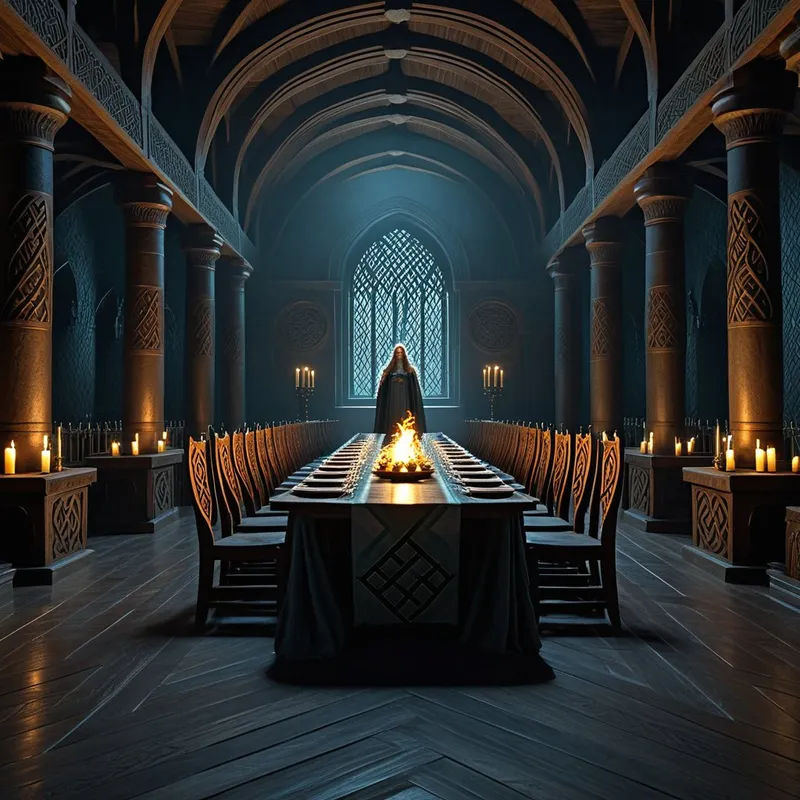
Listen, and let the fire’s crackle become the roar of the hearth in Tara. The air is thick with the scent of roasting boar, honeyed mead, and woodsmoke. The hall of Bres the Beautiful is a jewel of the world, its walls hung with bright shields, its benches filled with the laughter of the Tuatha Dé Danann. Bres reigns, fair of face and form, but a coldness sits at the heart of his splendor. His rule is one of taking, not giving; his hospitality is a calculated display, not a sacred duty.
Into this warmth comes a chill wind. The great doors groan open, and a figure enters alone. She is an old woman, cloaked in grey, leaning on a staff. Her eyes are like deep pools in a winter forest. She is the Cailleach, the very spirit of the land, walking in disguise. She moves through the throng, ignored by the revellers, until she stands before the high seat of the king.
“A blessing on this house,” her voice, though soft, cuts through the din. “I ask for a place at your fire, a share of your meat, a cup from your cauldron. For I have traveled far, and the night is deep.”
King Bres looks down upon her, his lip curling in barely concealed disdain. Her cloak is travel-stained, her form bent. To him, she represents need, a blemish on his perfect feast. “There is no place here for you,” he declares, his voice ringing with false authority. “My hall is for the noble and the strong. Seek your sustenance elsewhere.”
A silence falls, heavy and sudden, as if the very air has been sucked from the room. The firelight seems to dim. The old woman straightens, and though her form does not change, her presence expands, filling the space with an ancient, terrible power.
“You have refused the guest,” she intones, and her words are not sound but law. “You have withheld the cup from the thirsty and the meat from the hungry. Therefore, I lay a geis upon this hall and upon your reign.”
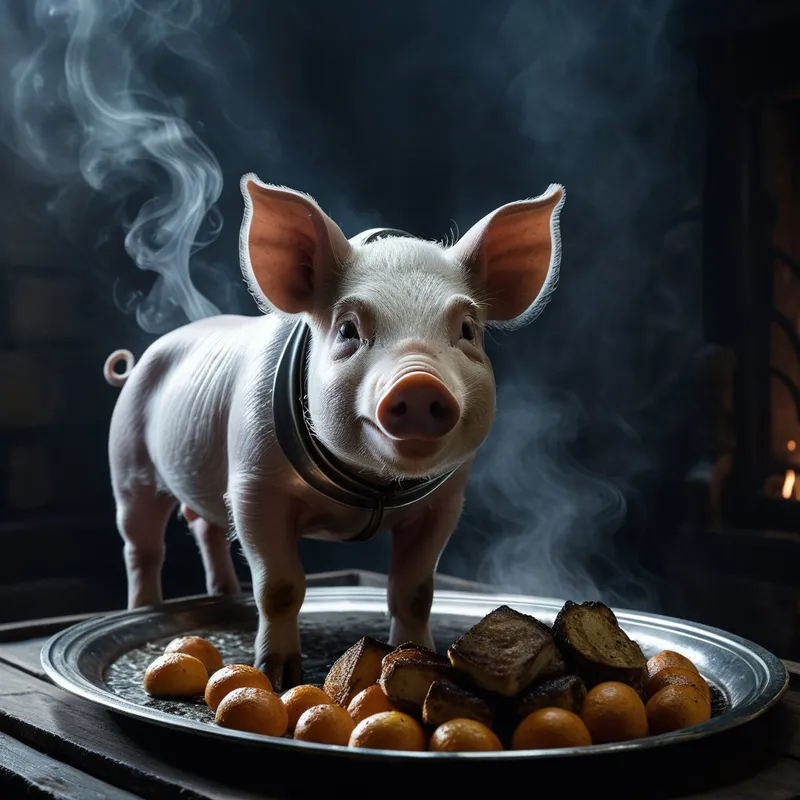
She raises her staff, and the vibrant tapestries seem to bleed of color. The succulent meats on the platters shrivel and harden to stone. The sweet mead in the cups turns to brackish water. The laughter of the gods dies in their throats, replaced by a hollow ringing silence. The warmth flees, leaving a damp, marrow-deep cold.
“While you rule with a closed hand and a cold heart,” the goddess proclaims, “your land will know no abundance. Your cows will give blood, not milk. Your rivers will run dry. Your people will whisper your name not with love, but with hunger. Sovereignty is not taken; it is received through generosity. You have forgotten this, and so you are forgotten by the land.”
With that, she turns and walks into the night, leaving a hall not of celebration, but of desolation. The curse is woven. The feast is ended. And the long, bitter winter of Bres’s reign begins, a winter that can only be broken by an act of true recognition, a sacrifice of pride for the sake of the whole.
Cultural Origins & Context
This story, in its many variations, is not mere entertainment but the bedrock of a social and cosmic contract. It emerges from the deeply interwoven fabric of early Irish and broader Celtic society, where the king was not an absolute ruler but a sacred intermediary. His primary function was to ensure the fertility and prosperity of the land through just rule and, most critically, through boundless hospitality.
The myth was the province of the filid, the poet-seers who acted as custodians of lore, law, and legitimacy. Recited at gatherings, perhaps even during actual feasts, the tale was a potent reminder to any ruler. It encoded the legal and spiritual principle of féil. To refuse a guest was not just bad manners; it was a cosmic crime that severed the symbolic marriage between the king and the Sovereignty Goddess. The resulting blight—barren cows, failing crops—was a direct, observable consequence of this broken relationship. The myth thus served as a divine check on power, a story that held the king accountable to a law higher than his own will.
Symbolic Architecture
The Feasting Hall is the psyche in its ordered, conscious state—the ego’s domain of control, identity, and social persona. It is where we display our achievements, our “face” to the world. King Bres represents the ego that has identified solely with its own beauty, power, and self-sufficiency. He is consciousness that has forgotten its dependence on the unconscious, the vast, nourishing, and often mysterious ground of being.
The disguised goddess—the Cailleach—is the ultimate emissary from that unconscious. She is the shadow and the anima combined. She appears not as a beautiful maiden, the accepted form of the goddess, but as the Hag, the aspect we most wish to reject: need, poverty, age, and raw, untamed nature.
The curse is not a punishment from without, but the inevitable inner state when consciousness refuses dialogue with the soul. The hall turns cold because the ego has cut itself off from the source of its own warmth and vitality.
Her request for hospitality is the psyche’s call for integration. To offer her a seat at the fire is to acknowledge the parts of ourselves we find ugly, needy, or primitive. Bres’s refusal is the ego’s tragic arrogance, its belief that it can sustain itself on its own light alone. The resulting desolation is the psychological blight of depression, meaninglessness, and creative sterility—the direct result of a life lived only on the surface, in the brightly lit but ultimately cold hall of the persona.

The Dreamer's Resonance
When this mythic pattern stirs in the modern dreamer, it often manifests not as a medieval hall, but through its symbolic equivalents. You may dream of a lavish party where you are the host, but you realize you have no food to serve, or the guests are faceless and silent. You might dream of your own home, but find a strange, disheveled, or unsettling figure sitting at your kitchen table, demanding your attention, and you are paralyzed by a mix of fear and obligation.
Somatically, this can feel like a constriction in the chest, a coldness in the limbs, or a profound dryness in the throat—the body’s literal experience of the “withheld cup.” Psychologically, it signals a critical moment. The ego-structure is being confronted by an aspect of the inner life it has systematically excluded. This could be a repressed emotion (grief, rage), a neglected talent, a past trauma, or a deep instinctual need. The “curse” in the dream is the growing sense of inner deadness, anxiety, or repetitive failure that arises from this refusal. The dream is the psyche’s final, potent attempt to get the ego’s attention, to force a crisis that demands a change in attitude.

Alchemical Translation
The path from Bres’s cursed hall to restoration is the alchemical nigredo, the blackening. It is the necessary death of the old, rigid ego-identity. Bres must fall from power, must endure the famine, must be humbled. This is the painful but essential dissolution of the persona that believed itself sovereign.
The transmutation begins with the recognition of the goddess in her true form. This is not an intellectual understanding, but a visceral, humble seeing. It is the moment the dreamer, in the midst of their own psychological blight, finally turns to the neglected figure at the table and asks, “What do you need?” This question is the beginning of the albedo, the whitening.
To offer hospitality to the inner Hag is to perform the supreme alchemical act: transforming the lead of rejected shadow into the gold of integrated wisdom. She does not change because you accept her; you change because you have accepted her.
The act of giving her the seat of honor, the choicest meat, the fullest cup, is the act of valuing the soul’s deepest, most “unacceptable” needs above the ego’s desire for perfect self-image. In doing so, the inner landscape is rewoven. The curse lifts because the split is healed. The cauldron of the psyche, once dry, begins to overflow. The restored feast that follows is the rubedo, the reddening—the joy, creativity, and genuine connection that flow from a self that is no longer at war with its own depths. The true Ruler archetype is then born: not a tyrant who dominates, but a sovereign who serves, who governs the inner kingdom with justice, generosity, and a reverent hospitality toward all that dwells within.
Associated Symbols
Explore related symbols from the CaleaDream lexicon: