Faust's pact with Mephistophel Myth Meaning & Symbolism
A scholar trades his soul to a demon for boundless knowledge and worldly pleasure, only to find the price is his own humanity.
The Tale of Faust's pact with Mephistophel
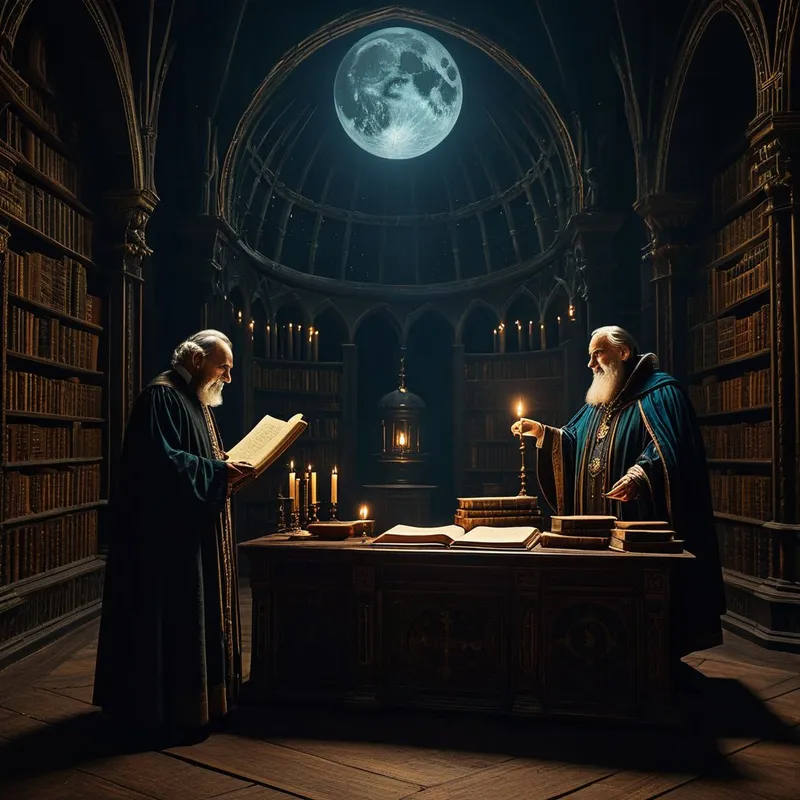
In the deep, silent hours when the world turns to shadow, there lived a man whose mind was a prison. His name was Faust, and he dwelled not in a home, but in a tomb of books. The air in his study was thick with the dust of centuries, smelling of old parchment, dried herbs, and the bitter tang of metallic failure. He had consumed all the knowledge the world deemed lawful—philosophy, law, medicine, theology—and found it to be ashes on his tongue. It explained nothing of the pulsing heart of the universe, the secret fire that animates the stars and the soul. Emptiness, vast and cold, echoed in the chambers of his heart.
One night, in a fury of despair, he took a knife and drew a circle upon the floor, inscribing it with signs that whispered of forgotten pacts. He called into the darkness, not to God, whose silence was his torment, but to whatever power would answer a hungry heart. The air grew heavy, then still. A scent of sulfur and ozone, subtle as a memory, touched the room.
And then he was there. Not with a clap of thunder, but as if he had always been present, leaning against the mantelpiece with an air of elegant boredom. He was Mephistopheles, clad not in scales and horns, but in the rich attire of a nobleman, a faint, ironic smile playing on his lips. His eyes held the weary wisdom of one who has seen the rise and fall of every empire, every dream.
“You called, scholar?” His voice was like velvet wrapped around steel.
Faust’s breath caught. Here was no monster, but the very embodiment of the answer he sought—a being who walked the hidden paths of the world. “I am weary of knowledge that builds no bridge to power,” Faust declared, his own voice trembling with a lifetime of frustration. “I wish to experience… to feel, to know not in the abstract, but in the blood and bone. To grasp what binds the spinning spheres.”
Mephistopheles’s smile deepened. “A noble aim. And one I can facilitate. For a term of years, I shall be your servant. You will lack for nothing. Every secret, every pleasure, every height of passion and depth of experience will be yours to command. You will live as a god among men.”
“And the price?” Faust whispered, though in his soul, he already knew.
“The price is the usual one,” Mephistopheles said, producing a scroll from the air. “When the term is done, and you have drunk your fill of this life, you will serve me in the next. Your soul, for my service.”
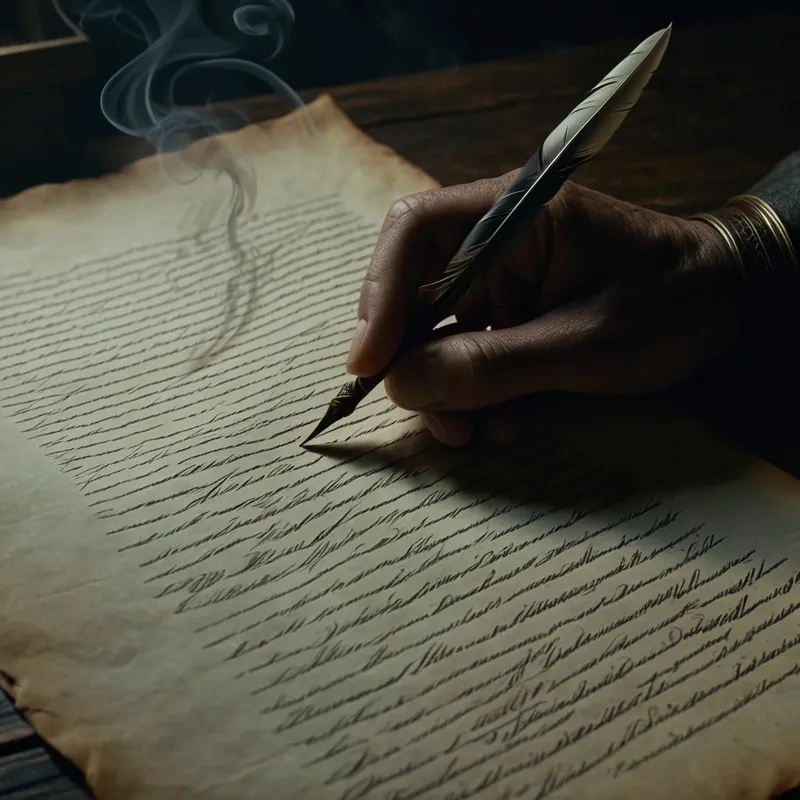
The quill was in Faust’s hand. The parchment seemed to glow with a light of its own. He felt the weight of eternity in one balance, and the desperate, aching hunger of his mortal life in the other. With a cry that was both triumph and despair, he slashed the pen across the page, the ink a stark, black wound upon the vellum. The pact was sealed. The scholar was dead. The magician was born.
Cultural Origins & Context
The story of Faust is a peculiarly modern myth, born from the crucible of the European Renaissance and Reformation. While the figure of the man who bargains with the devil exists in folklore worldwide, the specific tale of Doctor Faustus crystallized in 16th-century Germany. It was based on the semi-legendary travels of an actual itinerant scholar and magician, Johann Georg Faust. The story spread not through ancient oral tradition, but via a popular chapbook, the Historia von D. Johann Fausten (1587), which presented it as a grim, moralizing Protestant cautionary tale against the sin of pride, or hubris.
Its societal function was dual. On the surface, it reinforced religious orthodoxy, warning against the pursuit of knowledge outside sanctioned channels. Yet, beneath that, it gave voice to the terrifying new spirit of the age: the dawning realization that humanity, armed with reason and will, might no longer need God. Faust is the archetype of the emerging individual, breaking free from medieval constraints, yet terrified of the existential abyss that freedom reveals. The myth was later immortalized in Christopher Marlowe’s tragic play Doctor Faustus and, most profoundly, in Johann Wolfgang von Goethe’s two-part dramatic masterpiece, which transformed the damned sinner into a striving, dynamic hero whose very striving ultimately redeems him.
Symbolic Architecture
At its core, the pact is not about magic, but about a psychic bargain we all recognize. Faust represents the human intellect and spirit in a state of profound alienation—cut off from feeling, instinct, and the sacred. His study is a symbol of the mind isolated from life.
The pact is the moment the conscious ego, feeling empty and powerless, makes a deal with the personal shadow and the collective archetype of the trickster-destroyer for the energy needed to live.
Mephistopheles is not merely an external devil. He is the psychological embodiment of the neglected, amoral, and vitalistic side of Faust’s own psyche—the spirit of negation, skepticism, and raw life force that Faust’s dry scholarship has repressed. The contract symbolizes the fateful decision to harness this dangerous, unconscious power to fuel the ego’s ambitions, without integrating it. The promised “years of service” represent a temporary inflation—a period where one feels omnipotent, freed from conventional limits, but is ultimately being drained by the very force one sought to control.

The Dreamer's Resonance
When this myth stirs in the modern dreamscape, it rarely appears as a gothic drama with a devil. Instead, one might dream of signing a terrifying but exhilarating employment contract for a dream job that feels “soulless.” One might dream of accepting a vast sum of money in exchange for something priceless and intangible, like one’s voice, name, or a cherished memory. The somatic feeling is often a mix of thrilling power and deep, gut-wrenching dread.
This dream pattern signals a critical juncture in the dreamer’s psychological process. It indicates that a part of the psyche is attempting to broker a deal: sacrificing long-term integrity, authenticity, or deep connection (the soul) for immediate power, success, or escape from a feeling of impotence or boredom (the magical service). The dream is a stark depiction of a Faustian bargain being constructed in one’s own life. It asks the dreamer: What am I willing to trade away? What vital part of myself am I deeming expendable to get what I think I want?

Alchemical Translation
The alchemical journey mirrored in the Faust myth is not the opus itself, but the perilous and necessary first stage: the Nigredo. Faust’s despair in his study is the black sun of the Nigredo—the feeling that all known ways of being have turned to ash. His call to Mephistopheles is a misguided attempt to shortcut the alchemical process. He tries to acquire the philosopher’s stone (ultimate knowledge and power) without first submitting to the dissolution of his old, rigid identity.
The true alchemical translation of the myth lies not in the signing, but in the potential within the journey that follows. The temptations and experiences Mephistopheles provides are the raw, chaotic prima materia of the soul.
For the modern individual, the path of individuation requires us to confront our own “Mephistopheles”—the cynical, pleasure-seeking, power-hungry shadow. We must not simply sign it away or be enslaved by it, but, as Goethe’s Faust ultimately learns, we must engage with it, be scorched by its fires, and through striving, error, and experience, attempt to integrate its vital energy. The redemption, in a psychological sense, comes when we stop trying to own absolute knowledge or power and instead commit to the endless, imperfect, and heartfelt process of engaging with life. The pact is only eternally damning if the journey is undertaken in the spirit of possession. If undertaken in the spirit of experience and growth, even the devil can become an unwitting instrument of one’s salvation, forcing the confrontation with everything one is not, so that one may finally begin to become what one truly is.
Associated Symbols
Explore related symbols from the CaleaDream lexicon: