Faust's Pact Myth Meaning & Symbolism
A scholar's insatiable thirst for ultimate knowledge leads him to bargain his soul, embarking on a journey of power, despair, and a final, redemptive choice.
The Tale of Faust's Pact
The night was not merely dark; it was a velvet shroud, heavy and complete, smothering the town of Wittenberg. In a single high tower, a flame fought back—a guttering candle in the study of Johann Faust. The air was thick with the dust of parchment and the bitter scent of crushed herbs. For years, the walls of this room had heard only sighs, the frantic scratching of a quill, and the low, desperate mutterings of a man who had drunk from every well of knowledge and found them all empty.
Philosophy had given him systems but no truth. Theology offered dogma but no presence of God. Medicine revealed the body's mechanics but not the spark of life. Faust, his face etched with the trenches of relentless thought, pushed the great books away. They fell like dead things. "I have studied it all," he whispered to the oppressive silence, "and I am no wiser than a beast. What is the point of this brief, guttering light if it cannot illuminate the core of the world?"
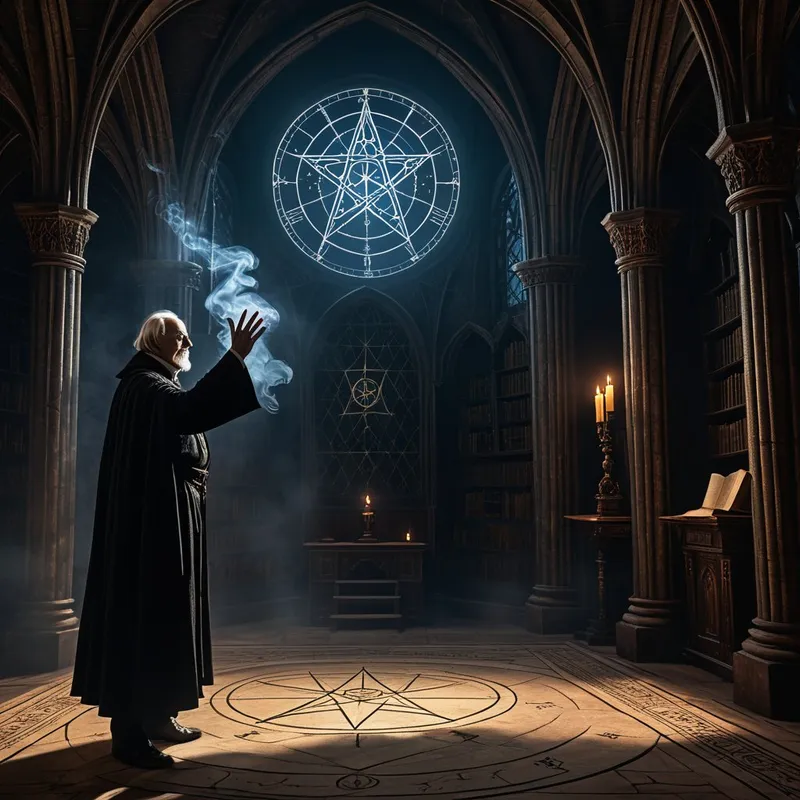
Despair, that cold alchemist, transmuted his yearning into a reckless resolve. He would call upon forces the Church forbade. With a hand that trembled not from fear, but from a terrible hunger, he drew the Circle of Protection on the stone floor, inscribing names of power that burned the air. He lit the braziers, and their unnatural green flame cast dancing, monstrous shadows. He spoke the incantations from the Clavis Inferni, his voice gaining strength with each blasphemous syllable.
The air grew cold, then hot. The candlelight bled into a sulfurous yellow. From the very center of the circle, where no form had been, a man coalesced. He was impeccably dressed, a nobleman of perhaps forty, with eyes of polished jet and a smile that held no warmth, only an infinite, amused patience. This was Mephistopheles.
"You called, Doctor? Your longing was a shriek in the silent halls of my domain."
Faust, his heart a drum against his ribs, stood his ground. "I am weary of words. I crave experience—the very essence of life, the secrets behind the turning stars, the pleasures of the earth and the knowledge of the heavens. All of it."
Mephistopheles gave a slight, elegant bow. "A modest request. I am a servant of such desires. For twenty-four years, I shall be your guide. You will know no limit, no delay, no earthly want unsatisfied. Every mystery will unravel before you. In return, you need only grant me a trifle: a signature, pledging that at the journey's end, your soul shall be mine, to do with as my masters please."
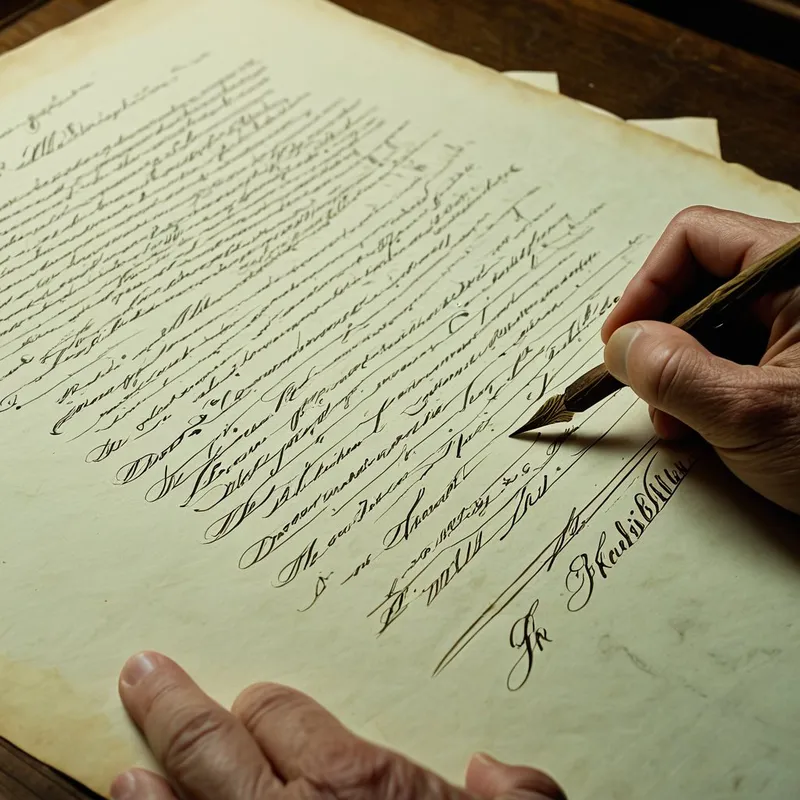
The contract appeared, floating on the air. Its parchment was pale as skin, its ink a living red. Faust did not hesitate. The quill felt like a dagger in his hand. As he signed Johann Faust, a sound echoed—not in the room, but in the vault of his own being—like the snap of a cosmic thread.
And so the wager began. Mephistopheles, ever the perfect servant and subtle tempter, showed him wonders. Faust reveled in youth restored, seduced the beautiful Gretchen, summoned the phantoms of Helen of Troy, commanded spirits, and tasted every sensual and intellectual delight. Yet, every joy turned to ash upon his tongue, for it was not earned, only rented. The knowledge he gained was sterile spectacle, not earned wisdom. Gretchen’s ruin and death became a weeping wound in his soul that no magic could heal.
The years, once an endless expanse, bled away like sand. On the final night, as the clock tolled the hour of his surrender, Faust stood broken, not by the threat of hellfire, but by the profound emptiness of his fulfilled desires. In a moment of utter clarity, born not from magic but from a lifetime’s accumulated suffering, he saw a vision not of power, but of purpose: a people, free and working on a fertile land, a common good he could help build. "Linger on, thou art so fair!" he cried out to this fleeting vision of meaningful action.
As he spoke these words, the demons sent to claim him recoiled. The contract, which stipulated the damnation of a contented, stagnant soul, could not hold a man who, even at the brink, strove for something beyond himself. In that final, striving moment, his soul was wrested not into hell, but into a mystery beyond even Mephistopheles’s understanding.
Cultural Origins & Context
The Faust legend is a uniquely Faustian phenomenon, emerging from the fertile, turbulent soil of the German Renaissance and Reformation. It is not a single myth but a cultural complex, crystallizing around the semi-historical figure of Georg (or Johann) Faust, a wandering scholar, astrologer, and magician who died around 1540. His reputation for necromancy and dubious miracles spawned a flood of popular Volksbücher (chapbooks), most famously the 1587 Historia von D. Johann Fausten.
Told not in royal courts but in taverns and market squares, the story functioned as a potent religious and social cautionary tale for an age where traditional medieval certainties were crumbling. The printing press, the discovery of new worlds, and the challenge to Church authority created a vertiginous new landscape of possibility. The Faust myth gave form to the era’s profound ambivalence: its exhilarating hunger for unbounded knowledge and experience, and its deep, terror-stricken fear of the spiritual consequences of overreaching. It was a story told by a culture to itself, wrestling with the birth pangs of the modern, secular, and ambitious self.
Symbolic Architecture
At its core, the pact is a master symbol of the psyche’s negotiation with its own shadow and its drive for wholeness. Faust represents the eternal human Streben—the insatiable striving that defines the Western soul. He is pure, undisciplined intellect and desire, severed from heart, spirit, and ethical grounding.
Mephistopheles is not merely an external devil, but the embodied spirit of negation, the psychological shadow. He is the cynical voice that says, "Nothing has meaning, so why not indulge? All your efforts are futile."
The pact itself symbolizes the catastrophic, yet often necessary, psychological bargain: the ego, impatient with the slow, difficult work of genuine growth, seeks to shortcut the process. It trades long-term essence (the soul/Self) for short-term power and inflation (the services of the shadow). The twenty-four years represent a full cycle, a complete, yet sterile, experience of life lived solely on the shadow’s terms. Gretchen symbolizes the innocent, feeling function (anima) that is inevitably betrayed and destroyed when the psyche is ruled by such a one-sided, power-driven contract.

The Dreamer's Resonance
When this myth stirs in the modern dreamscape, it rarely appears as a medieval scholar. Instead, one may dream of signing a devastatingly lucrative but soulless employment contract, of accepting a shortcut that promises fame but requires moral compromise, or of being in thrall to a charming but ultimately hollow guide or mentor.
Somatically, this can feel like a clenching in the solar plexus—the seat of personal power—accompanied by a chilling dread. Psychologically, the dreamer is at a crossroads where ambition, desperation, or ennui has opened a dialogue with the shadow. The dream is a stark dramatization of the inner Mephistopheles offering a seductive solution: "I can get you what you think you want, but the cost is your authenticity, your connection to your deeper purpose." The terror of the dream is the recognition of how tempting the offer truly is.

Alchemical Translation
The Faust myth is not merely a cautionary tale; it is a precise, if harrowing, roadmap for the alchemy of individuation. The initial nigredo, the blackening, is Faust’s despair in his study—the utter dissolution of his old, intellectual worldview. In his arrogance, he tries to bypass the necessary suffering of the albedo (the purification) by summoning the shadow directly.
The long middle period of the pact represents a tortured, inverted alchemical process where the shadow acts as the prima materia. Faust experiences everything, but in a corrupted, literalized form. This is the crucial, often misunderstood stage: one must, to some degree, "make the pact" and engage with the shadow’s energy. The danger is permanent identification with it.
The redemptive moment—"Linger on, thou art so fair!"—is the rubedo, the reddening. It is not a vision of personal pleasure, but of selfless service. Here, the striving ego finally aligns with a symbol of the Self.
Salvation comes not from avoiding the deal with the devil, but from exhausting its terms. The soul is saved not by its innocence, but by its hard-won experience. The modern individual’s "alchemical translation" lies in recognizing their own Faustian bargains—the ways they trade soul for security, cynicism for truth, inflation for grounded power—and, through the suffering that inevitably follows, discovering that the only true fulfillment lies in turning one’s striving toward a purpose that transcends the petty, grasping ego. The pact must be lived through to be broken.
Associated Symbols
Explore related symbols from the CaleaDream lexicon: