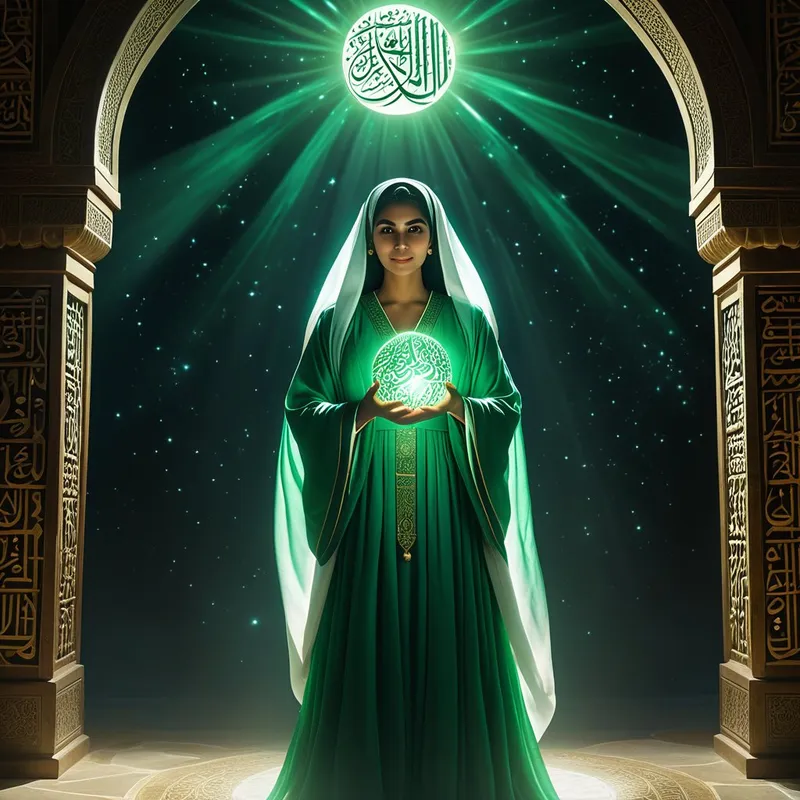
Fatimah al-Zahra Myth Meaning & Symbolism
A luminous figure born of divine light, whose life of devotion, profound grief, and enduring legacy embodies the soul's resilience and the light within the shadow.
The Tale of Fatimah al-Zahra
Listen, and let the veil between worlds grow thin. In the time when the desert sands whispered secrets to the stars, there was a light that preceded the dawn. From the essence of the Nur Muhammadi, she was fashioned—not of clay and water, but of celestial radiance. They named her Fatimah al-Zahra, and her birth was a sigh of relief from the heavens, a daughter to the Seal of the Prophets in a world that often turned its face from the light of daughters.
Her life was a tapestry woven with threads of devotion and thorns. She was the steadfast companion, the tender hand that bound wounds and ground grain until her own hands bore the marks. She moved through the nascent community of faith like a quiet river, nourishing all she touched. Her home was a sanctuary, a humble space where divine revelation descended and the future of a world was nurtured in the hearts of her sons, al-Hasan and al-Husayn.
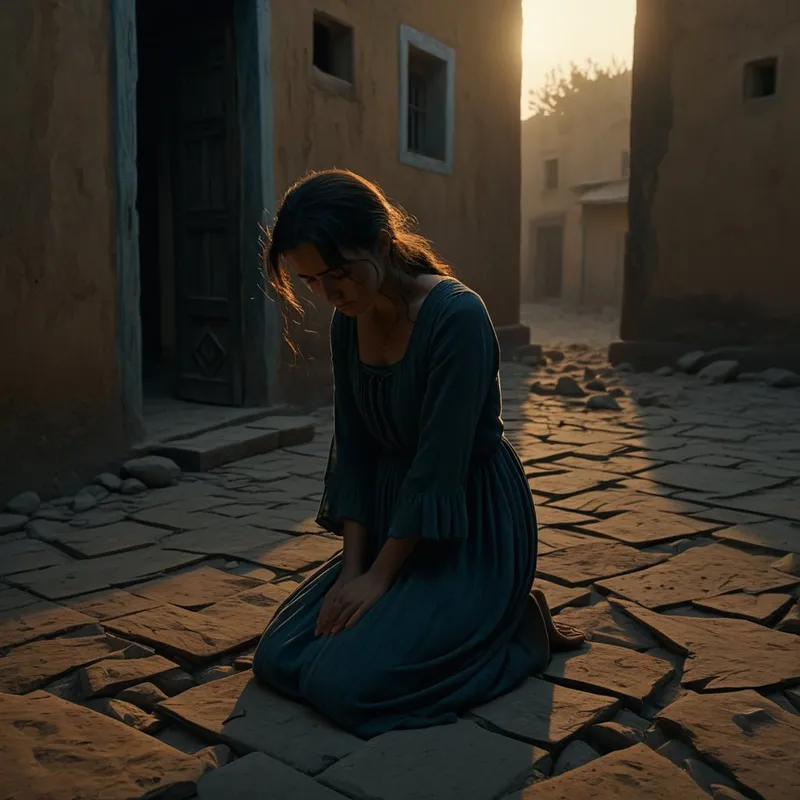
But shadows gather where light is brightest. When the voice that had recited the divine word fell silent, a cold wind swept through the oasis. The world shifted on its axis. In her profound grief, Fatimah became a fortress of memory, a living testament to what was being eclipsed. The conflict arrived not with armies, but with a chilling disregard at her threshold. The story whispers of a door, heavy and wooden, the barrier between the sanctity of the home and the clamor of the world. It was against this door that the rising action of her passion crashed—a demand, a refusal, a force applied. The wood, pressed against her, did not yield without cost. The sound of its splintering was the sound of a world breaking.
In the aftermath, she did not rage with fire, but with a light that grew more intense, more inward. Wounded in body and spirit, she withdrew, a moon waning but never extinguished. She spoke her truth, a clear, unwavering testimony that echoed in the chambers of power and the silent hearts of the faithful. Her resolution was not one of victory in this world, but of transcendent fidelity. As her strength ebbed, she asked to be taken to her final rest under cover of night, her grave a secret known to the stars and the grieving earth. She returned to the light from which she came, leaving behind not an empire, but a legacy etched in tears and resilience—a lineage that would carry the torch of her sorrow and her light through the centuries, an eternal proof of the cost of truth and the unbearable weight of a love that outlives the beloved.
Cultural Origins & Context
The narrative of Fatimah exists in a complex space between history, hagiography, and foundational myth. While rooted in the early 7th century of Islamic history, her story quickly transcended mere biography to assume a mythic stature within Shi’a consciousness, and a deeply revered, albeit differently emphasized, place in Sunni tradition. Passed down through oral reports (Hadith and Akhbar), historical chronicles, and most powerfully, through ritual lamentation poetry and majalis (commemorative gatherings), her tale was not merely told; it was performed, wept over, and internalized.
Societally, her figure functioned on multiple levels. For the early community, she was the vital link, the "Mother of her Father," connecting the prophetic lineage to its future through her sons. In the Shi’a context, her suffering and the injustice she endured became the primordial template for understanding the plight of the righteous (Ahl al-Bayt) in a world of oppressive power (Zulm). Her story legitimized a lineage of spiritual and political authority while encoding a theology of redemptive suffering. She became the archetypal mourner, and in turn, the one for whom all mourn, teaching the community how to grieve with dignity and how to transform grief into a source of identity and resistance.
Symbolic Architecture
Fatimah al-Zahra is not just a historical woman; she is a constellation of profound symbols. She is the Zahra, the luminous blossom, representing the innate, pre-existent light of the soul and of divine wisdom manifest in the world. She is the Umm Abiha (Mother of her Father), symbolizing the soul's capacity to nurture and protect its own source of guidance and inspiration.
The most profound light is often born from, and shines most brightly within, the deepest fracture.
Her body, pressed against the door, symbolizes the ultimate vulnerability of the sacred feminine, the spiritual, and the domestic in the face of raw, political force. The door itself is a potent threshold symbol—the boundary between the private realm of faith, love, and authenticity and the public realm of power, negotiation, and compromise. Its violation represents a traumatic rupture in the cosmic order. Her secret burial transforms her into a hidden immanence, a light veiled from the world yet eternally present, much like the soul's deepest truth or the divine presence itself.
The Dreamer's Resonance
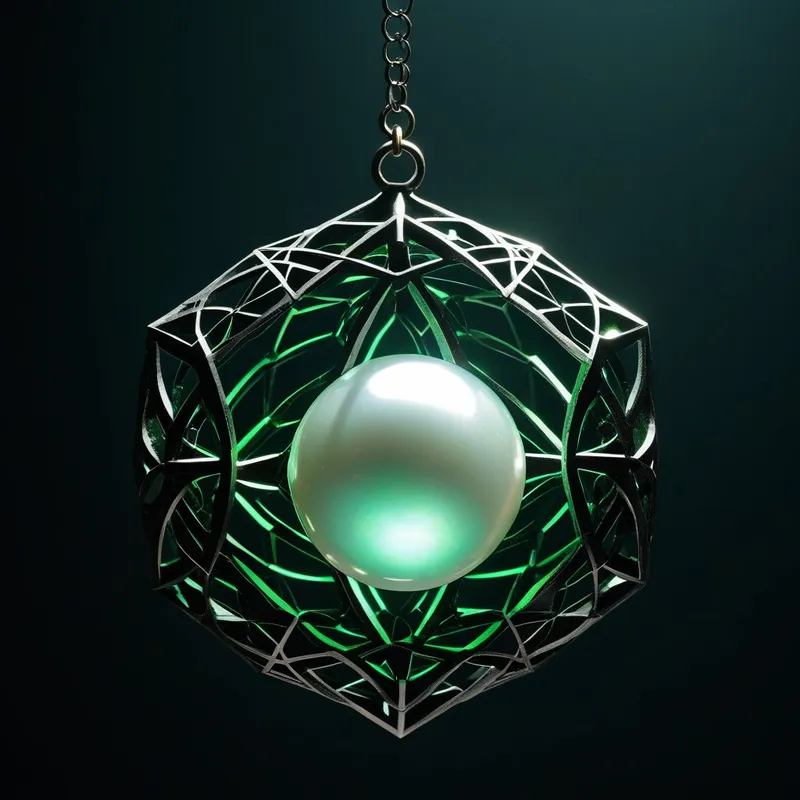
When the pattern of Fatimah’s myth stirs in the modern dreamer, it often signals a profound somatic and psychological process of sacred violation and luminous endurance. The dreamer may find themselves in a dream home whose door is broken, guarding a precious, fragile light (a child, a pearl, a flame) from encroaching forces. They may feel a sharp, resonant pain in the chest or side—a somatic echo of the mythical wound.
This is the psyche working through experiences where one’s inner sanctum—core values, creative spirit, vulnerability, or sense of justice—has been profoundly disregarded or breached. The dream is not merely replaying trauma; it is initiating a process of testifying. Like Fatimah, the dreaming ego is being called to inwardly and outwardly speak the truth of the violation, to name the fracture. The grief felt in such dreams is not passive; it is an alchemical substance. The dreamer is in the process of transforming personal injury into a foundational part of their identity, learning that their worth and light are not negated by the breaking, but are often revealed by it.

Alchemical Translation
The myth of Fatimah al-Zahra models a harrowing yet essential path of psychic individuation: the transmutation of profound injury into incorruptible identity. The process begins with the Coniunctio of light and clay—the incarnation of a pure, divine spark (the Self) into the harsh realities of earthly life and relationship.
The alchemical vessel is forged in the moment it is shattered; the soul's gold is revealed not in spite of the blow, but in its very crucible.
The crisis is the Nigredo, the blackening: the traumatic violation at the threshold. This is the crushing of the naive ego, the experience of betrayal and injustice that seems to extinguish the inner light. Here, the individual feels pressed, wounded, and obscured. The alchemical work is in the next phase: not a fight for external victory, but a deliberate internal testimony. This is the Albedo, the whitening. The individual withdraws to tend the wound, to separate the essential light of their true nature from the debris of the event. They must speak their truth, if only to themselves, and crystallize their understanding.
The final transmutation is the Rubedo, the reddening or the emergence of the Lapis (the philosopher's stone). This is embodied by Fatimah’s secret grave and enduring legacy. The light does not return to its source unchanged; it becomes a hidden, enduring force within the psyche. The injury is integrated, not forgotten. It becomes the very foundation of a new, unassailable integrity. The individual’s sense of self is no longer dependent on external validation or intact boundaries alone, but is rooted in a luminous, resilient core that has been tested in the fire of violation and has emerged, not unscathed, but authentically and eternally true. They become, like Zahra, a hidden light that guides their own lineage—the future choices, values, and creations born from their transformed consciousness.
Associated Symbols
Explore related symbols from the CaleaDream lexicon: