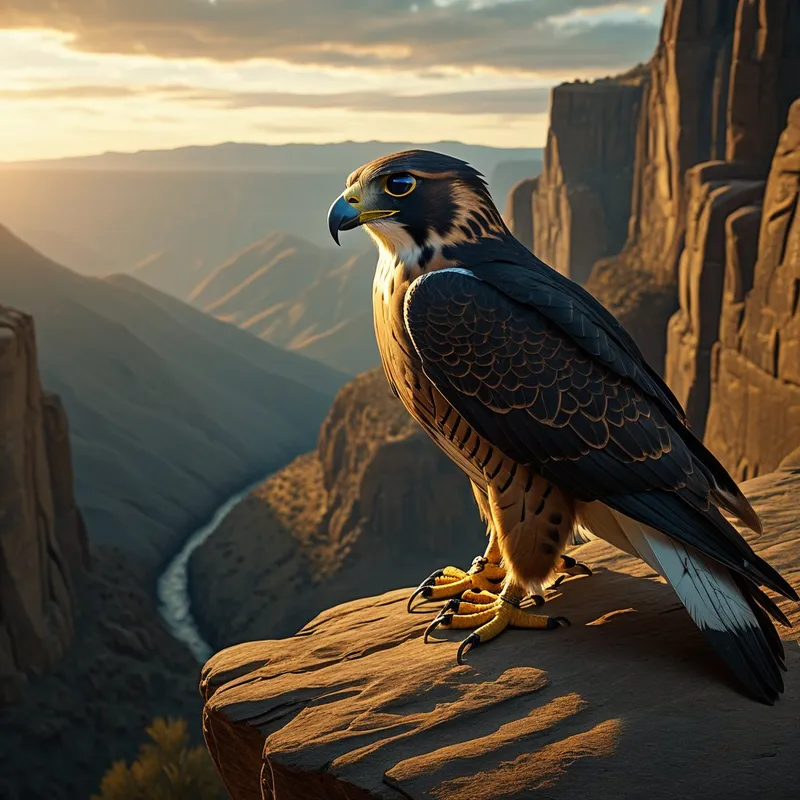
Falcon Clan Myth Meaning & Symbolism
A myth of a clan who sacrificed their earthly form to gain the falcon's piercing vision, becoming messengers between the earth and the sky.
The Tale of Falcon Clan
Listen. In the time when the world was still soft, when the mountains were young and the rivers sang their first songs, there was a people who lived in the shadow of the great stone ribs of the earth. They were a strong people, good hunters and keepers of stories, but a shadow lay upon them. A great fog, thick as wool and cold as a forgotten memory, had settled in the valleys below. It stole the sight of the hunters, muffled the songs of the children, and hid the paths of the deer. The people were becoming lost in their own home.
Their chief, a man named Keen-Eye, climbed the highest spire of rock, a place where the wind screamed and the eagles nested. For three days and three nights, he fasted and prayed, his face turned to the empty blue. On the fourth dawn, as the sun split the horizon, a shadow fell upon him. It was Falcon. The bird did not land but hung in the air, a knife of wind and feather, its eye a black pool holding the entire world.
A voice, not of sound but of knowing, entered Keen-Eye’s heart. "You walk in the fog because you see only with your feet. You must learn to see with the sky."
Keen-Eye returned to his people, his own eyes now holding a strange, distant light. He gathered the clan and spoke of the choice. The fog was not of the world, but of the spirit. To lift it, they could not remain as they were. They must trade the comfort of the known earth for the terrifying clarity of the sky. They must become like Falcon.
Not all agreed. Some wept for the feel of solid ground. But a core of the clan, their hearts ignited by the vision, followed Keen-Eye back to the high spire. There, as the wind whipped around them, they sang the old songs for the last time with human voices. They offered their earthly form—the heavy limbs, the ground-bound sight—as a prayer.
It began not with pain, but with a great stretching. A lightness entered their bones. Their skin prickled as if brushed by a thousand breaths. Their sight blurred, then shattered, then reformed with impossible sharpness. The world fell away beneath them, not as a place to walk, but as a map to read. The fog below was now a thin veil, and beyond it, they could see the deer trails, the river’s bend, the distant smoke of other fires. With a cry that was both triumph and farewell, the first of them—Keen-Eye—pushed from the cliff. Not falling, but claiming the air. One by one, the clan followed, their human shapes dissolving into the swift, sure forms of falcons.
They did not abandon their people. From that day, they became the watchers, the guides. When the fog of confusion threatened, a shadow would cross the sun, a cry would pierce the air, and a path would be revealed. The Falcon Clan was no longer of the earth, but they became its guardians, forever bridging the muddled ground and the boundless, seeing sky.

Cultural Origins & Context
The narrative of the Falcon Clan finds its roots among various Pueblo and other Southwestern tribal traditions, where clan systems are fundamental to social, spiritual, and ecological identity. Unlike a single, monolithic "Native American" story, it is a type of origin myth shared across cultures with local variations. These stories were not mere entertainment; they were the living constitution of the people, told by elders and medicine people during ceremonies, initiations, and winter gatherings.
The myth served multiple societal functions. Primarily, it explained the sacred relationship between a particular clan and its totem animal, defining roles, responsibilities, and taboos. The Falcon Clan, in societies that held this story, would likely have been associated with roles requiring sharp perception—scouting, strategy, mediation, and spiritual vision. The myth also encoded an ecological truth: to survive and thrive, one must sometimes adopt a different perspective, to literally and metaphorically rise above a limiting situation. It taught that identity is not fixed but can be transformed for the greater good of the collective, reinforcing values of sacrifice, adaptability, and visionary leadership.
Symbolic Architecture
At its heart, the myth of the Falcon Clan is an allegory for the awakening of consciousness. The Great Fog symbolizes a state of psychic stagnation, where one is trapped in literal-mindedness, habit, and a ground-level view of life’s problems. It is the dull ache of knowing there is more, but being unable to see it.
The sacrifice is never of the true self, but of the familiar cage that holds it.
Falcon is the archetypal symbol of acute, focused vision—the ability to see the pattern in the chaos, the truth hidden in plain sight. Its domain is the sky, the realm of spirit, mind, and perspective. The clan’s transformation is not a punishment but an arduous initiation into a higher order of perception. They exchange the security of the terrestrial—the known, the heavy, the immediate—for the sovereignty of the celestial—the visionary, the light, the strategic.
Psychologically, Keen-Eye represents the nascent ego that first intuits the call to something greater, the individuation process. The cliff’s edge is the liminal threshold, the point of no return in any profound psychological transformation. The moment of stretching and becoming is the death of the old self-concept and the often-disorienting birth of a new, more complex identity.

The Dreamer's Resonance
When this myth stirs in the modern dreamer, it often manifests as dreams of sudden, exhilarating flight or, conversely, of being trapped in low, murky places. To dream of transforming into a bird of prey, especially a falcon, signals a psyche undergoing a crucial shift in perception. The somatic sensation is one of literal uplift—a feeling of weightlessness in the chest, a sharp intake of breath upon waking.
This dream pattern emerges when the conscious mind is stuck in a "fog"—a confusing career path, a relationship at an impasse, a creative block. The unconscious, in the guise of the Falcon, is presenting a solution not through more effort on the same plane, but through a radical change of vantage point. The psychological process is one of dis-identification. The dreamer is being shown that their current identity ("the ground-walker") is too limited for the challenge at hand. The anxiety or exhilaration in the dream mirrors the soul’s negotiation with the necessary sacrifice: the comfort of the known problem versus the freedom of an unknown, but clearer, perspective.
Alchemical Translation
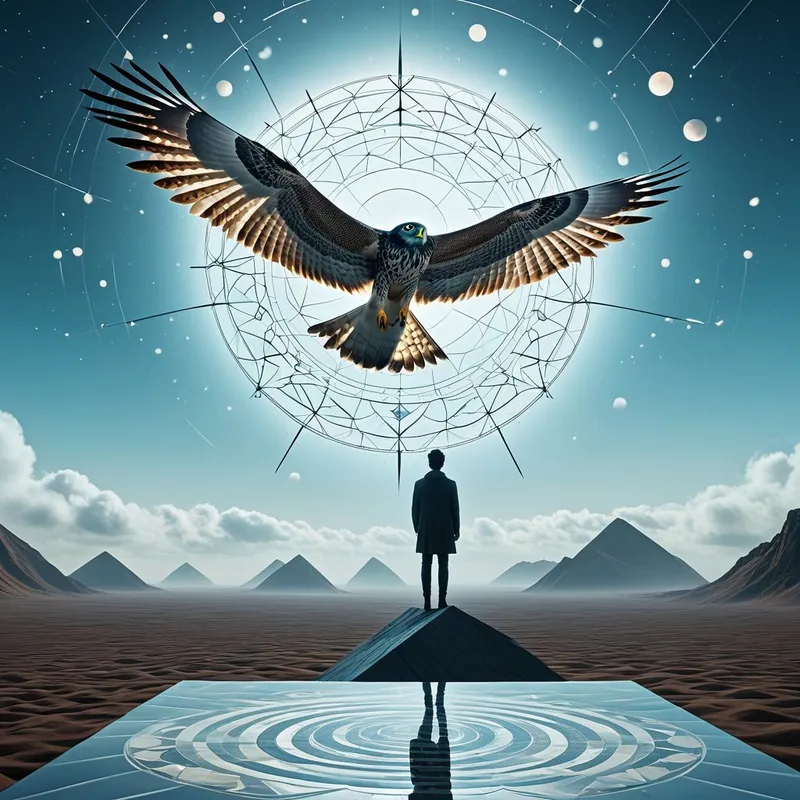
The alchemy of the Falcon Clan myth models the psychic operation of sublimation—the transmutation of a lower, denser state into a higher, more refined one. The "lead" of the human condition—its myopia, its heaviness, its entanglement in the immediate—is subjected to the fierce wind and burning sun of spiritual crisis (the vigil on the cliff). Through the willing sacrifice of the inferior attitude, it is transformed into the "gold" of visionary consciousness.
Individuation demands we trade the solid ground of who we think we are for the dizzying sky of who we might become.
For the modern individual, this is not about literal flight. It is the internal act of ascending to the observer’s position. It is stepping back from the engulfing emotion, the obsessive thought, or the entrenched narrative. It is the practice of seeking the pattern in one’s life rather than getting lost in the events. The "Falcon Vision" is cultivated through meditation, introspection, journaling, or therapy—any discipline that creates psychic altitude.
The myth assures us that this transformation, while solitary in its execution, ultimately serves a connective purpose. The Falcon Clan returns to guide. Similarly, when we achieve clarity through our own difficult transformations, that clarity does not isolate us; it becomes a gift we can offer to the collective "fog" of our families, communities, and culture. We become messengers between the confused, earthly realm of human struggle and the clear, spacious realm of insight, forever bridging the two. The sacrifice of the small self is the birth of the seeing self, whose purpose is to serve the whole from a newfound height.
Associated Symbols
Explore related symbols from the CaleaDream lexicon: