
Fairy Glamour Myth Meaning & Symbolism
A mortal pierces the enchanting illusion of the fairy folk, confronting a reality both terrifying and sacred, and learns the price of true sight.
The Tale of Fairy Glamour
Listen, and let the peat-smoke carry you. There was a man, a harper of some renown, who wandered too far into the twilight places where the oak roots delve deep into the old bones of the world. The path he knew vanished, swallowed by mist and whispering ferns. And in its place, a light appeared—not the warm gold of hearth-fire, but the cool, beguiling silver of captive moonlight.
It led him to a ráth, a hill that swelled like a sleeping giant. From within came music that plucked at the very strings of his soul, and laughter like ringing crystal. He crossed the threshold, and his breath caught. A hall of impossible splendor unfolded, walls woven from living ivy and spider-silk, lit by gems that hung like frozen stars. At its head sat their Queen, a being of such devastating beauty it was a physical ache to behold. Her eyes held the depth of forgotten lakes, and her smile promised an end to all mortal longing.
"Play for us," she said, and her voice was the wind in the reeds. "Play, and you shall have every delight."
Enchanted, he played. His fingers flew, and the Aos Sí danced, a whirl of silk and light. They gave him wine that tasted of summer peaches and eternal youth. He feasted on food that satisfied a hunger he never knew he possessed. For a night, or a year—for time had unspooled like a dropped skein—he was the heart of their world.
But a thread of his mortal self remained, knotted tight in his chest. A memory of rough wool, of smoke-stung eyes, of a love with a human face. As he raised a crystal goblet to his lips, he caught, for a fleeting instant, his own reflection. Not the flushed, joyous visage he felt, but a gaunt, weary face, eyes wide with a silent scream. The shock was a cold knife. He spilled the wine.
The revelry stopped. The beautiful faces turned to him, and in that perfect silence, he heard the truth: the skitter of chitin, the dry rustle of leaves, the drip of water on stone. He blinked, and the Glamour tore like rotten cloth.
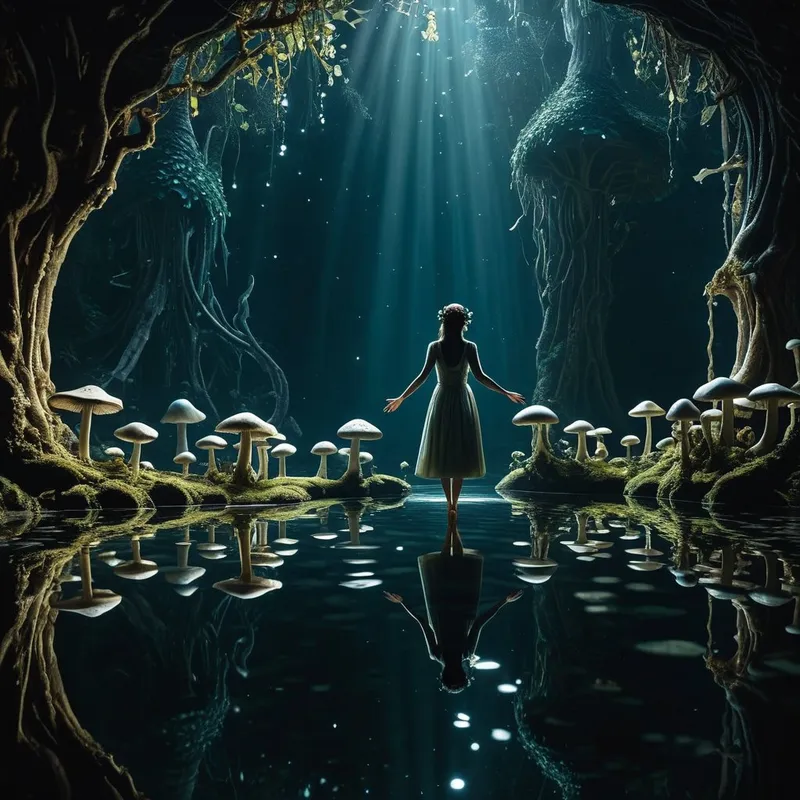
The shining hall was a cavern, dank and dripping. The silken banners were tattered cobwebs. The gem-light was the cold phosphorescence of fungus on stone. And the court… the dancers were now tall, attenuated shapes with skin like bark and eyes like black pits. The Queen remained, but her beauty was a hollow mask over a countenance of ancient, indifferent power, as timeless and severe as a mountain crag.
No word was spoken. The silence was judgment enough. The path back to the world of men opened, a bare tunnel of roots and earth. He stumbled into the dawn, the harper’s tunes forever dead on his tongue, his eyes now cursed to see the world stripped bare, and yet, in that terrifying clarity, more truly than ever before.
Cultural Origins & Context
The concept of Fairy Glamour is not a single myth but a pervasive folk belief woven through the Celtic cultures of Ireland, Scotland, Wales, and Brittany. These narratives were not the property of a priestly class but lived on the tongues of seanchaí (storytellers) and around cottage hearths. They served as profound ecological and psychological maps.
The tales functioned as cautionary wisdom, delineating the boundaries between the human world (an saol seo) and the Otherworld (an Saol Eile). The Aos Sí were not mere sprites; they were the old gods diminished but not departed, the spirits of the land itself. To enter their realm uninvited, to eat their food, or to be ensnared by their Glamour was to risk one’s soul, one’s time, and one’s very humanity. The stories enforced respect for liminal spaces—fairy forts, lone hawthorn trees, misty passes—teaching that perception is negotiable and reality is layered. The harper’s tale is a masterclass in this lore, illustrating the ultimate transgression: not theft or violence, but the piercing of the illusion that maintains the cosmic order.
Symbolic Architecture
At its core, Glamour is the archetypal symbol of projected illusion. It represents all the seductive, ready-made realities we are offered to spare us the burden of confronting the raw, unvarnished truth. The fairy feast is the promise of effortless fulfillment, eternal pleasure without consequence, a paradise that demands the surrender of one’s authentic self.
To see through Glamour is not to see ugliness, but to see structure. It is the movement from being enchanted by the image to comprehending the architecture of the real.
The beautiful Sídhe Queen symbolizes the Anima in its captivating, magical aspect—the soul-image that promises wholeness through projection. Her true form, the ancient, severe power, is that same Anima in its transformative, often terrifying, aspect: not a lover, but a initiatrix into the depths. The harper’s journey is one of disillusionment in the most literal sense. His “gift” of true sight is also a curse, for it exiles him from the collective dream. He can no longer partake in the simple, agreed-upon realities of his community. He has seen the wiring behind the world, and that knowledge isolates as much as it liberates.

The Dreamer's Resonance
When this myth stirs in the modern psyche, it manifests in dreams of piercing clarity that shatter comforting self-deceptions. You may dream of a beautiful, alluring partner or a perfect home that, upon closer inspection, reveals itself as a facade—walls made of paper, a face that is a mask, a room that is empty and echoing. The somatic experience is often a jolt, a visceral knowing in the gut that things are not as they seem.
This dream pattern signals a critical moment in psychological development: the ego’s capacity to withstand the dissolution of a cherished complex. The “fairy feast” is any addictive pattern, ideological possession, or idealized relationship that we have mistaken for sustenance. The dream is the psyche’s attempt to break the enchantment, to force a confrontation with the underlying, perhaps more barren or demanding, truth of a situation. It is a painful but necessary awakening from a collective or personal trance, often preceding a significant life transition where old identities must be shed.

Alchemical Translation
The alchemical journey mirrored in this myth is the Nigredo—the blackening, the initial putrefaction. The harper’s moment in the cavern is the crushing of the prima materia of his naive consciousness. His old “gold”—his talent, his joy, his place in the world—is revealed as dross, an alloy of projection and illusion. This is not destruction for its own sake, but the essential first step in the opus of individuation.
The psychic transmutation begins not with seeking light, but with consenting to see in the dark. The fairy gold must be exposed as dead leaves before the philosopher’s stone of the authentic self can be sought.
For the modern individual, the process involves a courageous withdrawal of projections. It is to look at the career, the relationship, the belief system that once glittered with “fairy gold” and to ask: What is its true nature, stripped of my need for it to be magical? What ancient, enduring power (the true Queen) resides beneath my romanticized image? This is the path of the Sage. The harper loses his mundane music but gains the silent, resonant knowledge of what is real. His exile from the fairy feast is his initiation into a sober, more demanding, but ultimately sovereign existence. He trades the enchantment of the collective dream for the arduous, lonely, and sacred responsibility of seeing truly—the only foundation from which a genuine life can be built.
Associated Symbols
Explore related symbols from the CaleaDream lexicon: