Fairy folk Myth Meaning & Symbolism
A story of the ancient, hidden people of the hollow hills, their eternal dance, and the perilous pacts that bind our world to theirs.
The Tale of the Fairy folk
Listen. Listen to the wind in the hollow hills, for it carries a music older than stone. This is not a story of a time that was, but of a time that is, just beneath the skin of the world you know.
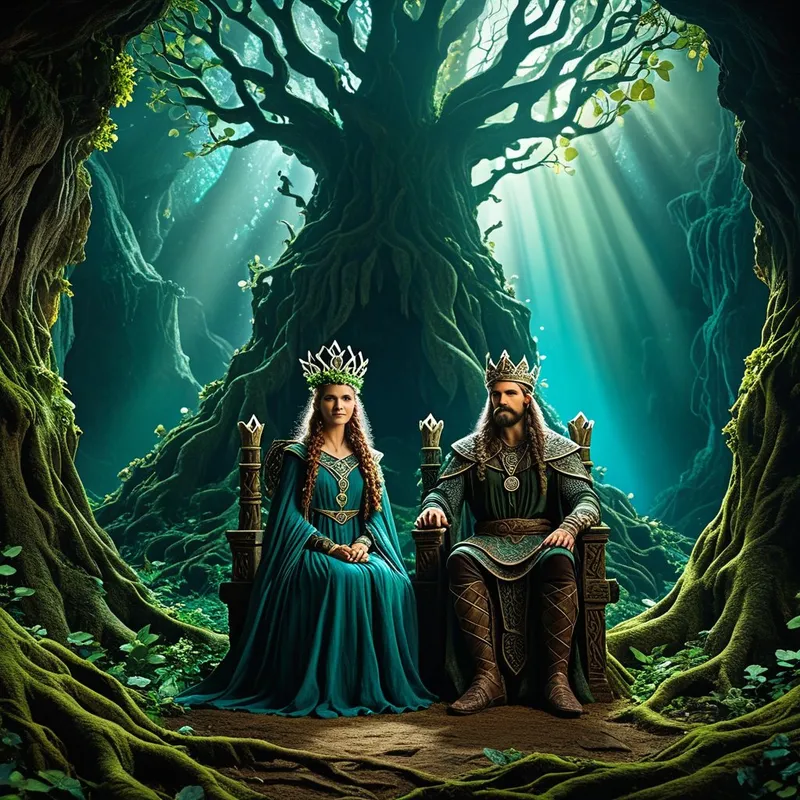
Before the songs of saints and the ring of iron, the land belonged to the Tuatha Dé Danann. They were a people of fierce magic and deep craft, who walked with the seasons and spoke with the rivers. But a new tide of humanity washed upon the shores of Éire, and a great battle was fought. Not for hatred, but for sovereignty—the right to shape the soul of the land itself. The Dé Danann were not slain. They could not be. Instead, in a pact woven from necessity and power, they did the unthinkable: they stepped sideways.
They retreated into the very body of the land—into the green hills, the dark lakes, the ancient oak groves. These became the Sídhe, glorious halls of everlasting feast and song, hidden by a veil of glamour. They became the Aos Sí, the People of the Mounds. And the land above? It was leased, not given.
On certain nights, when the fabric of the world grows thin—at Samhain or Bealtaine—the doors of the Sídhe swing open. Their processions, the Slua Sí, ride forth on the wind, a breathtaking storm of beauty and peril. To see them is to be enchanted; to join their dance is to lose a century in a single night.
And sometimes, they take an interest. A child of uncommon beauty or talent might be stolen, a cuckoo left wailing in its crib. A musician of rare skill might be invited below to play for a king and return with fingers that can make the stones weep, but with eyes that forever look through this world to another. They offer gifts: healing, prosperity, love. But every gift is a thread in a web, and the price is always your sovereignty. To eat their food is to be bound to their realm forever. To accept their gold is to watch it crumble to leaves at dawn. They are the keepers of the old, wild magic, and their law is absolute: respect the boundaries, leave offerings at the hawthorn tree, and never, ever break your word.
Cultural Origins & Context
The myth of the Fairy folk is not a singular tale but a living tapestry woven from the deepest strata of Celtic consciousness. Its roots are pre-Christian, emerging from the complex cosmology of the Tuatha Dé Danann, who were likely deities of a pre-Gaelic pantheon. With the arrival of Christianity, these powerful gods could not be entirely erased. Instead, they were narratively transformed—diminished in stature but not in potency—into the Fairy folk, a strategy that preserved their cultural memory while fitting a new theological framework.
These stories were the province of the seanchaí, the traditional storyteller, and were told not as mere entertainment but as vital social and psychological technology. They were shared at the hearth, mapping the invisible geography of the local landscape—that lone thorn tree, that peculiar mound, that suddenly silent stretch of road. They encoded laws of hospitality, environmental ethics, and community boundaries. The Fairy folk represented the capricious, untamable forces of nature and fortune. Honoring them was a way of acknowledging that human control is an illusion, and that survival depends on a respectful relationship with the unseen powers that govern life, death, and the fertility of the land.
Symbolic Architecture
Psychologically, the Fairy folk represent the autonomous, archetypal contents of the unconscious. They are not personal; they are transpersonal, existing in the mundus imaginalis—the imaginal realm that is ontologically real, yet not physically tangible. The Sídhe is the unconscious itself, a realm of boundless potential, eternal time, and profound danger.
The Fairy bargain is the psyche’s core dilemma: the allure of numinous power versus the cost of conscious selfhood.
The "fairy theft" of a child symbolizes the abduction of a nascent part of the personality—a talent, a vulnerability, a potential—by unconscious complexes before it can be integrated into conscious life. The changeling left behind is the hollow, unsatisfactory persona that remains when our authentic vitality is held captive by unseen forces. Their dazzling beauty and music are the seductive, enchanting face of the unconscious, which can lure the ego away from its developmental tasks into a state of passive fascination or inflation.
The Dreamer's Resonance
When this myth stirs in modern dreams, it signals a profound encounter with the liminal. You may dream of discovering a hidden door in your basement, of hearing irresistible music from a sealed room, or of being pursued by a beautiful yet terrifying host through a twilight forest. Somatically, this can feel like a humming in the bones, a sense of being watched by the landscape itself, or a disorienting shift in time.
Psychologically, this is the process of the ego confronting the autonomous, "other" reality of the unconscious. The dreamer is at a threshold. The Fairy folk’s appearance marks a call to acknowledge a part of life that has been relegated to the "hollow hills"—perhaps creativity, intuition, wildness, or grief—that now demands recognition and a renegotiation of terms. It is a crisis of sovereignty: will you remain solely in the daylight world of the ego, or dare to engage with the twilight powers that ultimately sustain it?

Alchemical Translation
The individuation journey modeled by this myth is not one of heroic conquest, but of sacred treaty. The goal is not to slay the Fairy king, but to learn his laws and parley with him. The first alchemical stage is nigredo: the "theft." This is the necessary suffering, the feeling that something essential has been taken from you, plunging you into the dark mound of the psyche.
The work of albedo and citrinitas is the careful navigation of the Tír na nÓg within. It involves learning the etiquette of the unconscious—paying attention to dreams (offerings), respecting its autonomy (not picking the fairy thorn), and keeping one’s word to oneself. One must taste the fairy food of insight without swallowing the whole feast and losing oneself.
The triumph is not escape, but the earning of a dual citizenship: to walk firmly in the human world while honoring the treaties made with the invisible one.
The final rubedo, the reddening, is the integration symbolized by the rare human who returns from the Sídhe with a gift that works in both worlds. The musician, the poet, the wise healer—these are figures who have faced the enchantment, retained their sovereign name, and brought back a piece of the Otherworld’s gold that does not turn to leaves. They carry the fairy touch, the connection to the deep, animating spirit of life, making them vessels of the numinous in a world desperate for authentic magic. They become the living bridge between the seen and the unseen, fulfilling the original, fractured pact in a conscious, creative, and whole way.
Associated Symbols
Explore related symbols from the CaleaDream lexicon: